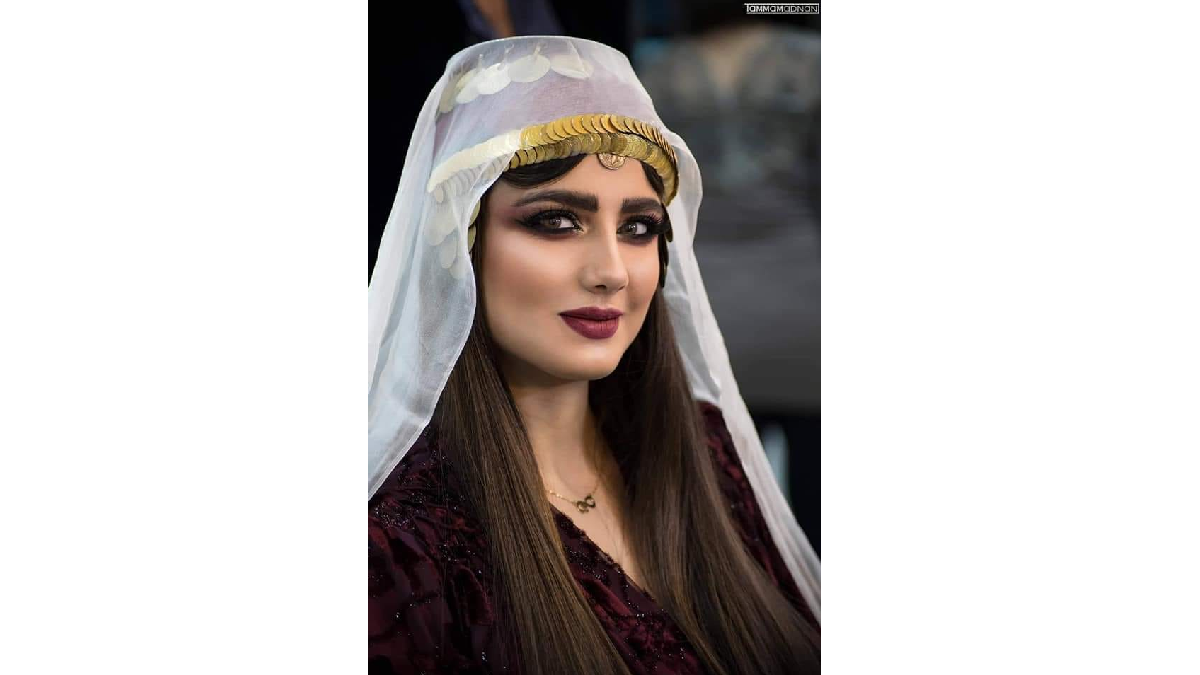
It is the most distinctive feature of the costume, made of red felt. It resembles a men's Turkish tarboosh (fez), but the difference in a woman's tarboosh lies in the additions it carries, most notably the "disk." This is a disk made of pure silver called "al-Rubas," characterized by its beautiful engravings, placed atop the tarboosh, where it is secured to its crown to give it its high shape. Several gold coins called "al-Jahayid" hang from its front, each weighing 4 grams.
In addition to the "disk" and the "al-Jahayid," there is the "al-Ruba'i," which are gold pieces located at the bottom front of the tarboosh, numbering between 60 and 80 pieces. They are attached so that half of each is visible, a style called "al-Shakka." The tarboosh may feature one or two of these "Shakka" rows. In the center, above the forehead, a gold coin is placed with half of it visible, called "al-Ghazi." Furthermore, on both sides, a set of gold pieces arranged in a triangle is placed above the ears, called "al-Shawaliq," consisting of six pieces on each side.
The "tarboosh," with all its weight, adds beauty and grandeur to a woman, and in the past, it was a standard condition for a dowry. Today, however, its acquisition is limited to the wealthy because it costs a fortune. Wealthy women wear it at weddings or traditional occasions, and they drape a white "fouta" (headscarf) over it, which adds even more femininity and beauty to this outfit. It can also be worn by a bride who prefers traditional attire on her wedding night.