
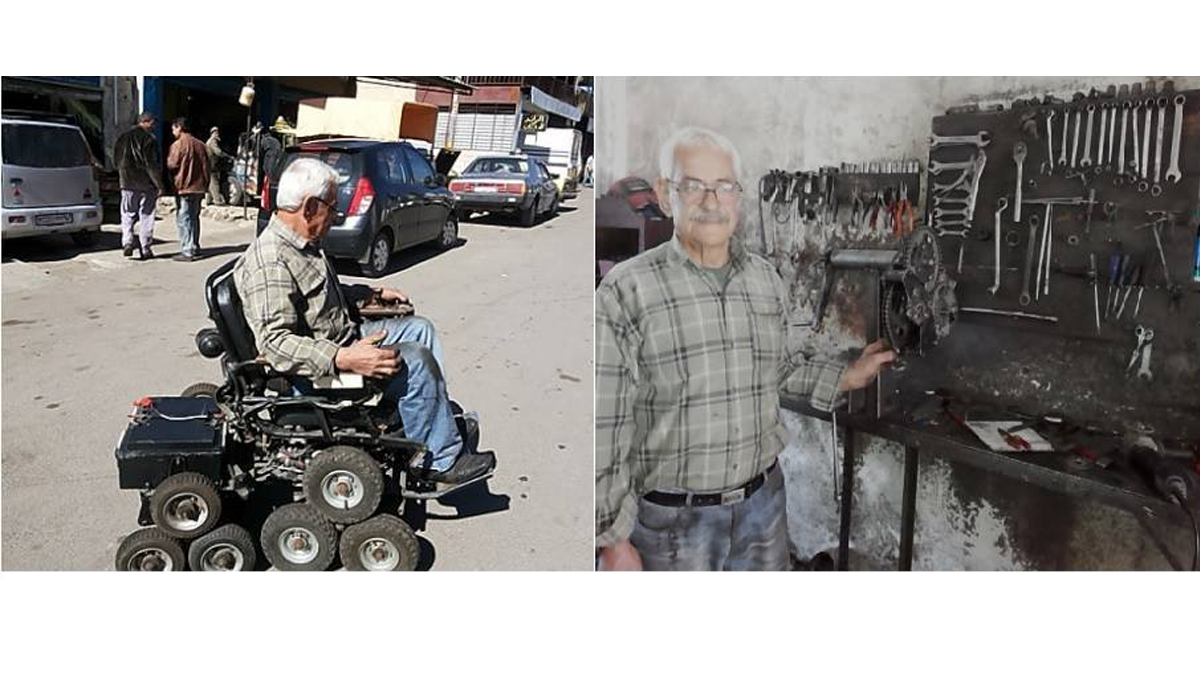
Ajwad Shujaa was born in the village of Al-Rashida in As-Suwayda Governorate in 1946 to an impoverished farming family. He studied at the village elementary school, then continued his middle and high school education in the city of As-Suwayda. In 1965, he obtained his high school diploma with good grades qualifying him to enroll in medical school, but his family's financial situation did not allow it, as living in Damascus required expenses beyond his family's means. He then had the opportunity to enroll in a two-year intermediate engineering institute, where the state committed to employing its graduates and students received a monthly stipend of 75 Syrian pounds (equivalent to a full year's wages), which was sufficient in those days for one person's living expenses and modest rent in a remote neighborhood of Damascus.
After graduating from the institute, he worked as an assistant engineer. Although his specialty was civil engineering, workshop machinery fascinated him, and he loved learning everything about it. During his employment, he bought a motorcycle that he did not previously know how to ride. Less than a month later, curiosity and a passion for knowledge drove him to dismantle it completely, leaving no piece untouched. While taking it apart, he studied the parts, how they were arranged, how they connected to each other, their operation, and the transfer of motion between components… It was then that he fully grasped the working principle of four-stroke gasoline engines, and he had no difficulty meticulously reassembling and running the motorcycle's engine.
An Alarm Device
He opened a small motorcycle repair workshop to work in after hours. Within a single year, his shop became famous, drawing customers from all across the governorate and sometimes from other governorates. The number of motorcycles staying overnight in his shop under repair was large, and he feared they might be stolen. This concern began to worry him, which prompted him to think about making an alarm device. However, building the device required expertise in electronics, of which he had no prior knowledge. So, he borrowed two books from an industrial high school student, through which he learned the properties and characteristics of various electronic components to the extent he needed.
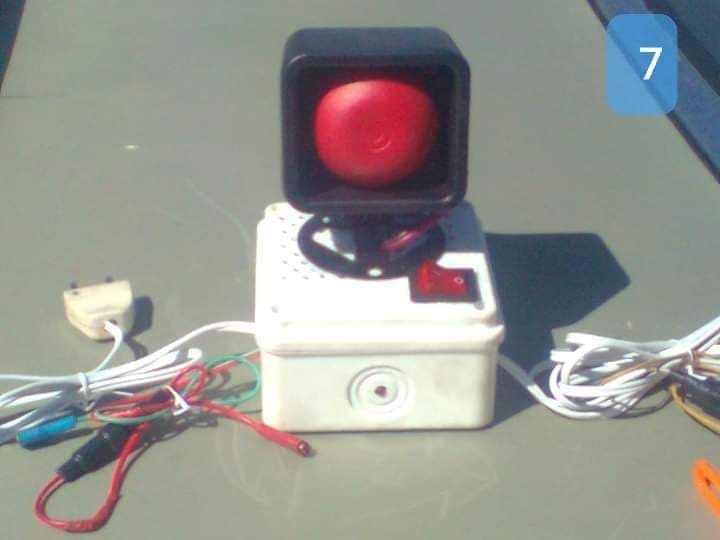
Using this information, he managed to create a telephone-operated alarm device that sensed any movement inside the shop or tampering with the doors or windows. It would dial his phone number as well as the police, broadcasting a pre-recorded message in his own voice reporting the burglary along with the address. He registered it as his first patent in 1999 under No. 4935.
After that, he bought a car and could not resist dismantling its engine, even though there was nothing wrong with it. The process was very easy because all four-stroke engines share the same underlying principle; there is no difference between a motorcycle engine and a car engine except in shape, size, and a few details.
He expanded his work to include cars and motorcycles and resigned from his government job after 20 years of service so he could dedicate himself to his workshop. With the help of some workers, he built a hydraulic press to extract and press car bearings and straighten axles. This press served the majority of mechanics' workshops in the Industrial Zone – 1 – in As-Suwayda. When demand increased, he built another press to meet the needs of local industrial workshops.
Registered Inventions
The inventions registered in Shujaa's name are:
First: An automated stair-climbing wheelchair for people with disabilities
Patent No. 5852 of 2012
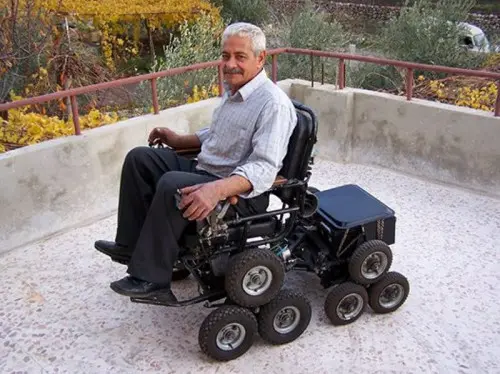
Powered by a 24-volt battery, it enables the user to climb and descend stairs and is also suitable for navigating all types of roads. The transition from road mode to stair-climbing mode occurs automatically without intervention from the user, and the driver's seat remains horizontal during ascent and descent. This wheelchair was crafted by hand from discarded scrap car and motorcycle parts due to the lack of financial resources to purchase new parts or cover manufacturing and machining costs.
Where Did the Idea Come From?
On a side street in Damascus, I saw a woman pushing a wheelchair carrying a young disabled man. She wanted to take him inside a government department, but the lobby was elevated four steps above the ground. A young pedestrian came forward to help her lift the wheelchair, but the wheelchair tipped toward the woman, and the disabled man fell to the ground before I could reach them... From that very moment, I began thinking of a solution to the problem of climbing stairs for individuals with special needs.
Second Invention
A wheelchair for quadriplegics and paraplegics, Patent No. 6041 of 2019
Several years after creating the stair climber—which never had the chance to enter mass production—and while watching a television episode discussing my inventions, a journalism student made an appearance on the show to support my "stair climber" invention and call for its manufacturing. This young man had neither hands nor legs; he was born that way, and he came specifically to support an invention that would not benefit him personally and whose creator he did not know, even though he was the most deserving of support. This inspired me to think about helping people with this type of disability, for whom there is nothing in our local markets to help them move around independently. However, the materials needed for manufacturing were unavailable due to the poor conditions in the country, and there were no financial resources to import them. I had no choice but to take the stair climber and dismantle many of its parts for the sake of a new and vital invention, especially since it had turned into a dusty piece of scrap, and it could always be rebuilt once materials became available based on the blueprints.
I was able to build this wheelchair, which can be driven by quadriplegics and amputees with head movements without needing to use their hands. The user simply turns their head in the direction they want to go, and the chair moves in the direction indicated by the head. It also operates on a 24-volt battery.
Third Invention
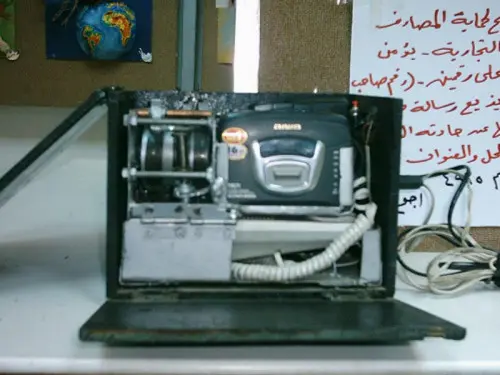
A telephone-operated alarm device. Patent No. 4935 of 1999, suitable for protecting banks, commercial shops, and homes from burglary. The device detects any movement inside the premises and places phone calls to two pre-selected numbers, such as the police and the owner, broadcasting a pre-recorded voice message such as: (Such-and-such shop in such-and-such area on such-and-such street is being robbed). It continues to call these two numbers alternately until the owner arrives and shuts it off. The device emits no audible sound nearby. The device originally operated mechanically, and I later modified it to use an electronic circuit.
Fourth Invention
A landline telephone protection device. Patent No. 4952 of 1999
It consists of a small electronic circuit connected to the landline telephone wire. It allows phone calls to be made only from inside the building and prevents unauthorized calls from being placed from outside the building, even from within the central exchange. It also emits an audible alarm if the line is tampered with. This device played an effective role in preventing phone line tapping and unauthorized calls before the widespread adoption of mobile phones in our country.
Fifth Invention
A wired anti-theft alarm device suitable for protecting property close to the home, such as cars, motorcycles, or anything else. The device's advantage is that it is located inside the house, far away from thieves' reach.
Patent approval was granted by the Scientific Studies and Research Center, pending issuance of the certificate from the Ministry.
In addition to other unregistered works, including:
A wind turbine for generating electricity
And during the Coronavirus pandemic: a medical ventilator used in emergency cases or while transporting patients by car from one location to another.