
First: On the meaning of Eid:
Eid was named 'Eid' because it brings joy and happiness to its people. The linguistic origin of the term refers to any day of gathering, for the Eid is a joy deeply rooted in the heart of every human being. Since humanity emerged and began to ascend the ladder of civilization and progress, it has defined time with specific intervals, creating milestones for self-refreshment on every happy occasion, which it named Eid. Thus, Eid is a manifestation encompassing several social and religious meanings.
In the social sense, Eid is a day for renewing and strengthening social ties based on love, loyalty, and brotherhood. On this day, the rich remember their poor brethren, and the strong remember the weak, so charitable people give alms; then, joy encompasses every home, for the sun of Eid does not rise without delight filling the heart and smiles adorning the lips.
As for the religious sense, Eid is an expression of gratitude to God for the completion of worship—a word that the believing Unitarian does not just utter with their tongue, but one that stirs in their heart with contentment and peace, appearing in their outward behavior as joy and jubilation.
Second: Holidays of the Unitarian Druze Community:
The Unitarian Druze community does not have special, exclusive holidays. Since this community is one of the Islamic sects, the blessed Eid al-Adha holds great importance. If Eid al-Fitr, following the fast, is a joy for the dining table in this world and a symbol for the joy of the obedient and patient souls in the hereafter as they behold the Holy King, then Al-Adha is the 'Greater Eid,' as it follows the hardship of the Hajj and the drawing near to God through the prescribed sacrifice.
Third: Eid al-Adha:
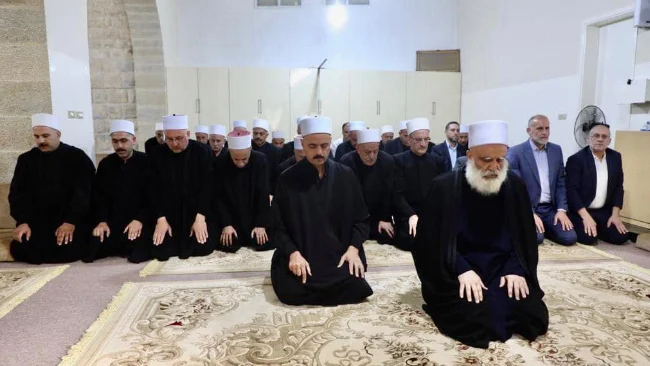
When the crescent moon of the month of Dhu al-Hijjah appears each year, it is customary for the members of the Unitarian Druze community to perform various religious and social duties. A sense of striving, surpassing the usual, spreads in their souls, and they head with the intention of seeking blessing and benefit toward the council halls, retreats, shrines, mausoleums, and the venerable Sheikhs, seeking to hear the blessed recitation and religious discussions.
Most families find blessings in preparing "Nuql al-Eid" (Eid treats) at home to bring joy and happiness, and they exchange "Mujabara" (greetings of sympathy and support), visits, and seasonal salutations to seek blessings on this annual occasion, to purify hearts, renew connections, reconcile, and accept congratulations, following the Almighty's saying: "And cooperate in righteousness and piety, but do not cooperate in sin and aggression" [Surah Al-Ma'idah: 2].
In addition to the above, it is recommended that Unitarians dedicate the first ten days, called the "Ten Days of Eid" of the blessed month, to chastity, fasting, prayer, and zakat (almsgiving) through charity and good deeds, while frequently engaging in supplication and seeking forgiveness, desiring God's pleasure through righteous deeds and sensing the approach of the noble Eid.
The Sheikhs and the devout also spend their nights in spiritual struggle, recitation, and seeking forgiveness, recalling the noble verse: "By the dawn and [by] ten nights" [Surah Al-Fajr: 1-2], embodying the state of Ihram (pilgrimage sanctity) in their limbs and hearts as a path to ensuring their intentions are pure for the completion of the meaning of sacrifice.
The focus of the "Al-Adha" purposes, religiously, is the victim that must be offered to God Almighty as a sacrifice to Him, a sign of obedience to Him, and undeniable proof of the creature's readiness to abandon all worldly possessions and luxuries for the sake of goodness in all its meanings, including turning away from all discord and finding comfort in all spiritual gentleness.
A 'Qurban' (sacrifice) is a name for everything with which one draws near to God Almighty, which man has known since the days of Jahiliyyah (pre-Islamic era). The story of Abel and Cain, which is the best witness to the importance of the sacrifice, is the first story in the journey of the prophets since the era of Adam (peace be upon him). It is said that Cain wanted to commit a sin, and his brother Abel forbade him. When they disputed, their father told them, "Offer a sacrifice to God, and whoever's sacrifice God accepts, his word shall be accepted." Abel, who was a shepherd, offered the best ram from his flock, and God accepted his sacrifice. Cain, who was a farmer, offered the worst of his grain, and God did not accept his sacrifice. When their father learned of the news, he congratulated Abel and consoled Cain, telling him, "Repent to your Lord." Cain grew intensely angry and said to his brother Abel, "I will surely kill you."
From this story, we deduce the affirmation of the oneness of the Creator, the acknowledgment of His messengers and prophets, and the prohibition of forbidden acts and transgressions; it also represents the struggle of the soul between good and evil.
To grasp the meanings of Al-Adha in the Islamic concept, one must return to the tradition of the Prophet Abraham (peace be upon him), who lived approximately 2,500 years before Islam. Abraham (peace be upon him) saw in his dream that God Almighty was commanding him to slaughter his son, and the visions of the prophets are "revelation." Upon waking, the Prophet of God, Abraham (peace be upon him), hastened to execute the command of God Almighty without hesitation. He said to his son, "Let us go and offer a sacrifice to God Almighty." They took a knife and a rope and set out until they walked between the mountains. His son asked, "Father, where is your sacrifice?" Abraham (peace be upon him) said to him: "Indeed, I have seen in a dream that I [must] slaughter you, so see what you think." [Surah As-Saffat: 102]. The boy submitted and said, "O my father, do as you are commanded. You will find me, if God wills, of the steadfast." [Surah As-Saffat: 102].
When they both submitted—that is, yielded to God's command—a voice called out to Abraham (peace be upon him): "You have fulfilled the vision. Indeed, We thus reward the doers of good. Indeed, this was the clear trial (i.e., the manifest test). And We ransomed him with a great sacrifice." [Surah As-Saffat: 105-106-107]. God sent forth His greatness to Abraham in the form of a sacrifice, which was a great ram that he slaughtered as a ransom for his son.
The best lesson to be drawn from this story is obedience to God Almighty, contentment, and submission to His will.
Yes, Al-Adha is prayer and slaughter, meaning an offering by way of gratitude. Commentators have stated that 'prayer and slaughter' are interpreted as the Eid prayer, which is the prayer purely for the sake of God, and the slaughter is the sacrificing of the best of livestock from the finest of Arab wealth; therefore, it was necessary for a person to offer the best they have to God Almighty.
God Almighty said to the Seal of the Prophets and Master of the Messengers (peace be upon him): "Indeed, We have granted you, [O Muhammad], the Al-Kawthar. So pray to your Lord and sacrifice" [Surah Al-Kawthar: 1-2]. This is an invitation to the Prophet (peace be upon him) to pray and sacrifice as thanks for what the Creator has given of abundant good, and proof that God's promise is inevitable. This world is an opportunity for giving, and His saying: "If you are grateful, I will surely increase you" [Surah An-Nisa: 147] is but a condition for increase after gratitude for the favors already bestowed.
It is mentioned in a Hadith Qudsi: "O My servant, I am generous, so be generous; I am merciful, so be merciful; I am appreciative (Shakur), so be appreciative." Al-Adha is the embodiment of this Hadith in its most sublime form. Every prayer of obedience is an Eid, and every sacrifice of obedience is an Eid for those who understand the meaning of drawing near through remembrance and giving for the sake of God, because it is a deposit in the vaults of the Kingdom that is seen with the eye of certainty by those who are the doers of good. This is the attribute of the righteous, and regarding them, the Almighty said: "Indeed, the righteous will be within gardens and springs" [Al-Hijr: 45]. He also said: "They used to sleep but little of the night, and in the hours before dawn they would ask forgiveness, and from their wealth was [given] the right of the [needy] petitioner and the deprived" [Adh-Dhariyat: 17-18-19].
If the meaning of the sacrifice is drawing near to God and ransoming oneself from the torment of Hell, and the believer offers it on Al-Adha, it is a celebration that transcends historical boundaries to be a holiday for the joy of the Hereafter, whose time has not yet come and which is eternal with no end—that is, no history defines its conclusion.
And if a ransom and sacrifice are necessary to deserve the eternal joy, then while the meat and blood of livestock are required offerings, they are insufficient because they belong to the world of perishability. The more lasting essence is the human soul, which God promises—if sold to Him—an everlasting bliss that does not perish. "So rejoice in your transaction which you have contracted. And that is the great attainment."
Man is between free will and destiny; he is free in all that lies within his capacities and his mental, physical, and psychological possibilities, and thus he is responsible before his Creator and his society. We have known—may He be glorified [1] and exalted—the concept of the Resurrection: that this world is a perishable abode and a temporary station leading to the eternal Hereafter, an inevitable matter promised by the Almighty in many verses of His Noble Book. Perhaps the wisdom in concealing the time of the Hour is so that man may remain vigilant and hasty in seeking forgiveness and repentance, as He said: "That they may know that the promise of God is truth and that of the Hour there is no doubt" [Surah Al-Kahf: 21]. He also said: "And We place the scales of justice for the Day of Resurrection, so no soul will be treated unjustly at all" [Al-Anbiya: 47].
A person's deeds are the measure of their profit and loss, and their good deeds in this world are gathered for them in the Hereafter. How much we feel the need to perform the act of sacrifice with all sincerity in our daily lives, and in the path of our societies, our nations, and all of humanity, to affirm our humanity—the young and the old—each of us in our own field and within our own capacity: the worker in his work, the teacher in his giving, the merchant in his trade, the administrator in his conduct, the student and adolescent in their blooming and learning, and the woman in her mission of nurture, upbringing, and refinement. Does duty not call upon us to sacrifice and ransom the humanity within each of us? For His saying: "So whoever does an atom's weight of good will see it, and whoever does an atom's weight of evil will see it" [Surah Az-Zalzalah: 7].
It is the duty of our children not to forget their heritage and their ancient, noble customs upon which they were raised and which have taken root in their depths. On this occasion, we deem it necessary to remind the seekers of the constants of the Unitarian path, which is based on the principles of belief in Divine Justice, adherence to the limits set by God Almighty for humanity, the striving of man—the noblest of creatures—in knowledge and work, the reliance on reason, wisdom, and moderation in words and deeds, the adherence to virtues, honor, and piety in actions, the distinction between the lawful and the unlawful, and contentment and submission in every situation.
Issued by the Office of the Sheikh al-Aql of the Unitarian Druze community - Beirut, on the occasion of the blessed Eid al-Adha for the year 1429 AH, corresponding to the year 2008 AD.
May God bring it back to you with goodness, prosperity, and blessings.