
The conditions for marriage are: (1) Unity of faith, (2) Consent without coercion or force, (3) Reaching the age of maturity in both mental and physical aspects, and the health of the spouses from contagious diseases. Supplemental conditions: performing the marriage contract before a competent authority in accordance with the Law of the Unitarian Druze Sect, and the public announcement of the marriage.
As for faith, it is based on the saying of the Messenger of God (PBUH): "Seek a person of faith," for there is no stable structure in a union without shared belief in God; it would be like a building on the waves of the sea.
As for consent: Because coercion is a violation of human dignity and freedom, especially for women in a matter concerning the future of their lives.
As for maturity: It is essential to achieve the purpose of marriage, and mental maturity alone is not enough, as it is a condition for legal accountability.
The Personal Status Law for the Unitarian Druze sect regulates the matter of marriage in the following legal articles:
First: Regarding eligibility for marriage:
Article 1: A groom possesses the eligibility for marriage upon completing eighteen years of age, and the bride upon completing seventeen years of age.
Article 2: (Amended by the law of July 2, 1959) One of the two Sheikhs of the Aql or the Sect Judge may authorize marriage for an adolescent who has completed sixteen years of age but not yet eighteen, if it is medically proven that their condition can sustain it, provided that the authorization of one of the two Sheikhs of the Aql or the Sect Judge is contingent upon the permission of the adolescent's guardian.
Article 3: (Amended) One of the two Sheikhs of the Aql or the Sect Judge may authorize marriage for an adolescent female who has completed fifteen years of age but not yet seventeen, if it is medically proven that her condition can sustain it and her guardian has granted permission.
Article 5: (Amended) It is not permissible for anyone at all to marry off a young male who has not completed sixteen years or a young female who has not completed fifteen years.
It is not permissible to marry a person of unsound mind, nor a person suffering from contagious diseases, namely venereal diseases, leprosy, and pulmonary tuberculosis in its active stage.
One of the two Sheikhs of the Aql or the Sect Judge must verify, before authorizing a marriage, that the spouses are free from unsoundness of mind and contagious diseases by requiring them to produce a medical certificate from a forensic doctor. An objection may be raised against this certificate before one of the two Sheikhs of the Aql or the Sect Judge, and their decision regarding it is subject to review procedures.
Article 6: (Amended) If a woman of legal age, whose age is between seventeen and twenty-one, requests to marry a person, one of the two Sheikhs of the Aql or the Sect Judge shall notify her guardian. If the guardian does not object within fifteen days from the date of notification, or if they object and the objection is deemed groundless, one of the two Sheikhs of the Aql or the Sect Judge shall authorize their marriage.
Article 7: The guardian in marriage is the male relative (asaba) in order, provided that he is legally competent. A minor, a mentally ill person, or a person of unsound mind has no guardianship over anyone at all.
Article 8: (Amended) If a person wishing to marry has no guardian, or if their guardian lacks legal eligibility, one of the two Sheikhs of the Aql, the Sect Judge, or their appointee for this purpose, shall assume guardianship.
Second: Regarding the marriage contract:
Article 14: The marriage contract is concluded by offer and acceptance from both parties in the presence of witnesses. Witnesses may be from the ascendants and descendants of the groom and bride, provided their number is not less than four. The contract must be in writing and signed by the spouses and their witnesses. If one of the spouses cannot attend the contract session, they may be represented by an agent authorized via a written power of attorney certified by the Mukhtar or their substitute, provided that the power of attorney mentions the amount of the dowry (Mahr) or leaves the determination to the agent's discretion, and provided that this power of attorney is attached to the contract.
Article 15: The offer and acceptance in marriage must be made in explicit terms, as well as in the engagement, and the gesture of a mute person serves as a substitute for verbal expression.
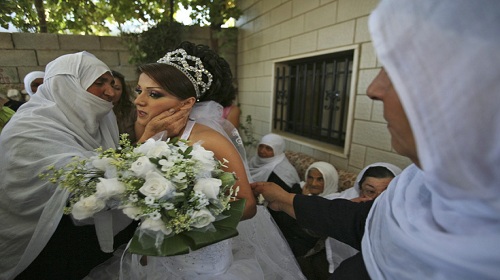
(It is customary among the Unitarian Druze sect to hold the marriage contract in a ceremony limited to family members, while the public announcement of the marriage takes place when the wife moves to her husband's home in a ceremony that includes family, acquaintances, and friends).
Article 16: (Amended) A marriage contract shall not be valid unless it is performed by one of the two Sheikhs of the Aql, the Sect Judge, or someone appointed by them to perform it.
Article 17: (Amended) One of the two Sheikhs of the Aql or the Sect Judge shall appoint one or more authorized officials (Ma'thoun) to perform the marriage contract in each district or town as required. The authorized official may not perform the contract before obtaining special written permission from one of the two Sheikhs of the Aql or the Sect Judge to do so.
Article 18: (Amended) After the authorized official drafts the contract, they shall send it to one of the two Sheikhs of the Aql or the Sect Judge for approval and registration, and the effect of this contract shall be valid from the date of its occurrence.
Article 19: (Amended) One of the two Sheikhs of the Aql or the Sect Judge must register these contracts in a special register, with pages stamped by them and numbered sequentially. The contract shall be returned to its owner within one month at most from the date of its submission to the sect court for registration.