
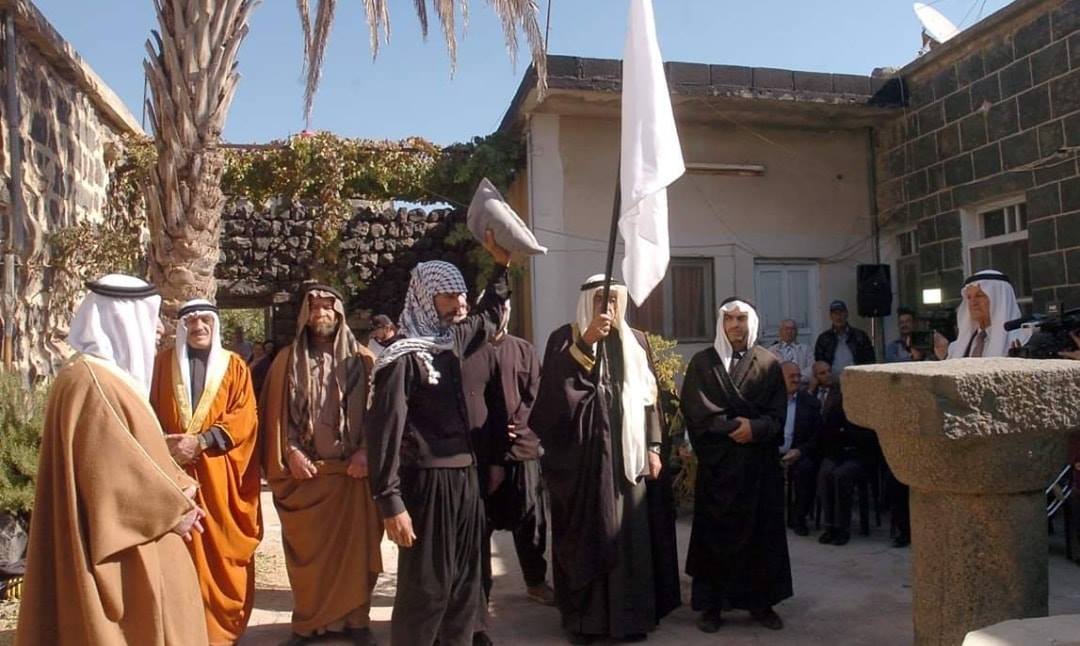
'Aqad al-Rayah' is one of the authentic traditions of the Druze Unitarian community. Here are its origins:
 'Aqad al-Rayah' (Tying the Flag) is the final stage of reconciliation between feuding and adversarial parties, often preceded by an intentional crime, such as an emergency dispute leading to a fight that later results in killing, or sometimes in cases of revenge. Note that this has decreased significantly due to the existence of courts and the rule of law.
Mediators intervene to resolve the conflict and shift it from a social issue between two families or clans to one involving relatives. Here, the mediation process begins by calming tempers and ruling out revenge or retribution against the perpetrator or their family. The weapon of mediation in this situation is the action and counter-action, and the repetition of this process. Among the contributing factors that facilitate mediation is distancing the perpetrator to a remote location to ensure they do not come into contact with either party, or their presence in prison.
Customs and traditions dictate the existence of a ransom or compensation, according to what is set by tradition, resulting in no bargaining or containment. If an agreement is reached through prestige and face-to-face mediation, repeated mediation, the presentation of convincing solutions, and the showing of respect, appreciation, and high valuation of this sacrifice—to the point that it is considered, upon acceptance, not just a favor to the perpetrator's family but to the entire community, as peace within its borders is the ultimate goal of reconciliation.
If the mediation reaches this result, a date is set for the reconciliation procedures, which is the 'Aqad al-Rayah'.
 Stages of 'Aqad al-Rayah'
The parties and all their relatives are invited to attend in a specific place; mediation is the guarantee for the meeting of the two parties at a specific place and time.
When the two parties meet at specific distances determined by the location, the mediators from the victim's family come forward in the name of national security, social peace, and the judgments of God Almighty—who ordained what happened—submitting to God's will and accepting what customs and traditions dictate regarding material and moral effects. They accept this large crowd of people who are witnessing the reconciliation ceremony and announce the reconciliation by tying the flag ('Aqad al-Rayah').
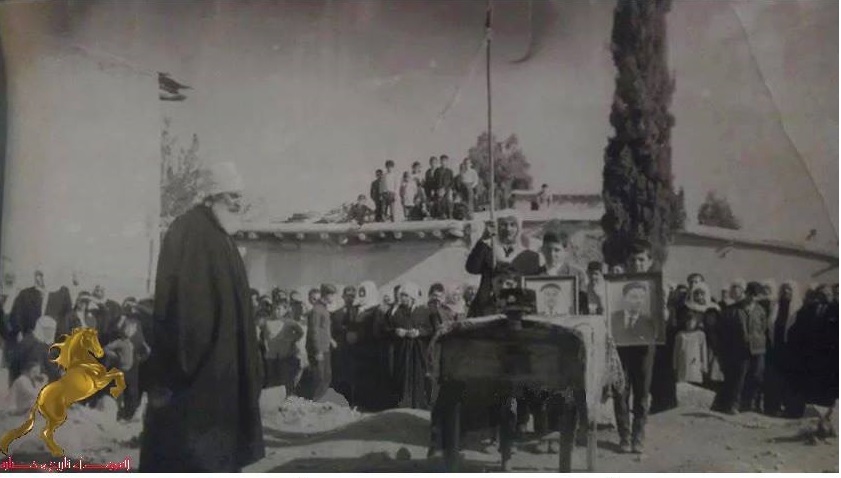
 The 'Rayah' (flag) is a white cloth tied to a spear; the spear is a symbol of pride and a weapon of self-defense where necessary. The white cloth is the document, i.e., the paper on which the terms and procedures of the agreement are written. Since this was difficult in the distant past and even in the present, the paper was replaced with a white flag, because a document or paper is signed by only two people, while the flag is seen by all parties. Tying this cloth and attaching it to the spear signifies signing in front of those present as witnesses to the event. This knot on the spear is tied again and again by the relatives consecutively, in addition to some friends, as well as the Sheikh of the tribe or the leader of the tribe from the perpetrator's side.
At that point, the mediation returns to the opposing side carrying this white flag, which is a sign of reconciliation. Then they summon the victim's family to approach to a certain distance so that their voice can be heard by those present, for the mediation to announce that they have accepted the reconciliation and forgiven the past. Afterward, the guarantors are requested, namely the 'Kafil Wafa' (guarantor of fulfillment), who guarantees the agreed-upon compensation, which is known today as dropping personal rights in court, a procedure that did not exist previously.
The other guarantor is the 'Kafil Dafa' (guarantor of protection), who guarantees that the other party will not retaliate or break the reconciliation. The 'Kafil Dafa' is requested from the victim's family, whether from their clan, outside it, or from the mediation itself. They are named explicitly, whether it is one person or several people. As for the 'Kafil Wafa', they are requested by the perpetrator's family.
The parties of opinion or mediation return to say: The two sides have named the guarantors, do you accept them?
In case of acceptance, the guarantors come forward and say the following: "Bear witness, people of honor... guests and locals... let those present inform the absent... that reconciliation has been achieved with satisfaction and consent... on what has been agreed upon.
Including all the victim's family, regarding the victim, those present and absent, those in the wombs and those yet to be born," and this serves as a guarantee for future generations.
The stakeholders responsible, whether for protection or fulfillment, respond to them: "We accept, and God is our witness to that," and the guarantors tie the flag over that.
Afterward, the flag is handed to a person with a loud voice so that he may call out and have people bear witness to what has transpired, saying: "Bear witness, people of honor... guests and locals... that the stakeholders (and they offer praise conventionally known for the victim's family) may God brighten their faces," and he repeats this phrase three times, so the mediation can take the hand of the perpetrator—who is mostly either in prison or exiled—to shake hands with the victim's family.
After that, all attendees are invited to the 'Milha' (bread and salt), which is a declaration of peace, security, and a new life.
In case of accidental killing
The mediation performs as mentioned above, and as a result of repeated incidents, the concerned parties bypass all these procedures because they take a long time and leave some sensitivities regarding naming the guarantors. Therefore, it is sufficient to meet between the two teams and deliver friendly speeches and cordial words from the mediation between the two parties. This one says, "I accept the reconciliation and forgive the cause," and the second group thanks and appreciates the sacrifice of the victim's family.
The attached photo is from a reconciliation flag-tying ceremony in the city of Jaramana in the sixties of the last century between the Barakat family and the Karbaj family, following the accidental death incident of the Mukhtar Abu al-Nour's son, where the Mukhtar offered pardon, forgiveness, and reconciliation on that day.