
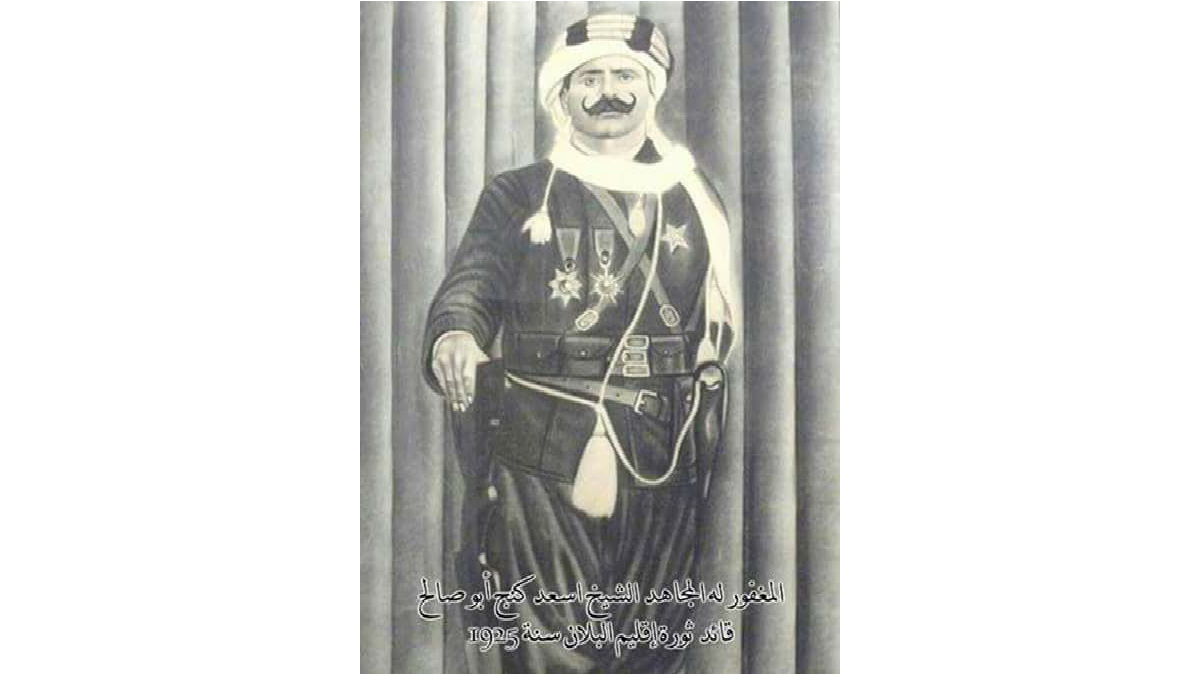
The leader of the Golan region revolution, the Mujahid Asaad Abu Saleh, was born in the town of Majdal Shams in 1879 to a prominent family. The family had settled in the Golan after arriving from Lebanon following a conflict with the rule of the Shihab emirs in the 1860s. They settled in the Golan after the Al-Farhat families from Southern Syria and the Al-Breik family from Lebanon arrived and defeated the gangs that had controlled the area and wreaked havoc and terror in the villages surrounding Majdal Shams over 400 years ago. They were able to establish their status and influence in the region, attaining social, political, and economic prominence. During the Ottoman era, social and political leadership emerged from within them. The late Sheikh Kanj Abu Saleh, who died in 1937, was one of the leaders who stood courageously before the Ottoman governor in Damascus and refused to register the region's youth in the census for recruitment into the Ottoman army and training for Turkey's wars. The Turkish authorities retaliated against him and issued an order for his arrest; he was dragged, hands shackled, behind horses from the town of Banias to Daraa, as the Ottoman governor was enraged upon learning of his refusal to register the region's youth for military service, after which he was exiled to the island of Arwad.
The French authorities arrested him at the beginning of the revolution in the Golan. One Egyptian historian says: "When the eldest son of the Golan leader was martyred, they made a mistake when informing him of the news, confusing his son with his brother, the leader of the revolution. He said, 'Praise be to God who ordained the martyrdom of my son, not my brother.' They asked him, with astonishment on their faces, 'How can you say that when it is your son?' He replied, 'The martyrdom of my son will not stop the revolution, but the martyrdom of my brother, the leader of the revolution, might stop it.'"
Among the immortal scenes in memory recorded by the history of the Golan residents is that General Gouraud sent large sums of money to the people of the region and its leadership from the Al-Kanj family (Sheikh Asaad Kanj Abu Saleh and his brother Sheikh Kanj Abu Saleh) in exchange for them not opposing the French forces and helping France control the south of the country. The Mujahid Asaad Kanj and his brother, Sheikh Kanj, in his capacity as the Sheikh of the region, called for a meeting of the sheikhs and leaders of the region at the religious council in Majdal Shams and said, "It is a shame for us that history records that we dealt with the French colonialism and stood as spectators to their occupation." The money was sent to King Faisal, King of Syria, who was stunned by what he saw and heard, and said to the Golan messenger, the Mujahid Asaad Kanj Abu Saleh, "You honorable people have twice this amount in the treasury of King Faisal, and I convey the Arabs' pride in the stance of the people of the region." He then issued a decree appointing Asaad Kanj as a captain in the Syrian army.