
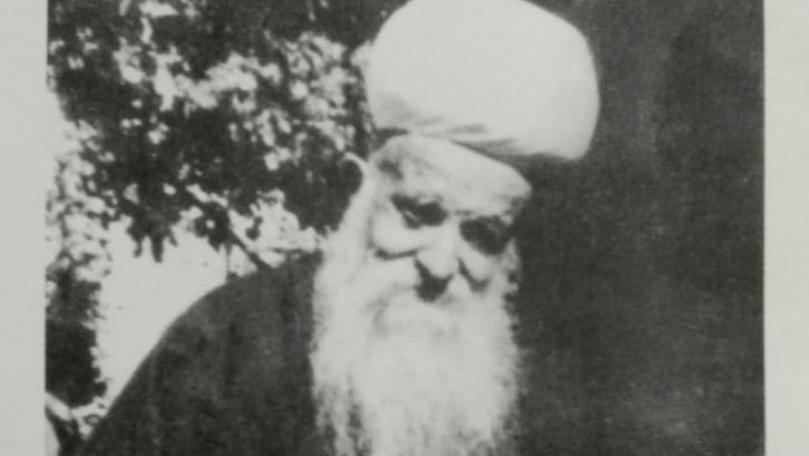
Sheikh Abu Hussein Mahmoud Faraj grew up under the care of his parents in a home of piety, religion, and culture. He was raised beside the shrine of Al-Amir Al-Sayyid, may God sanctify his secret, visiting it, gathering with the faithful and the seekers, and finding spiritual refreshment in the scent of faith emanating from this holy place. When he reached school age, his parents sent him to study, where he received basic primary education from specialized teachers and learned to read and write. He acquired a foundational education that qualified him, once he reached adulthood, to research and investigate the accounts of virtuous people, such as ascetics, devout worshippers, and pious individuals. He then began traveling through neighboring villages, connecting with his brothers—the sincere people of religion. He visited the town of Baisour most frequently, as it was home to a number of pious believers and sheikhs of that time, most notably Sheikh Abu Ali Ismail Hasika Malaeb, who was an authority on religion, piety, and devotion. Sheikhs from all Lebanese regions would visit him due to his advanced age and high status. Sheikh Abu Hussein also became acquainted with two other religious figures of that time: Sheikh Abu Faris Mahmoud Abdul Khaleq from the town of Majdalbaana, and Sheikh Abu Muhammad Rashid Eid from the town of Bshamoun. The three lived under the guidance of Sheikh Abu Ismail until God Almighty took his soul.
During this period, Sheikh Abu Hussein learned the trade of dyeing in the town of Kfarmatta, working during the day and seeking knowledge at night. Even as a young man, he became rigorous in his piety, exercising caution in all things. After he matured and grew strong, he sought independence from his family. His father registered a small piece of land above the town in his name, where he built his khalwa (seclusion retreat). It consisted of two small rooms, which eventually became a thriving home and a dwelling for him and his family, as well as a sanctuary for his noble brothers in faith. At first, he lived there in extreme poverty, much like the virtuous people, prophets, and righteous saints who came before him. This was because his father had sold most of his properties and gave him nothing worth mentioning. Furthermore, he did not inherit anything from him. As his financial situation improved, he used his own money to buy back some of the lands his father had sold, establishing a home and acquiring decent assets through the labor of his hands and the sweat of his brow, without owing any significant favor to anyone, not even his father.
The best that a person eats is from the labor of their own hands
The late Sheikh Abu Hussein was a man of work and activity in both his religious and worldly life. He used to say: "The best that a person eats is from the labor of their own hands." In addition to dyeing, he learned the trade of weaving from the late Sheikh Abu Hassan Yusuf Wahbeh, and the two were neighbors, brothers, and collaborators in both religion and worldly affairs. He worked diligently at his craft without weariness or boredom. Whenever he collected a number of abayas (cloaks), he would travel to various Lebanese regions and the region of Palestine, intending both to sell the textiles and to visit his pure, trusted brothers. His visits to them were like seasonal festivals; they would wait for him with warmth and longing to see him, seek his blessings, and prepare to serve him. The late Sheikh would reciprocate this longing, love, respect, and appreciation for them all, whether high-ranking or humble, especially the notables of the Al-Bayada retreats, the sheikhs of Rashaya, and the rest of his brothers. During one such visit, he went to Palestine and arrived at the village of Daliyat al-Carmel, where he was a guest in the home of his trusted friend, the late Sheikh Abu Hussein Ali Nasr al-Din.
The Ascetic Sheikh
The late Sheikh devoted his sincere efforts and great care to work, yet he was completely ascetic regarding the vanities of the world. He sought to reconcile the brothers, collect charity and good deeds, treat those who did him wrong with kindness, love the trustworthy, and follow the path of Truth. He was constantly engaged in holding himself accountable, subduing his soul with hunger and wakefulness. He was forgiving to those who shunned him; if he was angered, he endured with patience, and if he was pleased, he was humble and grateful. He was chaste, modest in his gaze, exceptionally patient, a hater of injustice, easy to associate with, generous in character, faithful to promises, a man of his word, humble, generous with his wealth, protective of his honor, constantly reflective, seeking spiritual poverty, a good companion, pious, meticulous in thought, and tender-hearted. He possessed sound judgment and a sharp mind, which made his virtue and merit evident among his peers. Consequently, the sincere of all ranks, and the fair-minded leaders of the era and notables of the country, reached a consensus to acknowledge his virtue and lofty status. They made him their obeyed Imam, their highest reference, and their supreme symbol on the spiritual path, without dispute. He became their only source of trust due to his precise and unique approach. His house became the destination for brothers of virtue and faith from far and wide. Many people often sought him out, longing to see him, ask for his blessing, and gain his wisdom. Many came complaining and seeking his help; he would take an interest in resolving his brothers' problems, settling their affairs, and striving with his body and mind to clarify obscure truths. Once the truth was clear, he would ensure every person with a right received it. His noble goal was to lift injustices and do justice to the oppressed. He sat in the comfort of Truth, spoke with sound judgment and honesty, and built his conduct upon justice, fairness, and kindness. Due to the precision of his path, he was a stranger among his brothers, yet through his kindness and humility, he was close to them. His days were long, his status rose, he satisfied opponents, supported the oppressed, guided people on righteous paths, elevated the virtuous, loved the pious, treated everyone well, lowered the wing of mercy upon them, and treated them according to the teachings of knowledge and wisdom. He showed them the utmost affection, guided them to the best path, addressed them with the kindest words, used gentleness in his replies, and referred to them with the highest titles. Hearts fell in love with him, and souls inclined toward him, making him a beacon for seekers and a source for pioneers, due to the abundance of his virtue and the reach of his justice. He met everyone with his innate cheerful face, open heart, and generous character. His sincere intention was always focused on reconciling the brothers of faith and achieving general and complete reform among the monotheists, limiting themselves to seeking the lawful in hopes of the Creator's satisfaction and forgiveness.
Sheikh Abu Hussein established a new routine for himself and his brothers. It was his custom to meet with his fellow sheikhs every Friday in his town's retreat, where they would perform prayers and recite verses. He continued this beautiful and virtuous practice until three months before his passing, when his health began to decline. He would still come to the retreat as per his habit every Friday, but would spend some time lying down in pain. He eventually decided to stay at home, confined to his bed, practicing beautiful patience. People came from the ends of the earth, in droves—men and women—to visit him and check on his well-being. This rush of loved ones and followers from both the worldly and religious spheres had a profound effect on his soul and eased his illness and suffering. Those present would ask about his condition and strength, and he would answer, "Praise be to God." He did not complain of pain throughout his illness, nor did he show regret for any worldly matter, surrendering himself entirely to the Ruler and the Wise, fulfilling the requirements of contentment and submission—the ultimate goal of knowledge and education. When it was suggested that a doctor be called, he replied: "I am now nearly ninety years old, what else should I wait for now but relief and hope from His Almighty generosity that the end will be good?" He thus surrendered his fate to God.
Immortalized by His Good Deeds
After months and days of patience in illness, Sheikh Abu Hussein Mahmoud Faraj surrendered his soul to its Creator on Monday, November 23, 1953. His body was placed at the Daoudia College buildings, and the news of his passing was broadcast on Lebanese radio. The country was stirred, and people rushed to attend his funeral. It was a great, historic day, attended by crowds from all directions. Those massive processions arrived to bid farewell to their great Sheikh and leader of the community. The masses moved in order and discipline to see him, seek his blessing, and bid him a final farewell, showering his pure soul with mercy and salutations. When the hour of burial arrived, the scholars stepped forward, carrying his bier upon the shoulders of men. Trusted religious sheikhs carried him alone, walking with praise and remembrance to the place of prayer. The Sheikh al-Aql, the late virtuous Sheikh Muhammad Abu Shaqra, delivered a eulogy: "God's prevailing justice has been carried out. A beacon of guidance and piety has been folded away—a saint among the righteous saints of God, an example of purity, chastity, devotion, and religion. The sheikh of the monotheists of this era, a master the likes of which the age rarely produces. He filled the ears and eyes with his awe-inspiring presence, his rare conduct, and his firm faith. His words are proverbial, and his noble character is too famous to need introduction."
"He disciplined his soul and turned it away from the fleeting and the transient; thus, victory was achieved, and he reached the summit of eternal glory. His sincerity and love for everyone were widespread, so his loss was felt by all. His charitable acts were all-encompassing, so the grief for his loss was universal, and people regarded his death as a major tragedy. He was an example to be followed, and all felt equal in their grief for him, as if he were their own kin."
"Blessings upon him, and may the Mercies of the Most Merciful be upon his pure and holy soul. Blessings upon him, and may God's mercy be upon those whose souls are at peace in their Lord's reward, while we remain in mourning for his loss."
"Our consolation lies in his righteous successor, a worthy successor and replacement, following in his footsteps, mirroring his ways, and walking his praiseworthy path."
"O great traveler, immortalized by your good deeds."
"For your pure soul, forgiveness and contentment; for your essential self, rest and bliss; and for your family after you, long life and beautiful patience and solace."
Memorial services were held in Jabal al-Druze, the Aleppo region, and Lebanon. A book published about Sheikh Abu Hussein Mahmoud Faraj in Abey in 1982 mentions a large funeral held for the late Sheikh in Palestine. On page 105, it states: "Our brother Abu Salman Najm Abdul Baqi, from the town of Anbal, told us that after the Lebanese radio announced the news of his death—and he was residing in Palestine at the time—the news shook the noble and generous Sheikh Abu Yusuf Amin Tarif, the Sheikh of the country there. He stood to perform the religious duty and fulfill some of the late Sheikh's rights. He distributed the death announcement to the sixteen villages inhabited by the Ma'rouf (Druze), and a public funeral was held for the late Sheikh in the town of Julis. The aforementioned Sheikh delivered a eulogy, recalling his noble traits, character, and enumerating his honorable deeds and merits. The radio broadcast this eulogy during their gathering at the aforementioned funeral. It is no wonder that the sheikhs of Palestine acted toward the late Sheikh as they did, for they were among the first to honor his status and recognize his position and virtue. If the barriers between us were lifted, they would not have settled for this amount for someone they consider the essence of the trustworthy in this era and the leader of the righteous. To us, they are at the forefront of the loyal and the cream of the saints. This sentiment and these condolences were nothing but human principles and religious necessities."
The men of virtue, wisdom, and loyalty decided that it was a duty to build a shrine befitting the late Sheikh's religious standing and lofty status. It was deemed appropriate for his blessed tomb to be in the courtyard of his house, on its eastern side, so that the house would remain a symbol and comfort for his noble brothers and a destination for visitors, just as it was a source for those arriving during his lifetime. The shrine was inaugurated on September 9, 1954, in the presence of the virtuous Sheikh Muhammad Abu Shaqra and the sheikhs and notables of the country.
Source: Al-Amama Magazine, excerpted from the book "The Turban: Its History and the Biographies of its Wearers" – 2007