
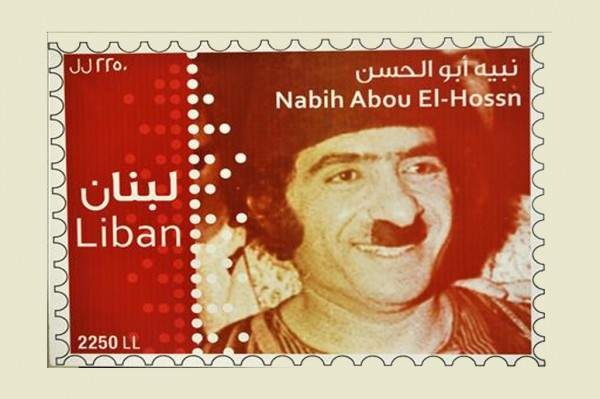
It is not normal for everyone in the country to define you as a “madman” (Akhwat). And not just any “madman,” but one by design, intelligence, wit, and artistry. “Akhwat Shanay,” who among us has not heard of him? That creative soul who embodied reality and conveyed it with pure objectivity.
Nabih Abu Al-Hassan was born in 1934 in the town of Btekhnay, Baabda District – Lebanon. He grew up in a family consisting of 9 children, 4 boys and 5 girls; his father was Ahmed Fares Abu Al-Hassan and his mother was Shahina Abu Al-Hassan. He loved art from a young age, and his first school performance was in the play “Torch of the Desert.” What we do not expect is that the artist and man of the theater began his professional life as a sports teacher in a school in Aley, then in Tripoli.
He presented some sketches on the village stage with the participation of an amateur troupe from the village residents, and he did not plan to turn professional at the time, as between teaching and working at a bank in Beirut, he found no time to enter the arts.
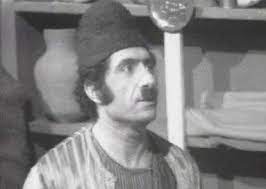
He traveled to Egypt and obtained a diploma in acting. He participated in several series, the most important of which was the series “Akhwat Shanay,” which achieved great success, as he brought the character of the madman to the stage and embodied it in several plays that reflected his revolutionary and critical direction, such as “Akhwat Shanay and Napoleon,” “Akhwat in Arabic,” “International Akhwat,” “The Princess and the Akhwat,” “The Akhwat’s Wedding,” “Akhwat Until Freedom,” and others..
In his time, Nabih Abu Al-Hassan formed an unprecedented artistic, social, and political storm, the impact of which still applies to this day. He was a noble human being whose name was linked to the poor and the weak, which made him the primary defender of justice against injustice and freedom against oppression through magnificent, peerless roles. Nabih Abu Al-Hassan did what he wanted in his life; he was an insatiable creator, a satirist who never stopped giving, and possessed a courage that false societies were not accustomed to.
In one of the interviews with Nabih Abu Al-Hassan, he said: “Akhwat Shanay is a character in conflict with the world. Sometimes he is nervous and other times introverted. As for the “Qabdai” (tough guy) role, it is a difficult one that speaks to the concept of heroism in this backward world, while in “Juha,” I was interested in the human being who knows how to get rid of life's problems with intelligence and cunning.” And about Nabih Abu Al-Hassan the human and his life, he used to say: “We were 9 people under the shadow of a father and mother, content with the good life we lived in the town of (Btekhnay). The family had its share of farms and fields, and I used to take on the mischief of my brothers and adopt any position or incident as long as the matter did not wound my dignity. I was five years old when I started accompanying my mother to the fields and we would sing all the way. In the shadow of that climate, nature, valleys, and mountains, beauty interacted within me and carried me to the world of art. I went down to Beirut when I was seventeen years old, and my weapon was my primary school certificate. I continued my education at night and worked during the day. I learned music at the Conservatory and was eager to sing and compose. Then I worked in journalism and received a scholarship to complete my studies in the Point Four Program, Health Department, so I chose to learn English. But art was interacting within me, so I presented sketches and played the Oud.”.
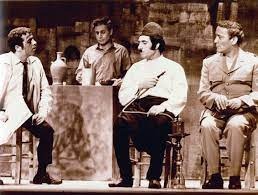
He received several medals and appreciation awards from Presidents of the Republic, ministers, and local and Arab bodies, until he became one of the brightest stars of Lebanese theater, and he is still being honored to this day. The Minister of Culture in the caretaker government, Mohammad Mortada, recalled him in a speech, saying: “Nabih Abu Al-Hassan personified the “Akhwat” character and succeeded in delivering the voice of reason to the patrons of his theater after they had despaired of theories and proposals.”
His last works were the play (Akhwat Until Peace) in 1993. After finishing rehearsals at the theater, and a week before presenting the play, on his way home, Nabih Abu Al-Hassan died in a car accident, which was said to have been orchestrated as the price for his bold positions and his direct political view towards Lebanon and its sovereignty. Thus, Abu Al-Hassan died as a martyr of the word and the shocking art that simulates the people's pain. The Lebanese theater lost one of its most important symbols, and the family lost their son, the phenomenon that will never be repeated. He was honored with the National Order of the Cedar, rank of Knight, amidst official and popular grief.
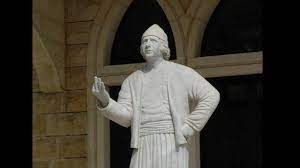
After his death, his brother, engineer Mahmoud Abu Al-Hassan, performed the play in his stead, and Nabih, the Akhwat of Shanay, was turned into a statue in his hometown of Btekhnay!