
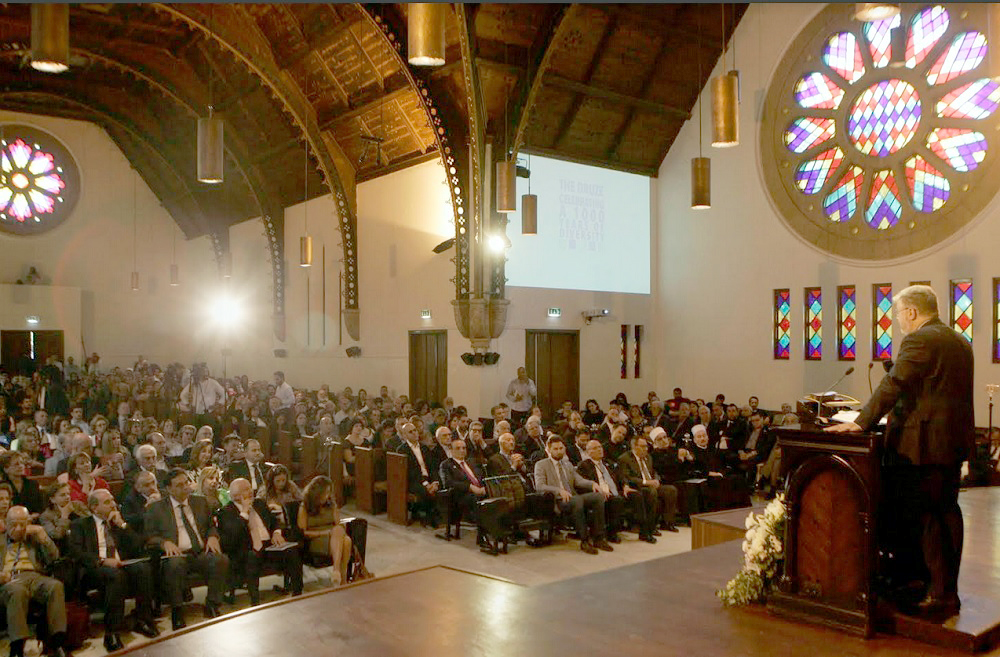
In a first-of-its-kind initiative, the Center for Arts and Humanities at the American University of Beirut (AUB) held an international conference titled “The Druze: A Thousand Years of Pluralism and Civilization” at the university’s Assembly Hall in October 2018. The event was attended by MP Taymour Jumblatt, AUB President Fadlo Khuri, as well as political, academic, and religious figures and students.
Abu Husayn
To begin, the national and university anthems were played, followed by introductory remarks by journalist Raneem Abu Khuzam. Then, Professor at the Department of History and Archaeology at the university, Abdul Rahim Abu Husayn, spoke. He pointed to the “crimes of ISIS in the Suwayda region of Syria” and said: “We are not celebrating the diversity and pluralism that characterized Islamic history, but rather we are here to condemn fanaticism.”
He added: “The Druze have always been part of the environment to which they belonged and defended, from the Ayyubids to the Mamluks, to the Ottomans, and through to World War I, and they maintained their existence in the Levant. This preservation is the reason for the culture they enjoy.”
He spoke about the “role of the Tanukhids, the Ma’ans, Shakib Arslan, Sultan Pasha al-Atrash, Rashid Talie, and Kamal Jumblatt,” stressing that “the Druze have played an important role in the societies in which they lived,” downplaying the importance of numbers in this regard.
AUB President
In turn, the university president said: “This occasion is very important to us because diversity and pluralism are important terms, and because the voice of extremism has become a catalyst for obscuring the voice of religion as it was in the Golden Age. This region has always been formed by a mosaic of communities.”
He added: “This celebration of the Druze millennium in history restores to this region its concept of diversity under which the members of this community have always coexisted, with the ability of the friends of the Druze to make the relationship firmly established.”
He pointed to the “Druze assistance to the local Protestant community in establishing a network of educational institutions, including the Abey School, because they understood early on the concept of shared freedom and freedom of belief.”
He listed the names of the first Druze graduates of the American University.
He expressed regret for the “absence of historian Kamal Salibi, who wrote much about the Druze and loved the diversity of Lebanon.”
El-Halabi
Judge Abbas El-Halabi indicated that “the Druze have persisted for about a thousand years since the emergence of the sect, and they were able to continue for a reason stemming from their historical role in protecting Islam and Arabism without ever feeling that they were a minority in this vast world; rather, they were always part of the ruling majorities. Their resolve was strengthened by their constant exposure to persecution and abuse in politics, and to distortion and fabrication in religion, so the bond of solidarity was stronger.”
He noted that “the Unitarian Druze strive to remain loyal to their historical political goal, which is to defend the Arabism of Lebanon and its independence. At the same time, they carry the banner of defending the Lebanese idea, of which they were pioneers and proponents since the seventeenth century, rejecting the creation of a separate geographic entity for themselves, or accepting the partition or fragmentation of Lebanon. The Druze look at Lebanon as being unique in this region, composed of sectarian and doctrinal diversity, with a system that recognizes individual rights and grants guarantees to sects.”
He said: “Despite the harsh and difficult political circumstances that the Arab world is experiencing, one should not underestimate the weight of the Druze communities in the Middle East, or belittle their importance, as they constitute a strong, solid, and interconnected network in the region. The Unitarian Druze demonstrate their national and patriotic sentiment wherever they are, by confirming their attachment to their land and their historical heritage…”
He continued: “The Unitarian Druze, like the rest of the Arabs, Lebanese, and Muslims, face the challenge of contemporary modernity. The Middle East is living through the most difficult times due to successive wars, lack of political stability, and the rising wave of religious fundamentalism. It also suffers from stagnation caused by the prevention of democratic mechanisms, the suppression of freedoms, and the absence of social, educational, and economic reforms, among others. The Arab world, which considers itself civilized and rich, is now going through a stage of decline and is facing globalization in an open battle.”
He added: “It is certain that the Unitarian Druze living in the Middle East are called upon not to close in on themselves, but rather to attempt to restore the historical role they played in the past and to free themselves from religious and political complexes. They cannot face modernity except through promoting expressive scientific research. The Unitarian Druze, who managed to overcome difficult historical stages and maintain their identity and faith, are also called upon today, like the rest of the sects, to adapt to the spirit of the age, because living in a closed circle is harmful. A minority, such as the Unitarian Druze sect, that possesses this rich heritage, has every right to be proud of its identity and to liberate itself from all its complexes regarding Islam and the Arabs.”
He concluded: “I thank the American University, its president, and the organizing team for holding this conference to show the bright image of the life of this group in all its aspects, especially in customs and arts, which cannot be separated, neither nationally nor collectively.”
Abi Al-Muna
Then, Sheikh Sami Abi Al-Muna, head of the Cultural Committee of the Druze Community Council, spoke. He began with a poem about the Bani Ma’ruf, and said: “The Druze Community Council, as a fundamental legal authority, can be a starting point toward a better future if strengthened. It is of primary importance to emphasize that research into the history of the Unitarian Druze and the details of their path must start from a firm foundation that takes into account the fallacies that occurred as a result of strange and suspicious policies at times, and a lack of knowledge and scientific accuracy at others, as it also views the path of Tawhid (Unitarianism) as not being a separate religion in itself.”
He pointed out that “the Unitarians, despite their adherence to the essence of Tawhid and their commitment to a stable system of moral values, and despite their peaceful nature—and perhaps because of it—were exposed to many insults and slander throughout their history, where they were misunderstood and subjected to attempts at distortion, confusion, and the stirring of ambiguity. Also, their preoccupation with defending themselves and the frontiers, the successive wars, and the lack of stability in various stages of history, all led to some ignorance of the truth of their path and distortions in its image.” He said: “Despite all this, the Unitarian Druze played a fundamental and active role in dialogue and in establishing the foundations and principles of coexistence, as their interest in dialogue with the other stems from their conviction first, and then from their need for this other who is different in some aspects and manifestations, and who shares with them nationality and humanity, especially in this eastern environment and in a country like Lebanon and wherever the Unitarian Druze exist in the Levant, where there is the unity of Arab and Islamic civilization, the unity of environment, history, language, and the unity of the sources of heavenly messages, and where Lebanon forms an advanced model for common living and for dialogue between Muslims and Christians of various sects, and even between them and Jews, as followers of a monotheistic religion, not as proponents of a racist and authoritarian Zionist ideology.”
He noted that “the Unitarian Druze have affirmed their integration into their comprehensive Arab, Islamic, and human environment, while maintaining their historical character. They have also affirmed their attachment to their land and to the national entities in which they exist, as there is no alternative for them; they defend them against any aggression, regardless of the sacrifices it costs them, and they do not attack anyone, as they have no political project of their own. They also affirmed, in the field of creed, their adherence to the fundamental anchor, which is the revealed Book of God.”