
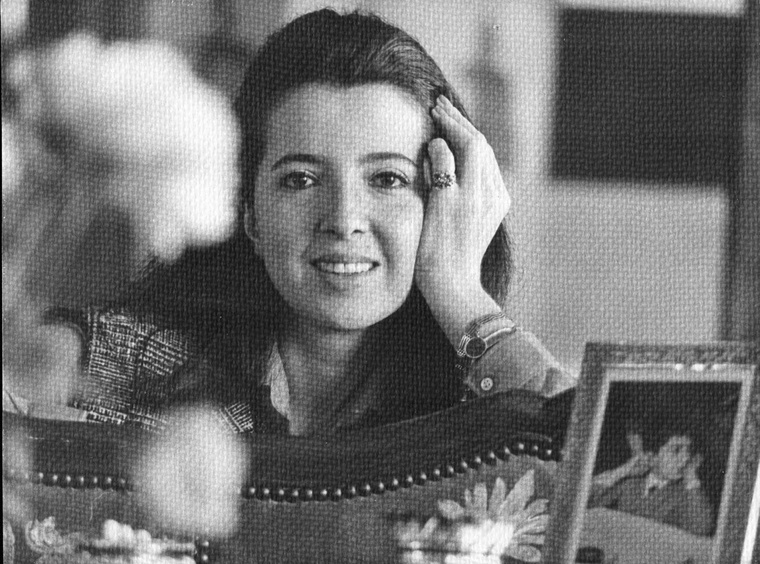
Nadia Mohammad Hamadeh is a Lebanese Francophone poet who has authored a large number of poetry collections.
Nadia Mohammad Ali Hamadeh was born in Beirut in 1935, and comes from an ancient Druze family from Baakline in Mount Lebanon. Her father, Mohammad Ali Hamadeh, was a Lebanese Druze writer and diplomat. Her mother was Algerian-French. Nadia grew up in a bilingual home. She has two brothers: the politician Marwan Hamadeh and the journalist Ali Hamadeh.
She received her education in French schools in Lebanon and Greece, and attended the Ecole des Soeurs de Besançon, followed by the La Mission Laïque Française. She completed her secondary education at the Lycée Français in Athens, where her father worked as the Lebanese ambassador. She then obtained her law degree from Saint Joseph University in Lebanon.
She published her first book of poems titled (Les Textes Blonds) in 1963, worked as a literary editor in 1967 for the Lebanese newspaper published in French, and contributed to many Arabic and French publications.
Throughout her life, she received many awards, such as the French Academy Award, the Order of La Pléiade (presented by the International Organisation of La Francophonie), and the Lebanese poet Said Akl Prize.
Nadia married Ghassan Tueni, editor-in-chief of the Lebanese newspaper An-Nahar and dean of Lebanese journalism, in 1954. She had three children, but all of them passed away before their father, who outlived Nadia. Her son, Gebran Tueni, a journalist and politician, was assassinated in 2005. Her other son, Makram Tueni, died at the age of twenty-one following a car accident in Paris in 1987. Nadia gave birth to her third child, Nayla, in 1955, but she died at the age of seven due to cancer.
Nadia described her homeland, Lebanon, in Poems of Love and War, saying: "I belong to a country that commits suicide every day while being assassinated. In fact, I belong to a country that has died many times. Why should I, too, not die from this ugly, slow, and brutal Lebanese death?"
She passed away in the village of Beit Mery in 1983, after an eighteen-year struggle with cancer.