
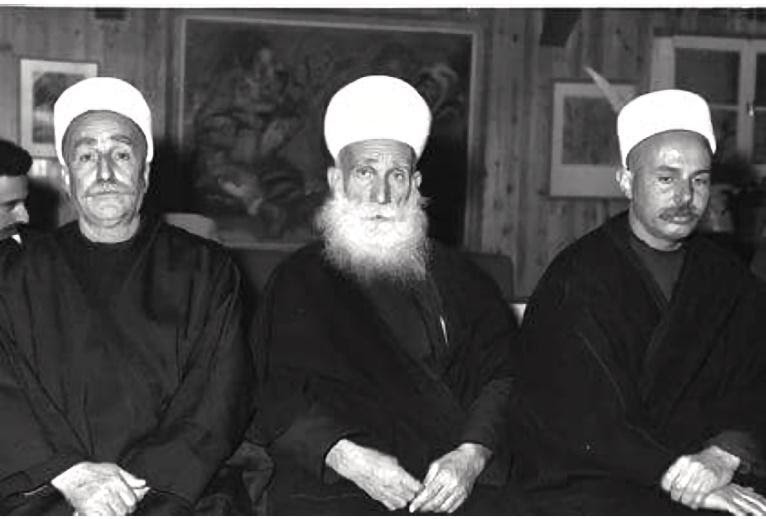
Al-Amama magazine, published in Palestine, wrote about Sheikh Yusuf Amin Tarif:
Spiritual leadership is an extension of the concept of spiritual Imamate, which means creating a conscious religious authority, capable of correcting every deviation, following the path of reason and wisdom to care for the legitimate, spiritual, religious, and social interests of the members of the community, and representing them in official forums and occasions and before position holders and officials.
Whoever reads the history of the community and its doctrinal historical extension understands that the community has never been devoid of a spiritual religious leadership since its beginnings, which has been, throughout the ages, the focal point around which the Druze gathered, relying on its opinion in managing all matters of life.
God Almighty blessed the Druze community in our land by placing its affairs in the hands of a personality like our master, Sheikh Amin, who stood out for his intelligence and wisdom, and prevailed through his piety and asceticism, applying the interpretations of the Master Prince (may God sanctify his secret) in their entirety, holding himself accountable for the smallest matters, and spending most of his energy and wealth in the service of the community and its members, seeking the satisfaction of God Almighty, by assuming the positions of the Spiritual Leader of the Druze community and the President of the Religious Appellate Court.
In 1928, following the death of our master the Sheikh's father, the Spiritual Leader at the time, the late Sheikh Tarif Muhammad Tarif, who bore the burdens of the religious and worldly leadership of the community for more than forty years, deliberations and consultations began among the sheikhs and notables of the community, in search of a successor to take the place of the deceased. Everyone agreed without hesitation to choose our master, Sheikh Amin, as a leader, guardian, and chief guide for this noble community after his father. This was despite him being the youngest of his brothers and his choice of the path of asceticism and piety, away from responsibilities and the spotlight.
The path of this noble saint was not free of obstacles and hardships, as some malicious people tried to sow discord and misunderstanding among members of the Tarif family, attempting to shake their decision to entrust the leadership to our master the Sheikh, but this minority collided with loyal men who knew the value of our master the Sheikh and declared that they would not accept any alternative to the virtue of our master Sheikh Amin.
After the decision was made unanimously, his Eminence was notified of this assignment by the notables of the Tarif family. Our master the Sheikh refused it firmly more than once, justifying his categorical refusal with his intention to renounce the world and his desire to devote himself, his wealth, and his work to the service of the people of religion and worship, following the path of the late our master Sheikh Ali Al-Faris (may God be pleased with him). Despite this refusal, attempts and pressures on his Eminence to accept the assignment continued, until they bore fruit after a long effort through which his Eminence was convinced to agree and accept the position, on March 21, 1928.
Before accepting, his Eminence set a condition: to be exempted from the task of authorization and handling the personal status of the Druze community, justifying this by his intention to dedicate his years of service to the community to purely religious services, guiding the members of the community, teaching them about the lawful and the forbidden, and applying the interpretations of our master the Prince (may God sanctify his secret) literally.
Based on that, his Eminence developed a guiding leadership program through which he sought to consolidate the status of the community in the country. At the beginning of this program, his Eminence, accompanied by a group of religious luminaries in the country at that time, conducted tours that included all Druze villages. Their goal was to follow preaching and guidance and stimulate religious movement among members of the community in various villages, to the point where they were called at that time the "Fleet of Truth" or "The Team of Guidance," because they were all memorizers of the Book of God and students of the noble Al-Bayada. Over time, these tours became a habit and an annual approach, as members of the community awaited his arrival, considering his visit a day of celebration, entrusting his delegation with solving all the problems that individuals or the community as a whole faced in all walks of life.
His Eminence never once deviated from the instructions of the Master Prince, upon which he was raised in the noble Al-Bayada, as he set his leadership plan to suit the Master’s interpretations and teachings, working to achieve many varied changes in religious and social life, correcting the methods of worship and prayer, and correcting kinds of reprehensible behavior that were prevalent during that period, due to the spread of ignorance and the inability of most people to read and write and to view religious books, interpretations, and heritage.
The first fruit of his Eminence’s effort was his bold decision to ban festivities and violations in weddings, which ceased completely after he assumed spiritual leadership. This was after his Eminence expressed his resentment of them in more than one council and occasion, saying that they "shook his body," because of what he observed in them of forbidden mixing between women and men, and other abominations that were prevalent at the time. Based on this, his Eminence separated what he called the "forbidden joy wedding," whose participants are punished with religious excommunication, and "rehabilitation," in which dancing, singing, and manifestations of vanity were forbidden, and it was blessed by his Eminence and by the sheikhs of the country.
His Eminence was once asked by some people about the reason for his banning joy and music, despite what is inherited about the arrival of the prophets on the Day of Resurrection amidst sounds of music and drums. His answer, may God be pleased with him, was: "What is permissible for the prophets is not permissible for humans. Their arrival, peace be upon them, in processions topped by music is by the permission of God Almighty, and this permission was not given to us. Are we at the rank of the prophets so that we may demand their same rights?"
Thus, his Eminence would meet those who wanted to argue with him or even oppose him; he used to discuss with them with patience and forbearance, presenting them with evidence and arguments that would amaze them and convince them of the correctness of his opinion and his wisdom.
Throughout many long years during the British Mandate, the guidance mission that his Eminence adopted, accompanied by the eminent sheikhs, did not stop. They traveled the country and visited the people, content with little and cheap clothing and food. They refused banquets and forbade themselves from eating them, refraining from all manifestations of imposition and worldliness, acting according to the path of the pure prophets and the righteous ascetics.
As the end of the British Mandate approached, the members of the blessed delegation decided to expand and renovate his Eminence's house, completing this hard work with their own hands, as they built a wide guesthouse, alongside two rooms and stairs extending to the roof. Our master the Sheikh met this initiative with a sad heart, believing in himself that he was burdening his brothers, the men of religion, with what exceeded their energy, despite them clarifying to him on every occasion that they were not building this house for him only, but for the Druze community and its members, who still visit this thriving house throughout the days of the year, to this day.
Since trials and calamities are blessings for those close to God, his Eminence faced many enmities and tribulations at the beginning of his path, the harshest of which were attempts to remove him from his spiritual position at the beginning of his tenure. Among those who stood out supporting his Eminence, and standing by his side with help, defense, and victory, was our master, the late Sheikh Abu Hussein Fandi Shuja, who stood in the face of what the malicious tried to convey to the ears of the sheikhs of Al-Bayada, of malicious and false rumors launched to tarnish the reputation of his Eminence.
In this regard, the story mentions that a gossiping messenger from the religious people succeeded in reaching the sheikhs of Al-Bayada, conveying to them false talk, and convincing them to believe the lies he brought, until some of the sheikhs of Al-Bayada wrote a letter against our master Sheikh Amin, in the presence of the late our master Sheikh Abu Hussein Mahmoud Faraj, who did not trust the relayed news, but preferred silence and deliberation as was his custom in honesty and good treatment. However, due to his courtesy, in the meantime, one of the pious went to the retreat of the late Sheikh Hussein Fandi Shuja and told him about the letter that the sheikhs had begun writing in order to impose a ban on our master Sheikh Amin and remove him from his position. The late Sheikh Hussein rose up and ran quickly to the meeting place, putting his noble hands on the door and reproaching them by saying: "Your Excellency, Sheikh, you want to break the dignity of the community from Daliyat al-Karmel to Hurfeish for the sake of (the name of the gossip) Effendi. This is not appropriate, not appropriate, not appropriate!" After that, Sheikh Hussein went to the room of his son, the late Sheikh Abu Fandi Jamal al-Din Shuja, entrusting him with the task of writing a document worthy of supporting the late our master Sheikh Amin. Sheikh Abu Fandi wrote the letter in his beautiful, dignified handwriting, so that the other sheikhs of Al-Bayada withdrew and placed their signatures alongside the signature of Sheikh Hussein Shuja, acknowledging that they had fallen into the trap of the trick brought by the messenger. Following that, and by the success of God Almighty and His victory for truth and justice, the letter reached our country carrying the signatures of the masters of the community in Syria and Lebanon, ending the opposition of the malicious who lay in wait for our master Sheikh Amin, and stood with their envy against his noble person, even though he, may God be pleased with them, met them throughout his life with all steadfastness, faith, patience, and expectation for the sake of God, which increased the certainty of his pure essence and his closeness to God, who does not test from His servants except the righteous and pious, to increase their closeness to Him and their elevation and high status among people.
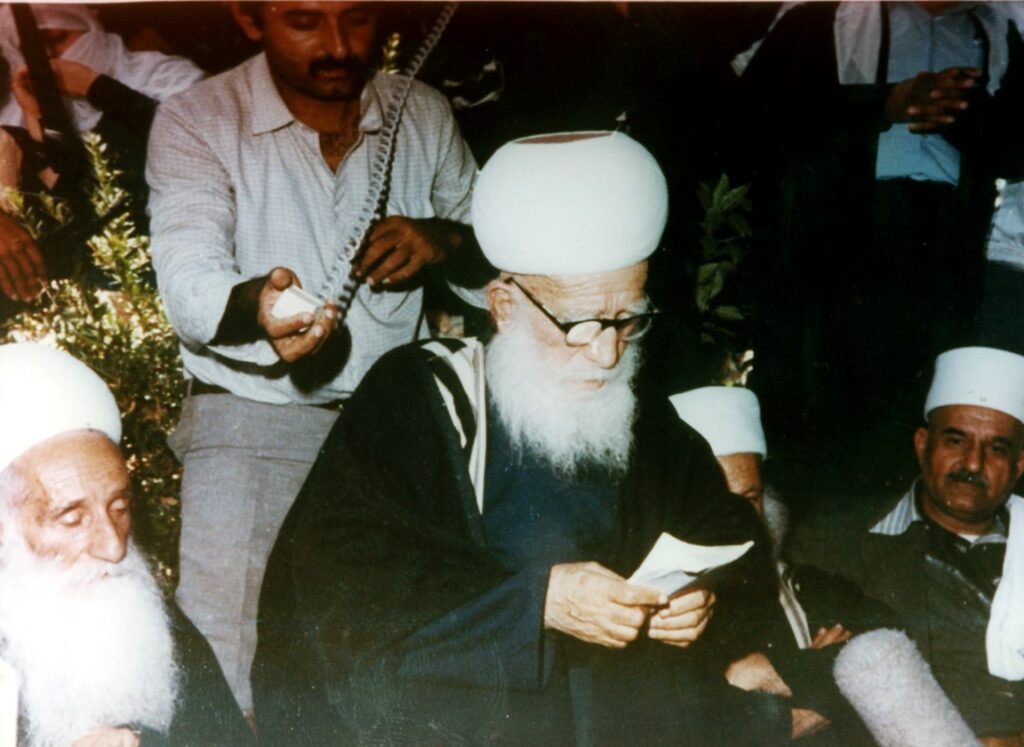
His relationship with the Druze around the world
Borders never prevented our master the Sheikh from following the news of the members of the community wherever they were in the world. May God have mercy on him, he used to take advantage of every occasion and meeting to ask about their conditions and news, and to reassure himself of their interests and comfort. His Eminence established deep friendly relations with his brothers from the Druze of Syria and Lebanon, who lived in his heart since his days in the noble Al-Bayada retreats, and he built with them strong bonds of closeness and brotherhood.
This love appeared through many long visits that his Eminence repeated to the families in Lebanon, during which he remained passionate about meeting the masters, acknowledging the merit of Lebanon in enabling the matter of religion and care. Likewise, his Eminence met many times with the late Sitt Nazira Jumblatt, who was a help and support to his Eminence, and his Eminence saw in her a person of wise opinion and intelligence worthy of appreciation.
As for his relationship with the Druze of Syria, it dates back to the first stage of his assuming the leadership of the community in Palestine at that time, as his Eminence used to consult his brothers in the Jebel al-Druze, presenting them with challenges, and asking them for advice and counsel in solving crises. Perhaps one of the most prominent of these relations was represented by the brothers in Jebel al-Druze sending a high-level delegation that came to the country in 1940, headed by the late Sheikh Abdul Ghaffar Pasha, Zaid Bey al-Atrash, and Hamza Bey al-Darwish, to settle problems and establish peace in the village of Shefa-'Amr following the killing of the late Sheikh Abu Saleh Hassan Khunaifes. God supported their endeavor and took their hand, and peace fluttered with the blessing of their intentions over the village of Shefa-'Amr, for the delegation to later stay in Julis, complying with an invitation launched by our master the Sheikh to eat lunch at his home table.
And because the reward of goodness is goodness, his Eminence also had a bright white hand in solving the problems witnessed by Jebel al-Druze, after malicious people with bad intentions succeeded in setting the members of the same community against each other, in the midst of dividing them into "Sha'biyah" and "Tarshan," and driving wedges of discord between them and igniting bloody battles that claimed the lives of the best youth. As a result, his Eminence headed a high-level delegation to the mountain, which arrived in 1941 accompanied by our master, the late Sheikh Abu Hussein Mahmoud Faraj, and the leader and teacher Kamal Jumblatt, where he was received there in the best way by the late leader Sultan Pasha al-Atrash, and succeeded after holding negotiations in burying the blind discord and returning things to normal in Jebel al-Druze.
In 1947, his Eminence received a large and rare delegation of Lebanese sheikhs, headed by his Eminence our master Sheikh Abu Hussein Mahmoud Faraj, to participate in the ceremonies of the annual official visit to the shrine of Prophet Shuaib (peace be upon him) in April. Following that, his Eminence returned the visit during the same year, and led a delegation of sheikhs of the country during the same year to participate in the visit of Prophet Ayoub (peace be upon him) in the Lebanese town of Ayha during the month of August. There, his Eminence met with the senior sheikhs from Lebanon and Syria, to be the last meeting that brought together the poles of religion from Syria, Lebanon, and our country, before the establishment of the state, for the relationship to become afterwards over the airwaves.
With the establishment of the State of Israel in 1948, the connection between our country and the brothers across the borders was severed, but his Eminence was always committed to the same proud stance in asking about them and caring for their affairs, expressing this by saying: "We cannot abandon the members of our community wherever they are, and borders cannot separate us from them or restrictions hinder us."
In 1953, his Eminence held a memorial service in the village of Julis following the death of the late our master Sheikh Abu Hussein Mahmoud Faraj from Lebanon.
In about 1954, his Eminence rose at the head of the Druze community, declaring their total solidarity with the families in Jebel al-Druze, standing with His Excellency Sultan Pasha al-Atrash and the general families in the mountain, against the practices of the tyrant Adib Shishakli, who ignored the role of the Druze in the independence of Syria and turned his injustice and tyranny towards them, for the events to end with his escape to South America, where he was killed there at the hands of the hero Nawaf Ghazala.
On 21/1/1968, his Eminence received the first delegation of Druze from the Golan Heights during their first visit to the shrine of Prophet Shuaib (peace be upon him) in Hittin.
On 22/1/1968, his Eminence led the first delegation to visit the shrine of Prophet Ya'furi (peace be upon him) in the Golan Heights, for this visit to become an official visit to this day.
In 1977, the news of the killing of the leader teacher Kamal Jumblatt reached his Eminence, which disturbed his mind and saddened his heart, holding afterwards official memorial ceremonies at the shrine of Prophet Shuaib (peace be upon him). This influence was not spontaneous, but came as a result of the intimate relationships he gathered with the family of the late Kamal Jumblatt, whom his Eminence met many times in his youth, and saw in him the personality of the conscious leader and the searching thinker. The late Kamal Jumblatt touched upon his Eminence in his book "This is my will," saying: "Unfortunately, we have not been in contact with the thirty thousand Druze in Israel for a long time. As for the past, i.e., when there was Palestine, they often used to come to Mukhtara. They are far from us now, but they have a high spiritual leader who leads them, and he is still, despite his age, an example of wisdom and rationality."
In 1981, his Eminence held a memorial service for the Sheikh of the blooming Al-Bayada, the late Sheikh Abu Ali Muhanna Hassan, who accompanied him during his youth in his path of spiritual study in the Al-Bayada retreats.
In 1981, his Eminence demanded that the responsible parties in the Israeli authorities lift the siege that was imposed around the villages of the Golan Heights, and the authorities immediately responded to his request.
In 1982, following the outbreak of the civil war in Lebanon, his Eminence followed the events night and day, inquiring every hour about the conditions of the Druze brothers, and conducting constant contacts with all responsible parties to ensure security and protection for the community. His Eminence later left for Lebanon on 23/7/1982 at the head of a delegation he formed, bringing about a positive change and standing in the face of the schism that threatened the members of the community there.
On 15/10/1982, his Eminence visited the noble Al-Bayada retreats after a break that had lasted since 1948, for that visit to turn into a traditional approach that the sheikhs of that region have been reviving to this day.
In 1983, as a result of the unfortunate events and the successive shelling of Druze villages in Lebanon at the hands of American warships, especially the battleship "New Jersey," his Eminence met with the American Ambassador Samuel Lewis in Tel Aviv, demanding that he stop the immediate shelling of Druze villages in the Lebanese Chouf, in addition to demanding the lifting of the siege and checkpoints established by the Lebanese Forces around the Druze villages.
In 1984, his Eminence held a celebratory victory meeting at the shrine of Prophet Shuaib (peace be upon him) in Hittin, to celebrate the retrieval of Al-Shahar and the restoration of the sanctities belonging to the community after the war. This meeting has become a blessed annual approach, which is still held to this day under the name "Al-Shahar Visit."
Since the blooming Al-Bayada was still living in his heart and memory, in 1990, his Eminence opened a spacious retreat in the blooming Al-Bayada, which he named "Al-Safadi Retreat," to encourage youth to visit it and stay there during their period of spiritual study and their memorization of the العزيز Book of God.
In 1991, his Eminence held a memorial service following the death of the Sheikh Aql of the Druze community in Lebanon, His Eminence the late Sheikh Muhammad Abu Shaqra.
After the death of his Eminence on October 2, 1993, a large memorial service was held in his memory at the shrine of the Master Prince in Abeih, in which hundreds of religious sheikhs and position holders participated. Also, another memorial service was held in Jebel al-Druze, in which thousands of mourners from the community and other communities participated...