
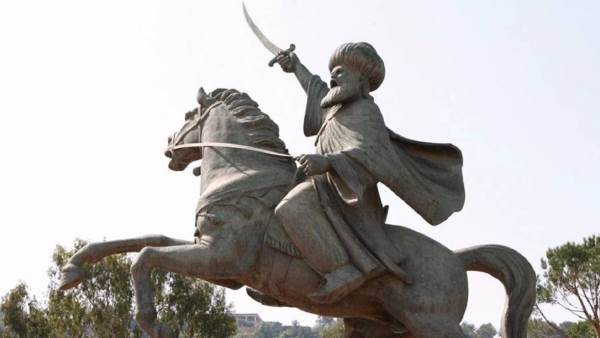
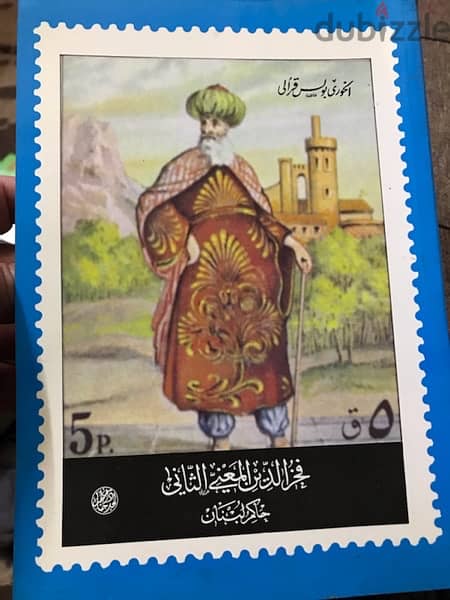
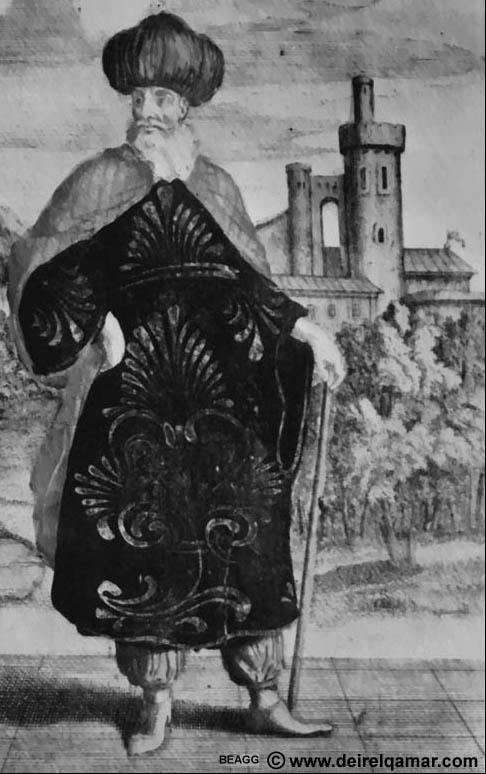
Prince Fakhr al-Din al-Ma'ni II the Great (980 – 1044 AH / 1572 – 1635 AD) is one of the Lebanese princes from the Druze Ma'n dynasty who ruled the Emirate of Chouf from approximately 1120 until 1623, when Fakhr al-Din unified all the emirates of the Levantine coast. Fakhr al-Din II is considered the greatest and most famous prince of the Levant in general and Lebanon in particular, as he ruled the regions extending between Jaffa and Tripoli with the recognition and consent of the Ottoman Empire. Many historians view him as the greatest national figure Lebanon has known in that era and the greatest governor of the Arab East in the sixteenth and seventeenth centuries. Fakhr al-Din II is considered the first de facto Prince of Lebanon, as he controlled all the territories that comprise modern Lebanon within its current borders, after they were previously ruled by multiple princes; thus, he is considered the "founder of modern Lebanon."
Fakhr al-Din was a shrewd politician; he was able to expand his emirate to include most of Greater Syria and obtain recognition from the Ottoman Empire for his sovereignty over all these lands, even though the Empire at that time was still at the height of its glory and power and would not have accepted any governor or prince showing any attempt at expansion, independence, or anything similar. During his reign, Fakhr al-Din allied with the Grand Duchy of Tuscany and Spain. The country flourished throughout his days, trade with Europe and neighboring countries increased, and people lived in prosperity and comfort until the Ottoman Sultan Murad IV returned and saw that Fakhr al-Din posed a threat to the Sultanate after his power increased, his reputation spread across the Empire, and he allied with Europe. He sent a military campaign that managed to capture the prince and send him to Istanbul, where he was executed.
His Upbringing
He is Fakhr al-Din ibn Qurqumaz Ma'n, known as the Second because his grandfather was also named Fakhr al-Din. He is called "the Great" because he was the greatest of the Lebanese princes in the sixteenth and seventeenth centuries. No other Lebanese prince equaled his greatness before him, and no prince came after him equal to him until 153 years later, when Prince Bashir II al-Shihabi appeared. Some historians believe that "Fakhr al-Din" is not a name but a title for the Ma'ni prince, like "Salah al-Din," "Nur al-Din," and other titles that princes used in the sixteenth century and before. These historians state that the name of Fakhr al-Din I was "Osman"; consequently, Fakhr al-Din II may also have been named Osman in honor of his grandfather. There is nothing to prevent this view from being correct. In any case, the title "Fakhr al-Din" prevailed for both princes, and they became known only by it.
Prince Qurqumaz, Fakhr al-Din's father, was killed by the Governor of Egypt, Ibrahim Pasha, in 1584, after being accused by Yusuf Sayfa, the prince of Tripoli and Akkar, and Ibn Furaykh, the prince of the Beqaa, of robbing a caravan carrying the tribute of Egypt and Palestine to Istanbul near Jun Akkar. This accusation was accepted by the Sublime Porte, despite its falsehood. When Prince Qurqumaz died, his eldest son, Fakhr al-Din, was not yet twelve years old. At that time, Ibrahim Pasha wanted to hand the rule of the Chouf to one of the Yemeni leaders, but Prince Saif al-Din al-Tanukhi, Fakhr al-Din's maternal uncle, was able to appease Ibrahim Pasha with gifts and convince him to make the Chouf a fief for him, i.e., for Saif al-Din. Thus, Saif al-Din al-Tanukhi acted as regent for Fakhr al-Din in the rule of the Chouf until he reached the age of maturity and the danger of the Ottomans faded.
Fakhr al-Din lived under the care of his uncle, who resided in the town of Abey, far from the eyes of his father's enemies. He received his education, trained in the methods of governance, learned about the conditions of the country and the inclinations of the people, and became closely acquainted with everything he needed to know. When Fakhr al-Din reached the age of eighteen, the resentment of the Ottomans had subsided, and the Governor of Damascus had changed. He took the reins of power from his uncle and assumed the emirate of his father and grandfathers in 1590. His mother, "Nasab," had a great role in preparing the young prince and cultivating traits of patience, courage, and determination within him.
The Conflict Against the Yemenis and the Expansion of the Emirate
The young prince found himself surrounded by numerous princes, each ruling their district as they pleased. He saw that the strongest of these feudal lords were Yusuf Sayfa in Tripoli and Mansur ibn Furaykh in the Beqaa, who had allied to swallow the districts of the leaders adjacent to them. Fakhr al-Din had no choice but to gather the scattered parts of the Qaysi party into a strong alliance that could stand against the two Yemeni leaders: Ibn Sayfa and Ibn Furaykh. Among these allies were the Shihabs, princes of Wadi al-Taym, and the Harfush family, princes of Baalbek. He attracted to his side some of the Arab sheikhs in Hauran and Ajloun in eastern Jordan. Fakhr al-Din used three methods to achieve his political goals: force, money, and intermarriage. He prepared knights and infantry, led campaigns to subdue his opponents, spent money and gifts to win over Ottoman governors, and formed marriage alliances with the Shihabs. He even saw it as beneficial to intermarry with the family of his opponent, Ibn Sayfa.
Eliminating Ibn Furaykh
Fakhr al-Din decided to remove Ibn Furaykh from his path first. He seized the opportunity of Murad Pasha al-Qabuji passing through Sidon on his way to Damascus to assume his new position as its governor. He went to welcome him and presented him with gifts. The governor became reassured of the Ma'ni prince and listened to his opinion regarding Ibn Furaykh and his poor policy. Murad Pasha soon lured Mansur ibn Furaykh to Damascus, captured him, and killed him in 1593. When his son tried to take his place, Murad Pasha instructed Prince Fakhr al-Din to attack him, so he attacked and eliminated him. Thus, the lands of the Banu Furaykh passed to the Harfush family, allies of Fakhr al-Din.
When Fakhr al-Din saw that he had gained the friendship of Murad Pasha al-Qabuji, the Governor of Damascus, he requested that the Sanjak of Beirut, which was subordinate to Ibn Sayfa, and the Sanjak of Sidon, which the Ottomans had taken from the Ma'nis following the Ottoman caravan incident in Jun Akkar in 1584, be granted to him. Murad Pasha agreed to Fakhr al-Din's request. Sidon returned under the shade of the Ma'nis nine years after it had been taken from them, and the lands of the two Sanjaks extended from the Dog River (Nahr al-Kalb) to Acre, including the land of Jabal Amil. From that time on, Fakhr al-Din made Sidon his headquarters.
Fighting Ibn Sayfa
Annexing Beirut to Fakhr al-Din's emirate was a severe challenge to the Governor of Tripoli, Yusuf Sayfa, to whom Beirut had previously been subordinate. Ibn Sayfa waited for opportunities until Murad Pasha al-Qabuji was removed from the governorship of Damascus. Then, Ibn Sayfa tried to retrieve Beirut, but Fakhr al-Din and his Shihab allies and the Harfush family surprised him in the Dog River pass, defeated his army, chased him to Keserwan and al-Futuh, and occupied them in 1598. After the new governor of Damascus and some mediators intervened, Fakhr al-Din returned Keserwan, al-Futuh, and Beirut to Ibn Sayfa in exchange for peace and his refusal to oppose Fakhr al-Din, as Fakhr al-Din preferred Ibn Sayfa's friendship over his enmity.
Once Fakhr al-Din felt secure in his northern emirate, he turned to expand southwards, annexing the Sanjak of Safed in 1600, which included a large part of northern Palestine. However, Ibn Sayfa did not keep his promise for long; he attacked the villages of the Harfush family, allies of Fakhr al-Din, burned the villages of Baalbek, and looted them. Fakhr al-Din then resolved to discipline his opponent. He advanced towards him with a large army that he had reorganized, reinforced with men and weapons. The forces of the two sides clashed in Junieh in 1605 in a fierce battle that ended with the defeat of Ibn Sayfa and Fakhr al-Din's recovery of Keserwan, al-Futuh, and Beirut. To maintain his new gains, Fakhr al-Din began showering the Governor of Damascus with gifts, and the governor recognized Fakhr al-Din's emirate over the areas he had seized.
The Alliance Between Fakhr al-Din and Ali Janbulad
Despite Fakhr al-Din's victory, Ibn Sayfa continued to control the districts of northern Lebanon and central Syria, from Byblos to Latakia. He remained powerful and still controlled large areas of the country. Since Fakhr al-Din could not get rid of this opponent, who stood in his way and in the way of expanding his emirate alone, he formed an alliance with the Kurdish leader Ali Pasha Janbulad, who had been a governor of Aleppo for the Ottomans and then kept it for himself and rebelled against his state, which was busy with wars in the Balkans and Persia. Yusuf Sayfa wrote to the Ottoman Empire requesting to be made prince over all of Syria, pledging in return to eliminate the rebellious Aleppo governor, Ali Janbulad. The Ottoman Empire agreed to this.
Yusuf Sayfa moved with his army to fight Janbulad, and the two sides met on the plains of Homs. Fakhr al-Din and his Shihabi and Harfush allies rushed to help their ally, occupying Tripoli and blocking the path for Ibn Sayfa, who had returned defeated from his battle with Janbulad. When he found his lands occupied, he sailed to Cyprus, and from there he headed to Gaza and then to Damascus, hoping to prepare a new army. But Ali Pasha Janbulad and Prince Fakhr al-Din followed him to Damascus and besieged it. Ibn Sayfa fled and sought refuge in the Krak des Chevaliers (Hisn al-Akrad). Ali Janbulad followed him alone after Fakhr al-Din returned to the seat of his emirate. Janbulad besieged the Krak des Chevaliers, so Ibn Sayfa was forced to appease him; he presented him with gifts and made peace with him to free himself to confront the Ottomans. Fakhr al-Din agreed to this reconciliation, and an intermarriage took place between him and the Sayfa family, as Fakhr al-Din married the daughter of Yusuf Sayfa's sister.
The Ottoman Empire soon concluded a truce in the Balkans and a truce in Persia, and became free to deal with the affairs of Syria, so it directed an army led by Minister Murad Pasha al-Qabuji, who was the governor of Damascus, to fight Janbulad. When Janbulad felt his weakness, he fled from Aleppo, and Murad Pasha entered it, thus ending Janbulad's rebellion against the state. The Minister wanted to fight Fakhr al-Din, but Fakhr al-Din, who had previously dealt with Murad Pasha, knew his weaknesses. He sent him an alluring golden gift, carried to him by his young son Ali, accompanied by the prince's advisor, Hajj Kaywan ibn Abdullah. The minister was pleased with the gift, remained silent about Fakhr al-Din, and renewed his governorship over Sidon, Beirut, and Keserwan in 1607.
Summary of the First Period of His Reign
In the first period of his life, Fakhr al-Din was able to consolidate the pillars of the Ma'ni emirate. He allied with his Shihabi and Harfush friends and got rid of his two opponents: Ibn Sayfa and Ibn Furaykh. There was no longer any powerful person in all of Lebanon except Fakhr al-Din II, who became the prince of most Lebanese districts, after having been the prince of the Chouf. However, he realized that all the methods he used to preserve his emirate or expand its territory were not enough to achieve his ambitions. The forts and castles he built, the strong Ma'ni army, his alliances with Janbulad and the princes, and his friendships with the ever-changing Ottoman governors all helped him establish his emirate, but they could not guarantee his independence from the Ottoman Empire. He had to look toward a strong state to supply his army with effective military equipment.
In addition to his alliances, Fakhr al-Din also relied on the style of intermarriage to consolidate his rule, as he married Princess Fakhra, daughter of Prince Ali ibn Yunus Ma'ni, to Prince Ahmad ibn Yunus al-Harfushi in 1027 AH.
This marriage is a subject of confusion for Mikhail Alouf; sometimes he says it took place in 1605 AD and the bride is Fakhr al-Din's daughter. At other times, he dates it to the events of 1617 AD and says the bride is Fakhra, daughter of Prince Ali Ma'ni, "as Prince Ali, son of Prince Fakhr al-Din, contracted the marriage of his daughter Fakhra to Prince Ahmad ibn Yunus al-Harfushi, who came and lived in Mashghara."
Al-Safadi (Fakhr al-Din's historian) himself placed it in the events of 1030 AH / 1620 AD, saying: "In the sacred month of Muharram of the mentioned year, Prince Hussein ibn Prince Yunus ibn al-Harfush and his father's deputies and group came to Prince Fakhr al-Din in Beirut, seeking the hand of the noble daughter of Prince Fakhr al-Din for Prince Ahmad ibn Prince Yunus mentioned. Prince Fakhr al-Din headed to the city of Sidon and fulfilled their wish, and each of them returned with what they had obtained in terms of fulfillment, and he sent his noble daughter with the appointed notables of his group, and they headed to Qabb Elias, and Prince Yunus came and met them there and treated all those who headed from Prince Fakhr al-Din's side with due respect."
Al-Safadi himself was confused about the date of the marriage, as he said in the events of 1617 AD, "Before these events, Prince Ahmad ibn Prince Yunus ibn al-Harfush had become part of the intermarriage with Prince Fakhr al-Din ibn Ma'n and concluded his marriage contract to his noble daughter!.."
Prince Haydar al-Shihabi reported it in the events of 1027 AH / 1617 AD: "Prince Ahmad married Fakhra, daughter of Prince Ali Ma'ni, and he came and lived in Mashghara in the Beqaa region and built a great house there. Correspondence took place between him and the Shiites of Tripoli, the sons of Daghir, and the princes of Jabal Amil, the Banu Ali al-Saghir, and the Banu Munkar..." This bothered Prince Ali Ma'ni, and he demanded that Prince Yunus al-Harfushi remove his son from Mashghara, which he did, and he returned to Baalbek. Perhaps the engagement took place beforehand, but circumstances prevented the completion of the marriage ceremonies? However, it is known that Prince Ahmad died in the month of Ramadan in the year 1030 AH / 1620 AD, i.e., nine months after the date mentioned by Al-Safadi.
Prince Yunus wanted the intermarriage with the Ma'ni to continue, so he took advantage of Hajj Kaywan's passing through Baalbek in 1621 AD and tasked him with requesting from the Ma'ni the marriage of Prince Hussein ibn Yunus to the widow of his brother, the noble daughter of Prince Fakhr al-Din, in exchange for eight thousand piasters to appease him. Hajj Kaywan, Fakhr al-Din's manager, went to Sidon and addressed him regarding this marriage, and he blessed it.
Fakhr al-Din's Alliance with Europe
In the first decade of the seventeenth century, European states were eager to connect with the East to regain the influence they had lost with the end of the Crusades. Among the foremost European princes who were following the conditions of the Ottoman Empire and its provinces was Ferdinando I de' Medici, Duke of Tuscany, who wanted to strengthen his trade ties with the East and establish his influence there. Tuscan merchants had been trying to reside in Tripoli since 1602, but the poor policy of Ibn Sayfa and the competition of Venetian merchants forced them to withdraw from it. Ferdinando I had contacted the Governor of Aleppo, Ali Janbulad, and concluded a trade and military treaty with him, but Janbulad's defeat before the Ottoman army did not allow this treaty to be implemented.
The Alliance with Tuscany
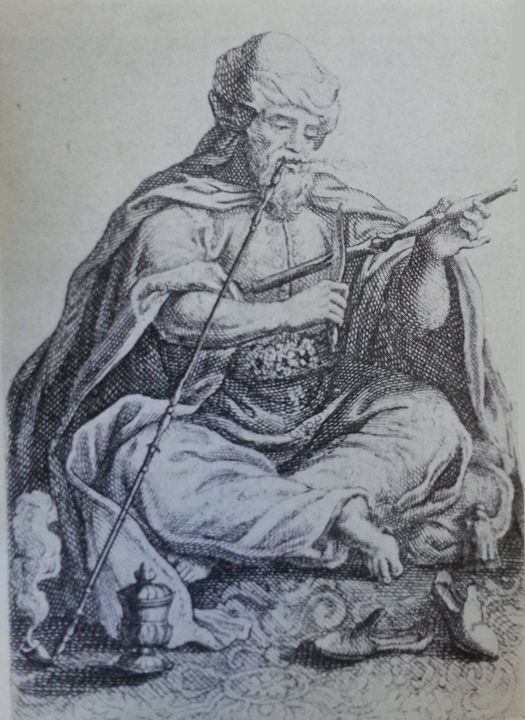
In 1608, Ferdinando I sent a mission to Prince Fakhr al-Din led by his ambassador, "Hippolytus Leonchetti," carrying a thousand rifles to him. After Fakhr al-Din received the mission in his palace in Sidon, in the presence of the French consul in Sidon who acted as a translator, an agreement was reached between the two parties for cooperation against the Ottoman Empire. Fakhr al-Din stipulated the following in this treaty:
Ferdinando I would place experts in cannon casting at Fakhr al-Din's disposal.
Ferdinando I would ransom the three Tuscan prisoners from Murad Pasha, the Grand Vizier. These prisoners had fortified some of Fakhr al-Din's castles, and their remaining with the Ottoman Empire posed a danger to Fakhr al-Din because they knew the secrets of his forts.
Ferdinando I would obtain a papal bull ordering the Christians of Lebanon to stand with Fakhr al-Din in upcoming wars against the Ottomans.
Ferdinando I would place two ships at Fakhr al-Din's disposal in the port of Sidon for the prince to use in exchanging letters and missions, and to transport his wealth to Tuscany if he were forced to do so.
Ferdinando I would grant Prince Fakhr al-Din a passport authorizing him to enter Tuscany whenever he pleased.
Ferdinando I fulfilled Fakhr al-Din's demands with satisfaction: Tuscan ships began anchoring in the ports of Sidon and Tyre, carrying rifles and cannons to the prince, then sailing back with silk, oil, and soap. Ferdinando I obtained a bull from Pope Paul V calling on the Maronites of Lebanon to fight under Fakhr al-Din's banner. As for Prince Fakhr al-Din, he began preparing a large army to be ready to execute what had been agreed upon with the Duke of Tuscany. A few months after the alliance was signed, Ferdinando I died and was succeeded by his son, Cosimo II, who declared his commitment to his father's policy toward Fakhr al-Din. He sent the prince a fleet loaded with military equipment, including rifles, cannons, explosives, and other items. In 1611, Prince Fakhr al-Din sent Bishop George ibn Marun al-Ehdeni to Cosimo II and Pope Paul V to renew the alliance treaty with each of them. So as not to alarm the Ottoman Empire with his relations with Tuscany, he continued to pay the taxes required of him on time, and sometimes even before their due dates.
However, these relations did not remain secret... the Ottoman Empire soon learned of their details from its spies and from some European merchants, then confirmed them after the proliferation of Tuscan ships in the ports of Sidon and Tyre. The Ottoman Empire was worried about Prince Fakhr al-Din's activity and decided to put an end to his ambitions. The Sayfa family, for their part, were not stable, seeing the Ma'ni prince's influence expanding and his relations extending abroad, so they contacted Hafiz Ahmad Pasha, the new governor of Damascus, and poisoned his mind against him due to his policy hostile to the Sultan and his connection with European countries, whose ships were anchoring in Sidon and Tyre without the permission of the Sublime Porte.
Hafiz Pasha's Campaign
When Hafiz warned Fakhr al-Din against continuing his cooperation with European countries, a violent feud arose between them. Hafiz resorted to provoking Fakhr al-Din by dismissing the sheikhs of the Hauran and Ajloun sanjaks, who were supporters of Fakhr al-Din. But Fakhr al-Din returned them to their positions by force through a campaign of three thousand cavalry and infantry led by his son, Prince Ali. Hafiz was enraged by this challenge and resolved to crack down on Fakhr al-Din. Nasuh Pasha, the Grand Vizier, agreed to the Damascus governor's plan and provided him with a land army supported by the Ottoman fleet from the sea. 14 other Pashas also agreed to this order. Mediators from the Shihab and Harfush families tried to reconcile the prince and the Pasha but did not succeed. The prince tried to appease the governor and sent a delegation of notables from Sidon and Beirut carrying a friendly letter from the prince and a sum of money, but Hafiz rejected them harshly. Prince Fakhr al-Din had begun fortifying many castles and supplying them with soldiers in preparation for such a day. However, he did not expect that day to come so quickly. Hafiz's armies marched from Damascus, accompanied by the men of Hussein Sayfa, son of Yusuf Sayfa, towards the lands of the Ma'ni prince. Hafiz was able to control the situation, and the Janissary soldiers began assaulting villages and fields. Meanwhile, the prince moved with his soldiers from fort to fort without Hafiz being able to overcome him.
The Ottoman fleet arrived and imposed a siege on the Lebanese ports to prevent supplies from reaching the prince. Ottoman sailors began landing on shore and attacking the emirate's lands. Then Prince Fakhr al-Din called his supporters to a meeting in Damour. The Ma'ni princes, Tanukhis, district sheikhs, Muqaddams, and the Khazen family responded to his call. He asked them to renew their strength to fight Hafiz, but what they described of the horrors that befell their followers and properties led him to decide to leave the country and leave the reins of power to his son Ali, provided that his uncle, Prince Yunus, Fakhr al-Din's younger brother, would assist him. From Sidon, Prince Fakhr al-Din sailed in September 1613 on three ships, two of which were French and the third Dutch, accompanied by his entourage consisting of his wife "Khaski," his advisor Hajj Kaywan ibn Abdullah, and about fifty men, after taking advantage of the Ottoman fleet's preoccupation with chasing the Spanish fleet, which had captured seven Ottoman ships. He had ordered his brother Yunus to move his residence to Deir el-Qamar from Baaqline, which had been the center of the Ma'ni properties; from that time on, Deir el-Qamar became the capital of the Lebanese emirate.
Prince Ali ibn Fakhr al-Din and his uncle Yunus continued to resist Hafiz with the forts and men they had. These forts exhausted Hafiz and his soldiers and remained impregnable; he besieged the Beaufort (Shaqif) Castle for 84 days and insisted on occupying it, mistakenly thinking that the prince's money was deposited there, then retreated from it in despair after its garrison stood firm. Hafiz also besieged the Banias castle in vain. His rage intensified, so he remained silent while his men destroyed crops, burned villages, and shed the blood of the innocent. The country was exposed to a terrible massacre, which became proverbial and was called "Hafiz's Year." When Prince Fakhr al-Din's supporters saw what had happened to the country, they thought of appeasing Hafiz: the Lady Nasab, the prince's mother, who had reached the age of seventy, went to him and offered him three hundred thousand piasters in exchange for his withdrawal from the country. The Pasha was satisfied with this offer, so Lady Nasab handed him one hundred and fifty thousand, the locals paid one hundred and thirty thousand, and twenty thousand remained. The Pasha took Lady Nasab with him as a hostage to Damascus until the prince's men paid the remaining amount.
Fakhr al-Din in Europe
Fakhr al-Din's ships headed to the Grand Duchy of Tuscany, located in the northern part of the Italian Peninsula, and entered the port of Livorno in October 1613. After Fakhr al-Din stayed in Livorno for a week, he headed to Florence, the capital of Tuscany, where Cosimo II welcomed him with a grand reception witnessed by princes and notables, then housed him and his entourage in the "Palazzo Vecchio" (the Old Palace), one of the most beautiful palaces of the Medici family, the princes of Tuscany. The prince asked Cosimo II for a military force to regain his country from the hands of the Ottomans, but Cosimo II's answer was to send a mission of experts to Lebanon to survey his news before taking a definitive stance on the prince's request. When the ship carrying the experts returned to Tuscany in April 1614, it carried with it a number of the prince's men. The mission presented its report to Cosimo II, informing him of the people's love for Fakhr al-Din and the strength of his forts, which increased Cosimo II's honor to the prince and his interest in his demands.
As for the prince's men who came with the experts' mission, they asked him to return to them, declaring their regret for failing him and showing their readiness to defend their country under his banner. The prince was negotiating with Cosimo II on the necessity of preparing a campaign in which most European countries would participate for it to be successful. However, Cosimo II preferred to undertake this military campaign alone, as long as the European countries were in conflict among themselves and not enthusiastic about achieving the prince's desires. Then Prince Fakhr al-Din despaired of effective military assistance and felt Cosimo II's lukewarm enthusiasm toward him, so he sent his advisor Hajj Kaywan ibn Abdullah to Lebanon to conclude a peace with the Ottoman Empire, postponing the achievement of his hopes to a future opportunity.
The Ottoman Empire was worried about Fakhr al-Din's presence in Tuscany and his contact with ambassadors of European countries hostile to the Ottomans. For this reason, Cosimo II had barely sent a messenger to Nasuh Pasha, the Grand Vizier, in Istanbul to negotiate amnesty for Fakhr al-Din, when Nasuh Pasha showed the Sultan's readiness to pardon him, provided he did not return to Lebanon, but returned to Istanbul, where he would be made governor of one of the Greek provinces. Fakhr al-Din did not trust this offer; and even if he did, he was not prepared to accept it.
The atmosphere improved between the Ottoman Empire and the Ma'nis; Nasuh Pasha was killed by order of the Sultan, and Hafiz was removed from the governorship of Damascus, both of whom were enemies of Fakhr al-Din. Muhammad Jerkes Pasha assumed the governorship of Damascus in 1615. There was affection between him and Fakhr al-Din, so he released Lady Nasab from the prison of Damascus and handed her the "amnesty firman" or "amnesty decree" for Fakhr al-Din. This decree authorized him to return to his country and his position. Lady Nasab sent the amnesty decree to Fakhr al-Din in Tuscany, but the prince had already left for Sicily. If news of the amnesty had reached him while he was in Tuscany, he would have returned to Lebanon immediately, but his seeking refuge in Sicily, which was subordinate to the King of Spain, an enemy of the Ottoman Empire, forced Fakhr al-Din to remain three more years in exile.
Spanish fleets were worrying the Ottoman Empire with their suspicious activity in the Mediterranean and their attacks on Ottoman commercial and military ships. The Ottoman Empire decided to attack the coasts of Sicily in response to these attacks. When the Duke of Osuna, the Spanish viceroy in Sicily, extended an invitation to Prince Fakhr al-Din to host him, he intended to mislead the Ottoman Empire into thinking that he was preparing, with Fakhr al-Din, a military campaign on the coasts of Lebanon and Palestine, so the Ottoman Empire would be forced to redirect its fleet from the coasts of Sicily to the coasts of Lebanon and Palestine to prevent the perceived threat. Fakhr al-Din accepted the Duke of Osuna's invitation and moved from Tuscany to Sicily in August 1615. In Sicily, longing for his homeland returned, so the Duke of Osuna prepared a few ships for him that took him to Sidon, where his family and supporters met him, then he returned quickly before the news of his visit spread. On his return journey, he stopped at the island of Malta, where its knights prepared a grand reception for him. When he arrived in Messina, the capital of Sicily, the Duke of Osuna had been transferred to Naples, so he invited him to accompany him. Fakhr al-Din moved with him there and stayed in a beautiful palace overlooking the sea. The Duke of Osuna tried to entice Fakhr al-Din to cooperate with Spain and hand over Tyre and Sidon, but the prince managed to evade him with tact and flexibility. Finally, he resolved to return to his homeland, so he showed the Duke a letter he received from his mother, Lady Nasab, urging him to return. The King of Spain had offered Fakhr al-Din to stay in Spain and rule Spanish provinces, but Fakhr al-Din replied, saying: "I did not come for rule or a kingdom; I only came to protect Lebanon."
The Return to Lebanon
Prince Fakhr al-Din returned to Lebanon in 1618, i.e., after an absence of five years, two of which he spent in Tuscany and three in lands belonging to Spain, the most powerful countries in Europe at the time. During this period, Fakhr al-Din contacted the French through correspondence and the Holy See through Maronite clergy residing in Rome. The appearance of Fakhr al-Din in Italy, as a prince of the Druze sect, which was unknown until that time, had aroused European curiosity. A rumor spread in the West claiming that the Druze - wandering in the mountains - were descendants of the Crusaders, to the point that they attributed the name Druze to Count "Dreux." It seems that Fakhr al-Din himself enjoyed this tune, which made him a subject of great interest in the West. As soon as the news of the prince's return to Lebanon spread, the country was shaken, and joy spread among all the people, so they came in groups to see him and greet him, after their trust and hope in him had increased after the disasters that befell Lebanon during his absence. Despite all of Fakhr al-Din's efforts, he could not achieve the primary goal of his trip, which was to seek help from European powers to resist the Ottoman Empire, but this stay in Europe had a major influence on his internal and external policy later on, as it helped him build his state and train his army according to the European organization.
Fakhr al-Din's Emirate at Its Maximum Extent
Consolidating His Rule
Long exile did not limit Prince Fakhr al-Din II's ambitions to expand his state; rather, this exile made him more determined to realize his idea, especially since expanding his state would rid him of some princes who were pleased with his absence from his emirate and oppressed his supporters. At the forefront of them was Yusuf Sayfa, prince of Tripoli and Akkar. During the prince's absence, the Sayfa family had raided Deir el-Qamar, the seat of the prince's family, demolished his palace, and burned his supporters' farms. Upon his return from Europe, the prince resolved to attack the Sayfa family. He gathered men and marched to Akkar, where the Sayfa family's palaces were, demolished them, and transported their beautiful yellow stones from Akkar to the port of Tripoli. From there, ships transported them to Damour, and from there they were moved to Deir el-Qamar, where he rebuilt his palace and the palaces of the Ma'n family with them. The yellow stones still exist in these palaces today. Yusuf Sayfa was then forced to make peace with the prince for a large sum of money after yielding the districts of Byblos and Batroun to him.
Ibn Sayfa was stalling the Ottoman Empire in paying the debts required of him, so the state appointed a new governor to Tripoli. However, this new governor could not take control of the city until he asked for help from Prince Fakhr al-Din. The prince prepared a campaign to help the Ottoman governor. As soon as Ibn Sayfa learned the news of this campaign, he abandoned Tripoli. The prince took advantage of Ibn Sayfa's weakness, seized the Bsharri region, and annexed it to his emirate. He also took advantage of the new governor's inability to collect taxes from the people of Akkar and Dinniyeh, so the prince took on this task and annexed them to his emirate. When Yusuf Sayfa died in 1625, the Ottoman Empire offered the governorship of Tripoli to Prince Fakhr al-Din, and he obtained it in the name of his son, Hassan, from his wife "Alwa," the daughter of Yusuf Sayfa's brother. The prince sought to revive commercial and industrial life in Tripoli, instructing the merchants of Sidon to move to Tripoli. Its markets flourished after they had been weak during Ibn Sayfa's era.
Eliminating the Sayfa family's rule in Tripoli did not keep Prince Fakhr al-Din busy from the Beqaa and its princes from the Harfush family, who were his allies in the past, then turned against him during his absence. When he returned from Italy, they feared his revenge, so they slandered him to Mustafa Pasha, the Governor of Damascus. Yunus Harfush exaggerated before the governor in portraying the danger posed to the governor and the Ottoman Empire by the prince's expansion and his contact with European countries. He continued until he convinced him of the necessity of getting rid of the prince, and the governor promised to help him against his opponent. Soon, the masses of the Harfush family and the forces of Mustafa Pasha gathered in the Beqaa, totaling 12,000 fighters from the people of the Damascus province, the Janissaries, Turkmens, and Bedouins. Fakhr al-Din was watching the movements of the Harfush family and waiting for this opportunity. He rushed with his Shihab allies and confronted the masses of his opponents in the village of Anjar with his army consisting of five thousand fighters from all the regions under his rule and from all sects.
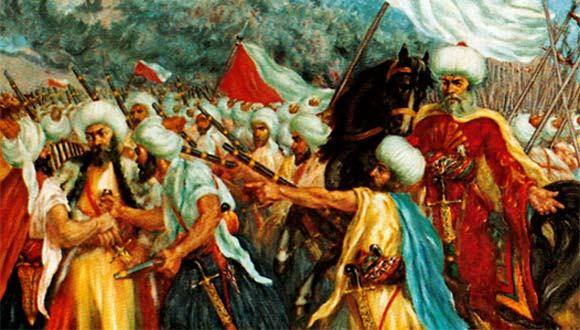
The battle began when the governor of Damascus advanced with his army, skirmishing with the reconnaissance forces led by the Shihabs. This alarmed the Shihabs, but Fakhr al-Din ordered the reconnaissance to retreat to Majdal Anjar. Most of the Damascus and Janissary divisions followed them to the "Burj al-Kharab" (Ruined Tower) located near Majdal Anjar, which they occupied. Immediately, Fakhr al-Din began executing his plan; he sent a hundred cavalrymen to harass Mustafa Pasha's cavalry and retreat before them to lure all of Mustafa Pasha's cavalry to follow his cavalry, so the Damascus governor's infantry would be exposed before him on the plain of Anjar. This is exactly what happened, because as soon as the prince's hundred cavalrymen began to retreat, a thousand of the governor's cavalry pursued them. The success of the maneuver increased by sending the rest of the Damascus cavalry to Burj al-Kharab to eliminate the reconnaissance forces. As soon as the governor's infantry was exposed on the plain of Anjar without the protection of the cavalry, the prince sent the rest of his army, infantry and cavalry, to eliminate the governor's army and end the battle. The prince's manager advanced with his men from Jabal Amil from behind the hills, accompanied by the men of Prince Ali ibn Fakhr al-Din, attacking the governor's army. As for Prince Yunus's men, they closed off the line of retreat for the Damascus army. As soon as the governor's army saw that it was surrounded, they turned and fled. The governor was forced to give orders to retreat; his army crumbled, hundreds of dead fell, four of the governor's top army commanders were killed, and the defeated were chased until Zabadani on the current Lebanese-Syrian border. After this fierce battle between the two sides, the Governor, Mustafa Pasha, was captured by the prince. However, the prince surrounded him with honor and hospitality, so the governor responded by acknowledging the prince's kindness, appointed him over the Beqaa, and permitted him the properties of the Harfush family. Thus, Fakhr al-Din achieved what he wanted, and in 1623 he became prince over fourteen districts over which the Ma'ni flag flew.
Extending the Emirate toward the Rest of the Levant
Fakhr al-Din realized the volatility and turmoil of Ottoman politics, so he was keen to keep his relations with the Ottoman Empire connected. He strengthened his position in Istanbul and relied on some ministers and influential people, upon whom he lavished gifts and money. In holidays and during promotions and appointments to state positions, he would rush to please everyone he needed or dealt with. Thus, Fakhr al-Din secured the affections of the men of power in the capital. When the prince felt secure in the strength of his position with the state, he coveted what was beyond the borders of Lebanon. He was encouraged by the presence of weak governors and incapable princes in the districts adjacent to his emirate. The governor of Damascus, following the Battle of Anjar, renewed for him the sanjaks of Safed, Galilee, and Nablus, and added to them Gaza, Acre, Nazareth, Tiberias, and Ajloun. These were rich, fertile regions that provided Fakhr al-Din with abundant money and supplied his army with men.
After Fakhr al-Din's emirate extended in the south, the prince turned to expand northwards. He seized Salamiyah, Homs, and Hama, then his influence reached Aleppo and Antioch. He built a castle near Aleppo, a castle in Antioch, and a castle in Palmyra that is still known today as the "Castle of Ibn Ma'n." Before that, he had seized Hauran and built a castle in Salkhad to protect the fertile Hauran lands he had annexed to his emirate. Thus, Fakhr al-Din's emirate included all of Lebanon, Syria, Palestine, and eastern Jordan. The prince was able to overcome the governor of Aleppo and the governor of Damascus with his daring and intelligence, and at the same time win the satisfaction of the Ottoman Empire. In 1624, he obtained the title "Sultan of the Land" (Sultan al-Barr), which is the same title his grandfather, Fakhr al-Din I, had received more than a hundred years before from Sultan Selim I. The Sultan bestowed another grand title on Fakhr al-Din: "Prince of Arabistan," meaning Prince of the Land of the Arabs. However, Fakhr al-Din preferred to be titled by a title dear to himself: "Prince of Mount Lebanon, Sidon, and Galilee."
Building the Ma'ni State
Military Organization
This vast expanse of land that Fakhr al-Din was able to rule would not have been easy to subdue if Fakhr al-Din did not possess a strong army with a large number of well-trained soldiers. The prince would not have been able to preserve the country he had annexed to his emirate if he had not established a network of forts and castles in appropriate strategic positions. Fakhr al-Din did not neglect weaponry; he equipped his soldiers with the best weapons his era knew and provided his forts with abundant ammunition and equipment.
Fakhr al-Din organized his army according to the latest methods known in the seventeenth century, aided by experts he summoned from France and Tuscany, and equipped it with weapons he brought from Spain. Fakhr al-Din's army was of two types: national and mercenaries. These two types were the pillars of the regular army. The national army was composed of Lebanese from different regions and religions, without feeling any difference or discrimination under its banner. The only thing that disturbed the purity of this unity was the party division between the Qaysis, who were the prince's supporters, and the Yemenis, who were hostile to him. Alongside this national army, Fakhr al-Din hired soldiers from the "Sekban" and other mercenaries. Among these mercenaries were some who were rebels against the Ottoman Empire; they had despaired of the Sultan's pardon, so they came to the prince, serving him and attacking the armies of his enemies among the Ottoman governors. The Sekban forces stood firm in the forts with marvelous endurance after the prince's travel to Europe, and their men refused Hafiz's promises and enticements. Prince Fakhr al-Din sometimes relied on the forces of his allies from the princes, such as the Shihabs and the Harfush family when they were with him, and the Arab tribes in Ajloun and Hauran. The number of soldiers in Fakhr al-Din's army varied from time to time; when he traveled to Tuscany, his army did not exceed twenty thousand. In the days of his final glory, it reached about forty thousand trained soldiers, who received salaries regularly. In times of war, Fakhr al-Din could prepare more than seventy thousand. In addition to this military readiness in terms of a large number of soldiers and the courage they displayed in combat, the prince's bravery and violence in battles had a major impact on the victories he achieved.
Fakhr al-Din's regular army consisted of infantry and cavalry. As for the infantry, they wore the lightest clothing and carried rifles and swords with broad blades. As for the cavalry, each knight wrapped himself in a wide cloak, carried a flintlock rifle, hung a sword at his side, and held a shield to protect him from blows. The prince had a small number of cannons he had brought from Tuscany and installed in the Beaufort Castle; he also had another number of Spanish cannons that came as a gift from the King of Spain. In his correspondence with the kings and princes of Europe, the prince pressed them to send him experts in weapon manufacturing and cannon casting. It seems that this request was not fulfilled. The prince did not possess a naval force with which he could resist the Ottoman fleet, and this naval deficiency had an impact in determining the fate of the emirate later. The prince once seized two warships of the Malta pirates because they assaulted the Lebanese coast, so he used them to protect his land army when it marched on the coastal roads, and he also used them to transport goods, ammunition, and soldiers between the Lebanese ports.
Prince Fakhr al-Din would not declare war until he discussed the matter with his advisors, the men of his emirate, and the feudal lords loyal to him. He would summon them to his palace for consultation; if they unanimously agreed to declare war, they would send messengers to the villages, or callers would climb to the high mountains and rouse the people of the neighboring villages to gather, or they would light a fire on the mountain peaks, which is a signal meaning that the people are invited to gather at the prince's palace. Prince Fakhr al-Din was the commander-in-chief of his army; if he was absent from the battle, his son Ali or his brother Yunus would act for him. Fakhr al-Din appointed permanent commanders for the regular army, the most famous of whom was Abu Nadir al-Khazen. Every feudal lord among the princes, Muqaddams, and sheikhs was a commander over his own men under the prince's command. The Ma'ni army's emblem was the red flag, which is the emblem of all the Qaysis.
Fakhr al-Din protected the emirate's lands with a network of forts, castles, towers, and walls, and distributed his soldiers in these forts and castles and trained them to fire cannons and throw explosive materials at the besieged. Fakhr al-Din built some of these forts. As for others, they had been built by the Crusaders or those before them, and Fakhr al-Din restored them and made them fit for fortification. The task of these castles and towers was to protect the communication routes in the emirate's lands from thieves, fight highway robbers, and ensure the comfort of travelers and merchants. The most famous of Fakhr al-Din's castles are:
Beaufort Castle: or "Shaqif Arnoun" castle. This castle stands on a towering rock overlooking the Litani River and the Marjeyoun plain. It is an ancient castle built by the Romans, the Crusaders increased its structures, and Fakhr al-Din II restored it. It is one of the most impregnable castles, which is why the Ma'ni prince made it a center for supplying southern Lebanon in years of drought and hid his money vault there. When Hafiz besieged it during his campaign, he could not overcome it and returned disappointed.
Niha Castle: or "Shaqif Tiron" castle. It is a fortified cave that was ominous for the Ma'nis; Prince Qurqumaz died there in 1584 when Governor Ibrahim Pasha chased him, and his son Fakhr al-Din II hid in it fifty years later, and his hiding there was the beginning of his end. This cave is located in the town of Niha in the Chouf.
Sidon Sea Castle: or "Sidon Castle" or "Sea Castle." It is a castle connected to the land by a stone bridge, and the Crusaders built it in 1228, and it was impregnable. The prince installed a large cannon in it to prevent pirates from invading its port.
Qabb Elias Castle: Prince Fakhr al-Din built it in 1625. Its ruins still stand today.
Mseilha Castle: It is a castle built by the Crusaders in the town of Batroun. It is called in French "Puy du Connétable." The castle is located on a towering rocky cliff overlooking the Joz River. Prince Fakhr al-Din restored it to protect the road from Tripoli to Beirut.
Among Fakhr al-Din's other castles in Lebanon are the castles of Tripoli, Byblos, Baalbek, Beirut, Tyre, and Ghazir. As for the most famous of Fakhr al-Din's castles outside Lebanon, they are:
Banias Castle: It is in the Quneitra region in the Syrian Golan. The Crusaders built it in 1107. The prince seized the castle in 1610, and Muhammad Jerkes Pasha, the Governor of Damascus, demolished it in 1616 while the prince was absent in Europe. Then the prince rebuilt it in 1625. It and the Beaufort Castle were the prince's most important castles.
Palmyra Castle: It was called the "Castle of Ibn Ma'n"; the prince built it to repel the raids of the tribes from his country's borders.
Salkhad Castle: In Hauran, the prince rebuilt and restored it in 1625.
Among Fakhr al-Din's other castles in Syria are the castles of Aleppo, Antioch, the Krak des Chevaliers, Marqab, and Ajloun.
Administrative Organization
Before the era of Fakhr al-Din II, the regions of Lebanon were torn apart by chaos and injustice. People and what they possessed of money, land, and houses were at the mercy of feudal lords, and if they survived them, it was difficult for them to get rid of highway robbers and Bedouin raids. As for the Ottoman armies that intervened to discipline a rebel or arrest someone refusing to pay taxes, some of them did not refrain from looting, killing, and assaulting the safe, as was the case with the campaign of Ibrahim Pasha the Egyptian. Going on pilgrimage to Makkah or Jerusalem was an insecure adventure because of the horrors and dangers facing pilgrims. When Fakhr al-Din came, he tried to establish justice in his rule among the people and spread security throughout his country. He reserved for himself the judgment of criminals, leaving to the sect heads the judgment in religious cases and cases of personal status such as marriage, divorce, inheritance, etc., and made the sect heads responsible for their followers to him. Fakhr al-Din's concern for spreading security in his emirate reached a limit that prompted him to prepare campaigns under his personal leadership to discipline rebellious villages or subdue a gang that cut off the road. When he returned from Europe and unified Lebanon and the Levant under his banner, he stood at the head of a campaign of his men and marched with them on a journey that took eight months. He toured Syria and Palestine from end to end, organizing the affairs of his vast kingdom, curbing the rebellion of the insurgents, cutting off the roots of crime, and restoring fortifications and equipping them with equipment, supplies, and men. He also set up observation towers and fortified caravanserais (khans) at crossroads prone to assault, equipping them with soldiers and means of defense and providing them with water and supplies. Thus, people felt secure for their lives and money while traveling and moving. Many travelers who visited Lebanon during Fakhr al-Din's era testified to this, as the security prevailing in Lebanon was at the forefront of what caught their attention. This matter was a factor that encouraged migration to Lebanon, as did the Janbulad family, who came from Aleppo during the time of Fakhr al-Din II and later became the Jumblatt family.
Fakhr al-Din organized his emirate with an administrative organization that ensured his supervision over its general affairs. He appointed responsible officials, whom he selected himself, and specified salaries for them that they received from the emirate's treasury. To control administrative records, he ordered the creation of records containing the names of Lebanese males capable of bearing arms, records of the number of orchards and their fruit trees, and records of the number of animals and livestock in each village. On the basis of these records, fees and taxes were imposed. He chose intelligent, loyal men for political, administrative, and military positions without regard to their sects. He was assisted by the Maronites: Abu Safi al-Khazen, Ibrahim al-Khazen, and Khazen al-Khazen, who was the prince's manager or minister. He appointed Yunus Hubaysh as treasurer of the treasury. He also chose his other assistants from the Druze, Sunnis, and Shiites.
Education
After returning from Italy, the prince felt the weakness of education and the scarcity of educated people in his country, so he encouraged sending a number of Maronite students to Rome to learn foreign languages and higher sciences, and to return to Lebanon to spread what they had learned among the youth. Student missions to Italy continued during his era, increased in number, and reached high ranks in the sciences they specialized in. A large number of student missions returned to Lebanon, and those who returned established schools for the youth. Some of them founded a printing press in Deir Qozhaya near Tripoli in 1610, which was the first printing press in Lebanon, indeed in the entire Arab East. Fakhr al-Din's tolerance in religious affairs helped the arrival of foreign missions to Lebanon and the establishment of schools there, including the mission of the Capuchin fathers, to whom Fakhr al-Din offered lands, where they built monasteries and institutes. As for Fakhr al-Din himself, his upbringing circumstances did not allow him to fully devote himself to study, but he was nevertheless inclined toward science and scholars and loved everything related to chemical and astronomical sciences.
Some Lebanese students remained in Italy, where they researched Oriental manuscripts and preserved them in the libraries of Rome. Some of them authored books and research papers. All of them worked on introducing Latin language styles into the Arabic language. Among them was Father Gabriel al-Sahyuni al-Ehdeni, who was a professor in the schools of Rome and then became a translator for King Louis XIII of France; Ibrahim al-Haqalani and Yuhanna al-Hasruni, who worked in translating religious books; and Youssef Sim'an al-Sim'ani, who was known in Europe as the "father of Oriental sciences."
Urban Renaissance and the Influence of Italian Art on Architecture
Fakhr al-Din was a lover of construction and urban development, just as his military life circumstances forced him to pay attention to building forts and towers and improving and developing their architecture. When he traveled to Italy and saw the beautiful palaces, impregnable castles, and landscaped gardens, his interest in the urban side increased, and he wanted to develop it in his country to serve his military interest in wartime and to enjoy the beauty of palaces and gardens in times of peace and stability. Fakhr al-Din entrusted the experts and Italian engineers he brought from Tuscany with the task of designing and executing his urban projects. Among the most important projects the Italian engineers executed were a number of bridges that were necessary for the movement of people and armies between regions, at the forefront of which was a bridge on the Awali River near Sidon, consisting of one arch; the arches that were rebuilt on the Dog River bridge; the restoration of the Beirut River bridge; and the water fountain (Sabil) that Fakhr al-Din established in Sidon to commemorate his wife, the daughter of Prince Ali Sayfa, who died in the prime of her youth. Travelers talked a lot about it because of its art and beauty. Establishing water fountains was of special importance in cities because drinking water did not reach the houses.
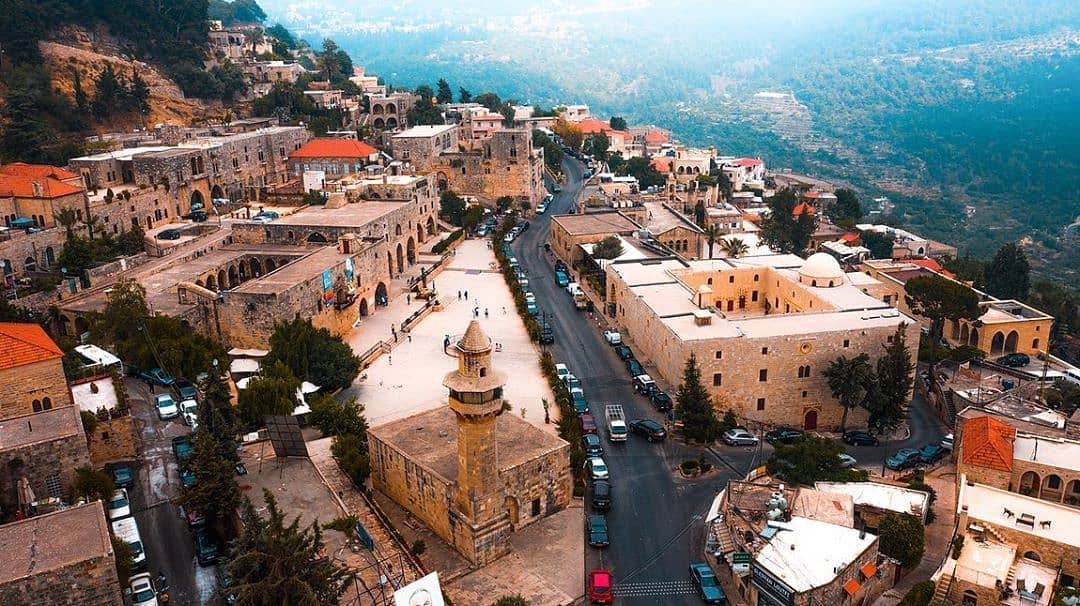
The prince built a palace for himself in Deir el-Qamar, whose traces still remain today. He built palaces for the Ma'ni princes in Sidon and established khans in cities and on long roads for foreign merchants and travelers to stay in. Among the most important of these khans is the Khan al-Franj in Sidon, which is today the headquarters of the Orphanage House belonging to the Sisters of Saint Joseph. Public baths were a health necessity in past centuries. Prince Fakhr al-Din took an interest in building a number of them, the most important being the "Berrani Bath," known today as the "Mir Bath" in Sidon. Fakhr al-Din decorated the city of Beirut and built towers and palaces in it, and his palace in it was the pearl of these urban facilities. A number of Italian engineers designed and built it in the Italian style. This palace included a number of wings: a wing for women, another for employees, and a third for guards. Water was piped into it, and vast gardens were created around it, in which orange trees and other fruits were planted. Water flowed in canals between multicolored squares of flowers, and the gardens were centered by a beautiful pool, around which were a number of animal statues carved from marble or cast from copper. In a part of these gardens, there was a zoo that included various types of beasts such as lions, tigers, and wolves. Tourists described Fakhr al-Din's palace as one of the wonders of the East. A high tower more than twenty meters high rose in one of the palace's corners, from which the prince oversaw the port of Beirut and its suburbs. The "Burj Square" (Tower Square), which has today become "Martyrs' Square" or "Freedom Square," is attributed to this tower. Fakhr al-Din's palace stood on its northwestern side. However, the most important legacy of the prince remains the pine forest he planted to protect crops and gardens from the encroachment of sea sands on the southern shores of Beirut, as the winds annually expelled mounds of sand from the Libyan desert, and the only way to deter them was by planting trees.
Houses with red tiled roofs and glass house facades, consisting of three arches and resting on graceful marble columns, which allow light and sun to enter the dwelling, spread during Fakhr al-Din's era. This style spread in house construction and continued after Fakhr al-Din's era in the coastal cities and mountain villages. Old houses existing today still maintain this character.
Economic Life
Economic life was prosperous during the reign of Fakhr al-Din II, and this helped him achieve his political goals. He was able to use the agricultural and industrial wealth of his country to pay the taxes imposed on him to the Ottoman Empire, to satisfy the Ottoman state men and its governors with precious gifts, to convince the state of Tuscany to ally with and assist him, and finally to be able to spend on his army and employees and consolidate the pillars of his emirate.
Agriculture
Fakhr al-Din encouraged agriculture and called for its improvement. He brought farmers from Italy to train Lebanese farmers on new agricultural methods that would increase production and accelerate its growth. The staples of agriculture in Fakhr al-Din's era were: mulberry, olives, cotton, grains, and fruit trees. Mulberry trees spread across the coastal plains from Sidon to Tripoli, and the slopes of the Chouf and Matn, and the regions of Byblos, Batroun, and the Bsharri district. The silk extraction industry, which was the staple of industry, depended on mulberry trees. Fakhr al-Din took care of the old olive trees and helped in cultivating new ones, so it became a main resource for Fakhr al-Din's treasury, who collected a generous share of agricultural production. Among the other important crops of Lebanon at that time were sugarcane and cotton. Lebanon's production of grains was enough for the needs of the population and had a surplus. When famine spread in Damascus, Prince Fakhr al-Din saved its inhabitants with the abundant quantities of wheat he sent to them. The prince did not neglect fruit farming, and a large number of the wealthy imitated him in it when he established an orchard full of various types of fruit around his palace. The prince's interest in fruit-bearing trees reached the point of placing special records for them, including the number of these trees in each orchard and in each region. These records were the basis for imposing taxes. Fakhr al-Din turned to the necessity of developing livestock wealth, so he encouraged the raising of cows, camels, sheep, and goats. He brought from Tuscany excellent types of cows and bulls and a number of farmers knowledgeable in raising them.
Industry
Handmade domestic industry was the most active type of industry during the era of Prince Fakhr al-Din. Silk was the pillar of the country's wealth and the most prosperous industry. Most Lebanese villages took care of raising silkworms to extract silk threads from them, until Lebanese silk reached a high level of quality, its fame spread in the markets of the world, and fabric factory owners in Europe competed to obtain it, buying large quantities of it from which they made the most luxurious and softest fabrics. The most famous types of silk were: White Tripoli silk and Golden Beirut silk. Silk was exported in abundance, given that the majority of men, especially Muslim men, did not wear silk clothing as this was considered imitating women, so a lot of it was in surplus. Prince Fakhr al-Din bartered foreign goods for silk and used it to pay taxes to the Ottoman Empire, and most of his gifts to the princes of Tuscany were of precious types of silk.
Next in importance at that time were industries extracted from olives: such as oil and soap, whose quality reached a high level. Prince Fakhr al-Din often gifted quantities of them to Ottoman state men. In 1612, he sent three ships full of soap to the Grand Vizier Nasuh Pasha, and he also sent other ships of it to merchants of Istanbul and Livorno to sell in the markets of Turkey and Europe. Cotton gins were spread in many places in Lebanon. Women in houses in winter dedicated themselves to spinning cotton, to the point that Sidon alone had a production of more than forty thousand quintals per year. Textile factories in Sidon covered local consumption and exported the surplus, which was a lot, to European countries. Leather tanning and candle making flourished during the prince's era. An industry that is no longer known today spread, which is the ash industry, from which glass was made. It was an industry that was prevalent in the seventeenth century: there were ovens in Tripoli and southern Lebanon where certain herbs were burned, then their ash was collected and exported to the city of Venice in Italy and the rest of the cities of Europe, where its factories manufactured the purest glass panes, crystal chandeliers, and shiny cups.
Trade
Trade flourished during the reign of Fakhr al-Din II due to the spread of security, the growth of the agricultural sector, and the activity of industry. Its pioneers increased in Sidon and then Beirut, both of which Prince Fakhr al-Din took as his winter capital in succession. The ports of Sidon, Tyre, and Beirut were full of various European ships, which unloaded their cargo of fabrics, paper, glass, steel, and silver and gold coins, then transported from the Lebanese ports silk, cotton, wool, soap, and wheat, and sailed with them to their countries. The trade activity is due to two reasons: facilitating the work of foreign merchants and protecting them, and securing the coasts from pirates. Prince Fakhr al-Din himself took on achieving these two matters; he chased thieves, highway robbers, and sea pirates, and inflicted the most severe forms of punishment on those he caught among them. He established wide khans to accommodate the merchants coming to Sidon and warehouses to hold their goods. He allowed some European countries to have consuls residing in Sidon to look after their employees' affairs. As much as European merchants found freedom, care, and facilities with Fakhr al-Din, they found forms of restriction, tightening, and monitoring in Aleppo and Damascus. European merchants felt these advantages, so they made the city of Sidon their stopping point, the anchorage of their ships, and their trade center in the East, until the number of ships that visited the port of Sidon in 1631 reached nearly 120 large ships, which is a large number for that era. Every city or large village had a weekly market during Fakhr al-Din's era, and the most famous of these markets was the Sidon market, which was held on Mondays and Tuesdays. Merchants would come to it from Acre, Damascus, Tripoli, and Beirut.
This prosperity that Prince Fakhr al-Din achieved had aroused the wrath of some of his opponents, and at the same time, the Ottoman Empire's concern had flared up due to Fakhr al-Din's growing relations with European countries and after it understood from his actions that his goal was not just to collect taxes and expand slightly in his region, but to build a modern and independent state. It began thinking of getting rid of him so as not to threaten the stability of its security and to be a lesson to anyone who thinks of disobedience or rebellion against the Sultanate.
The End of Prince Fakhr al-Din
The governor of Aleppo and the governor of Damascus were looking with hatred and wrath at the influence Fakhr al-Din had reached, and some Arab princes in Palestine were waiting for opportunities to get rid of the prince's control over them. The prince's enemies in Lebanon, who were from the Yemeni party, were working to provoke the governors and send complaints to the Sublime Porte in Istanbul to support the governors' reports about Fakhr al-Din's actions and ambitions. Each of these complaints and reports was enough to provoke the Sultan's anger against the Ma'ni prince. Among the accusations were: 1. Disrespecting the Islamic religion and defending Christians, 2. Expanding his lands after annexing his neighbors' lands to them, 3. Stalling in paying the taxes imposed on him. A complaint presented by the governor of Aleppo stated that the prince's goal from rebuilding the castles of Beirut and Sidon and all the forts was to destroy the Ottoman Empire itself and that he agreed with the state of Tuscany on that, so it sent him experts and engineers. The Ottoman Empire's suspicions were confirmed by what the Ottoman governor of Jerusalem wrote and what European merchants in Istanbul narrated about the existence of secret agreements between Fakhr al-Din and Spain, Tuscany, and the Pope to occupy the Holy Lands. In fact, the Ottoman Empire did not need these reasons to declare its hostility to the prince; it was enough to notice that the prince was acting in his emirate as an independent lord, appointing and dismissing employees, preparing armies, building forts, establishing relations with foreign countries, and allowing them to establish consulates in Sidon.
Ahmad al-Kujuk's Campaign
When Sultan Murad IV defeated the Persians and ended the Janissary rebellion, he saw that the time had come to eliminate this prince whose fame had spread everywhere, especially since he wanted to restore to the Ottoman Empire what it had lost of influence due to the negligence of some of his predecessors and the lack of obedience of the Janissaries and their refusal to fight when absolutely necessary. He prepared two large campaigns: the first, a land campaign consisting of 80,000 fighters from the Turks and the governors' men, led by Ahmad al-Kujuk after granting him the rank of Pasha and appointing him governor of Damascus. The Sultan chose Ahmad al-Kujuk because he had worked in the service of Prince Fakhr al-Din and knew all his secrets. When the prince dismissed him, he became resentful, traveled to Istanbul, and continued to move between positions and fuel the campaign of hostility against the prince until the opportunity arose when the Sultan appointed him at the head of the land campaign directed against the prince. The second, a naval campaign led by the admiral (Amir al-Bahr) Jaafar Pasha, consisted of twenty warships.
The two campaigns headed to Lebanon in 1633. Al-Kujuk prepared to attack the prince by sowing discord among the prince's supporters, enticing some of them with money to abandon the prince. He then joined some of the Ma'ni's neighbors among the governors and princes who were subject to whoever was strong. As for the prince, he tried to organize effective resistance, rousing the country's men and calling on them to defend their country. Only his allies from the Shihab family, the Khazen family, the Hubaysh family, and some "Sekban" responded to his call. He distributed them in the forts so they would stand firm against the Ottoman campaign and rushed to seek help from the state of Tuscany, but his hope for aid was not realized. Then the prince tried to entice Jaafar Pasha, the commander of the naval fleet, informing him that he declared obedience to the Sultan's orders and would hand over the castles of Beirut and Sidon and provide a sum of money. But the fleet commander took the castles and won the money, and did not stop fighting the prince. At the most critical time, the prince was surprised by the death of his son Ali near Hasbaya in a battle between him and al-Kujuk's forces, and Fakhr al-Din was pinning his greatest hopes on his brave son.
Fakhr al-Din then felt his weakness before his strong enemy, who occupied most of the fortified locations and separated the Lebanese by terrorism and enticement. He headed to Niha Castle to begin negotiating with the Ottomans and appease them with money. But al-Kujuk was coveting Fakhr al-Din's entire treasury and was also coveting the reward the Sultan had set for whoever captured the Ma'ni prince. Therefore, he tried to storm the castle and subdue it, but he did not succeed; rather, he suffered heavy losses throughout the siege that lasted two years. While the prince was negotiating with the Duke of Tuscany to prepare a ship on which he and his family could sail, one of his servants betrayed him, guiding al-Kujuk to the watercourse that poured into the castle, so al-Kujuk contaminated the water with animal carcasses and filth. When the prince sensed the water contamination, he moved under the cover of darkness to the Jezzine cave. But al-Kujuk's men kept chasing him until they learned his location. There, they poured vinegar on the cave's calcareous rock, so it became soft for the chisel to carve. Al-Kujuk's forces soon opened another cave below the one in which the prince was residing, and pierced the rock separating them, so the prince fell as a prisoner into the hands of the Ottomans in 1635. Al-Kujuk did not stop deceiving him after the prince was in his hands, as he was coveting the prince's money. When the prince offered to pay him a large sum of money and relinquish the rule to his son Mansur, al-Kujuk showed his acceptance of that. The prince instructed his son Mansur to present the Pasha with precious gifts, and also instructed one of his aides to pay the required money. But al-Kujuk took the money and gifts without releasing Prince Fakhr al-Din.
The Prince's Last Days
Prince Fakhr al-Din was sent as a prisoner to Damascus, and al-Kujuk imprisoned him and his children and women in the Damascus Citadel and returned himself to Lebanon. The prince was transferred after that to Istanbul with his children, and his wives remained in Damascus. In Istanbul, the prince was able to convince the Ottoman Sultan that he had not declared rebellion against the state, proving that he was paying the required money annually, but it did not always reach the Sultan. So he treated him with kindness and was satisfied with him, and it was decided that he would reside in what resembled house arrest in the capital. Many who saw this treatment thought that the prince would return to his former glory and majesty. The Sultan received worrying news from the governor of Damascus; Fakhr al-Din's nephew, Prince Mulhim ibn Yunus, had rebelled against the state after learning of his uncle's imprisonment and his father's killing. He gathered a large group around him and attacked the Damascus governor's army, and his supporters attacked Sidon and the suburbs of Beirut, and they rebelled in all regions and took revenge on the Ottomans. Then the Sultan ordered the killing of Prince Fakhr al-Din's wives in Damascus, and the killing of Fakhr al-Din and his children. They carried out his order on April 13, 1635, and it was narrated that he was hanged at the gate of the Serail, and it was said his head was cut off and it was told that he was pounded in a mortar.
The Prince's Legacy and Memory
Fakhr al-Din disappeared from the political life stage after being the greatest national ruler Lebanon had known, the greatest personality the Ottoman provinces had known in the sixteenth and seventeenth centuries, and after becoming, by the state's admission, "Sultan of the Land" and "Prince of Arabistan." Left behind from Fakhr al-Din's children was his youngest, "Hussein," whom the Sultan kept alive and made part of his entourage. "Hussein Bey" later became the state treasury agent, and Sultan Mehmed IV appointed him as ambassador to India. It is said that the Ottoman government consulted him when appointing "Bashir I al-Shihabi" as prince of Lebanon, and he advised this opinion.
Fakhr al-Din left behind a good reputation among most Lebanese, and news of his greatness, glory, and power. Some historians say that Fakhr al-Din II was the greatest national figure Lebanon has known from its ancient ages until today, while others see that Fakhr al-Din was not the greatest Lebanese personality at all, as many after him achieved fame like his and glory like his on the local and global levels, such as Prince Bashir II al-Shihabi, General Fouad Chehab, and President Rafic Hariri. Some people today look at Fakhr al-Din as a true patriot concerned with the interest of Lebanon and its people, and that he wanted its independence from the Ottoman governors who divided the people and exploited them to achieve their own interests without paying attention to the interest of Lebanon, and that he felt that his Lebanon, i.e., the Chouf, was not his whole homeland and that he would never be able to build a large homeland unless he adopted an opposite path to the path of the Sultanate, which ruled with a "divide and conquer" policy. To be able to restore unity to the Lebanese districts, which were divided by external rulers, he had to appease the Sultanate and at the same time annex the districts one after the other. While others see him as a traitor and a rebel against the Ottoman Empire, the protector of Muslims and the Islamic Caliphate, and that he was the one who corresponded with his nephew, asking him to rebel in Lebanon to pressure the Caliph to release him, and the latter indeed rebelled, and the Caliph Murad IV learned what happened, so he immediately ordered his execution.
What historians agree on is Fakhr al-Din's tolerance toward all religions and his release of freedom for religious rituals, which made people feel that he was not a stranger to them, and they got closer to him and respected him. He built the Qaa mosque in the Beqaa, the Berrani Mosque in Sidon, maintained the mosque existing in his capital Deir el-Qamar, and contributed to establishing the church of Bikfaya and the church of Arbanieh. His wise leadership had the greatest impact in spreading peace and prosperity quickly throughout the Levant. He was on good terms with the strong-willed tribes in Nablus, the Judean mountains, the desert nomads, and the Druze of the Jabal al-A'la in Aleppo and the Nusayriyeh. Sheikh Ahmad al-Khalidi al-Safadi, the writer of the prince's biography, says:
Fakhr al-Din al-Ma'ni II, Fakhr al-Din al-Ma'ni was pure-hearted, clean-minded, humble, and cheerful. He is frowning and violent in the arena of combat. He is forbearing in anger, and I never heard an obscene word from him. He listens to the oppressed, does justice for them against their oppressor, and sympathizes with their condition, being the best of them in mercy. Short of stature, wheat-colored, gentle, awe-inspiring, majestic, of great giving, strong-willed, very firm, good in management, and just as he is kind to the rich, he sympathizes with the poor.
What historians disagree on is the prince's religion and origin, as every sect claimed that he belonged to it. Muslims said their evidence was that he was a Sunni Muslim; he built mosques, had multiple wives, and fasted Ramadan, he and his family. Christians said he was Christian because of his kindness to the resting places of oppressed Christians, so they felt honored in his days, rode horses, wore wide trousers and ornate sashes, and he allowed them to perform their religious rituals openly and to ring church bells, all of which had been forbidden to them before. As for the Druze, they did not find difficulty in proving the Druze nature of the Ma'ni prince, for the prince was born to Druze parents and lived among his Druze people and remained Druze until his death. His grandfather was the prince of the Chouf, which had a Druze majority, so it is logical that he was Druze. His father also carried the name "Qurqumaz," which is a rare name among Christians and Muslims in Lebanon and common among the Druze. As for the Jews, he allowed their rabbis to practice their religious rituals and rites, and their merchants to work in the lands and regions within his emirate, so they said he was Jewish.
Lebanese sculptor "Halim al-Hajj" sculpted a statue of Prince Fakhr al-Din II, and this statue was placed at the entrance of the Lebanese Ministry of Defense in Yarzeh, after the army command intervened and transported it at its own expense from Rome, where it was sculpted, to Lebanon. There is also a wax statue of the prince in his palace, which has today become a museum for wax statues.