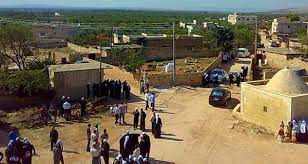

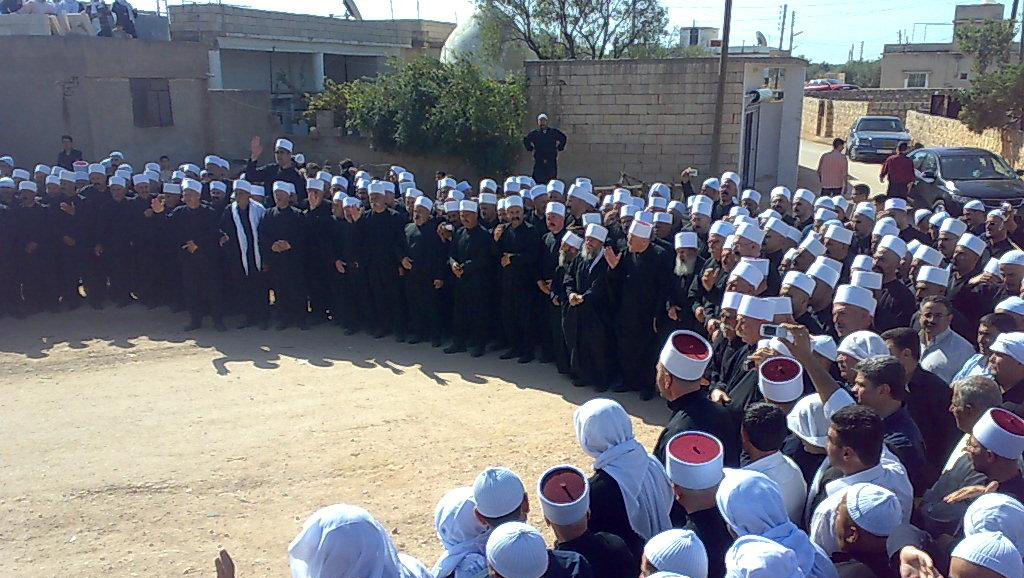
The Muwahhidun Druze community has had an ancient presence in the Syrian governorate of Idlib, specifically in the Jabal al-Summaq region. They are distributed across several villages: Banabel, Qalb Loze, Bashandlanti, Kafr Kila, Ibraita, Jad'in, Bashandlaya, Kafr Maris, Taltita, Hilli, Kuku, Al-Duwayr, Arshin, Kafr Bani, Kaftin, Birat Kaftin, and Maarrat al-Ikhwan.
The History of Jabal al-Summaq
Historically, the Jabal al-Summaq region spanned a large geographical area of the limestone massif extending across this region, from west of Aleppo to Antioch and Reyhanli to the north, and Jabal al-Zawiya to the south.
Looking back at history, this region witnessed the early cradle of Christianity after its emergence in Palestine, serving as a sanctuary for the early preachers of the new faith, with Antioch as their haven. Christianity spread throughout this region, and pagan temples were transformed into churches. When Philip the Arab—who hailed from Shahba in Syria—became the ruler of Rome, the region flourished, and he permitted them to construct buildings in 244 AD. Paul served as bishop in Antioch, and the second-oldest church in the world was erected in Qirqbize, 1 km from Qalb Loze on Jabal al-A'la, which rises 683 meters above sea level. In the village of Qalb Loze, the Qalb Loze Cathedral was constructed in 480 AD. Notably, the Jabal al-Summaq region flourished until the year 1100 AD, as evidenced by the architecture and ornamentation found in its monasteries and churches throughout this entire period.
The Tawhid Faith
Then came the Crusader invasion of the region, controlling it for a time as well. During the era of the Fatimid Caliphate, this area was inhabited by Arabs who embraced the Tawhid (Druze) doctrine during the time of al-Hakim bi-Amr Allah. They subsequently faced severe persecution under al-Zahir in 1020 AD, prompting some of them to migrate to Lebanon and As-Suwayda later on.
The Earthquake of 1138
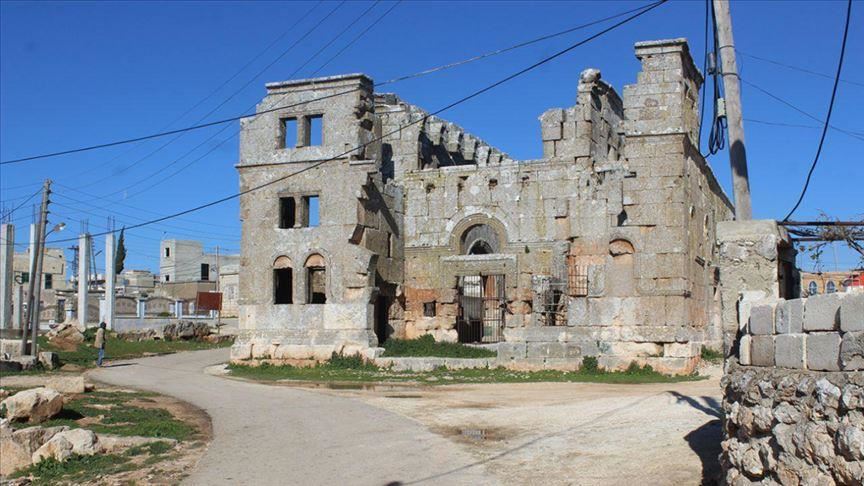
An earthquake struck in 1138 AD, destroying a large portion of the buildings, which led the Romans (Byzantines) to migrate from this region as well, with only a few remaining. This is reflected in some Syriac village names, such as "Mar Tahwan," which is now called Maarrat al-Ikhwan. Its inhabitants were renowned for their generosity, hospitality toward guests, standing up for justice against invaders, solidarity with their neighbors, and coming to the aid of those in distress—qualities that their descendants still preserve today. Under the Ottomans, their condition was favorable, as they engaged in olive and grape farming and hunting. In 1815 AD, the inhabitants faced displacement following an ordeal, prompting a group of them to migrate.
Modern History
During the period of the French occupation, they adopted patriotic stances by harboring rebels, most notably Ibrahim Hananu in 1925, and providing protection for the rebels' women and children.
Following Syria's independence, the sons of the mountain pursued education, studying and graduating from Syrian, Arab, and international universities.
With the onset of the 2011 events, the mountain's residents faced harassment, most notably the Qalb Loze massacre in 2015, which claimed the lives of numerous innocent civilians.
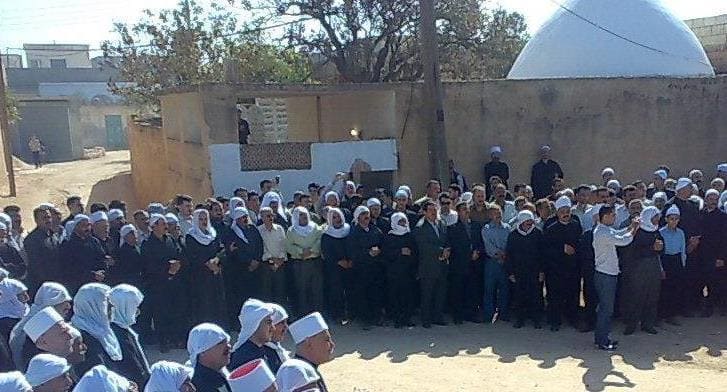
Prominent Villages
Below is an overview of the most prominent villages of Jabal al-Summaq:
Banabel
A Syrian village belonging to the Qurqania subdistrict in the Harem District of Idlib Governorate. Its population stood at 542 people in 2004, according to the Central Bureau of Statistics census.
Kaftin
It is considered one of the convergence points between the mountain and the plain, and one of the largest villages of Jabal al-Summaq.
Its population is approximately 3,000, all belonging to the Muwahhidun Druze community. It is bordered to the north by the town of Killi, to the east by the village of Hazano, to the south by the village of Birat Kaftin, and to the west by the mountain known as Mount Sheikh Daher—where Sheikh Daher (may God be pleased with him) is said to have fled from unbelievers into this mountain, and a rock split open for him to hide inside and emerge from the other side, as local folklore recounts.
Most of the residents work in agriculture, livestock breeding, and raising domestic animals, or in state institutions and departments, or as expatriates abroad.
The village has a municipality, an agricultural cooperative, two primary schools, and a middle school. It also features several caves, wells, and chambers of honorable sheikhs from the village.
Kaftin is renowned for the migration of numerous groups from it, particularly to Wadi al-Taym. It is clear that the Bu Nasr al-Din family, one of the families of Deir al-Qamar who departed Deir al-Qamar heading toward the town of Botmeh in the Chouf (in 1861), originates from Kaftin. Furthermore, groups of Aleppine-origin Lebanese and Syrians belonging to the Tawhid doctrine descend from this community that arrived from Kaftin to Al-Kfeir, who were four brothers.
A group of them migrated from Al-Kfeir to Jabal al-Druze in 1850 and settled in the villages of Lahitha and Hazm; prominent among them was Sheikh Sulaiman al-Halabi.
A branch of the descendants of a man named Abd al-Khaleq al-Halabi moved from Al-Kfeir to Mazraat al-Chouf, and his descendants reside there to this day. There is also a branch of the Bu Nasr al-Din family in the town of Yanta.
Historians recount that the Druze families arrived from Kaftin in the Aleppo countryside in waves, the most numerous being the families that arrived in 1881 through the efforts of Sheikh Bashir Joumblatt, numbering four hundred families who were dispersed across various parts of Lebanon; some took the surname Al-Halabi, while others adopted other names.
Arshin
Located 14 km from the city of Idlib, it dates back to the Roman and Byzantine periods and contains the remains of a two-story temple and the remnants of a basilica-style church.
Maarrat al-Ikhwan
Considered one of the most important villages in the northern region of Idlib Governorate, it is located northwest of the city of Ma'arratmisrin and about 17 km from the city of Idlib. It has produced many prominent figures of whom Idlib Governorate is proud; it served as a safe haven for the men of the revolution, having sheltered the wife of the freedom fighter Ibrahim Hananu in the home of one of the revolutionaries who fought alongside him against the French colonizers.
Qalb Loze
The village of Qalb Loze is situated 45 km northwest of Idlib and approximately 5 km southwest of the town of Qurqania, perched on the northern part of Jabal al-A'la at an elevation of 683 meters. Despite the abundance of surrounding archaeological ruins in the area, such as the ruins of Qirqbize to the south and along the summit of Jabal al-A'la, Qalb Loze is the only inhabited village between the villages of Banabel and Kafr Kila.
The village is famous for its church, an architecturally magnificent structure regarded as the jewel of Syrian churches and the pearl of Jabal al-A'la's antiquities in the Harem area, dating back to the late fifth century AD. The site has been inhabited by residents for a long time, with olive groves cultivated around the village's perimeter. Due to modern settlement, the church has become surrounded by modern homes, and the archaeological perimeter around this church extends for several meters on each side.
The church’s western facade is distinguished by two three-tiered towers flanking a grand portal with a semi-circular arch surmounted by a balcony. This facade constitutes a distinctive architectural feature of churches in northern Syria during the Byzantine era. On the western side of the building are three doorways whose frames are decorated with various decorative elements.
The Church of Qalb Loze is considered one of the ancient archaeological sites in Idlib Governorate, owing to its unique architecture, ornamentation, and artistry that tell the story of successive civilizations in the region.
Religious celebrations are held at the Church of Qalb Loze, which was inhabited in the tenth century AD, as the Byzantine Romans occupied this part of Syria in the tenth century and took over the village's basilica, converting it from the Syriac rite to the Byzantine Melkite rite.
The ruins of Qalb Loze in Idlib Governorate, considered one of the most significant archaeological landmarks, have captured the attention of scholars and travelers from near and far, both Arab and foreign. It has succeeded in becoming a primary destination for tourists visiting the governorate, topping their travel itineraries to view the most beautiful historic Byzantine churches in Syria.
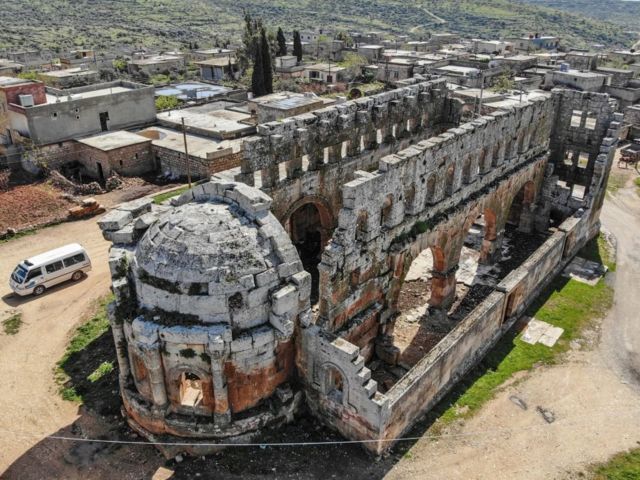
The ruins of Qalb Loze extend over the land that historically separated Barisha and Qirqbize. Nothing remains of its grand edifices except the massive basilica—"the church"—which brought the site its wide renown, in addition to the presence of olive oil presses covering a large area on the outskirts of the village, indicating that its economy was based on olive cultivation.
During the Byzantine era, the village of Qalb Loze was more of a small farmstead than a village, and its modest houses surrounding the church did not exceed ten; yet it contains numerous rock-cut olive presses around the village and at least four guesthouses (hostels), far exceeding the needs of Qalb Loze's inhabitants.
Scholars and researchers have long questioned the large number of presses and hostels exceeding the needs of the small village's residents, as well as the presence of the massive Qalb Loze Church. Traveler and researcher Tchalenko wrote that the church's importance cannot be explained by the importance of the village; its isolation within an enclosure wall, its location on the edge of the houses, the modern design of its plan, as well as the construction, decoration, and meticulous care in execution, lead us to see it as a place of worship dedicated to the entire region, and undoubtedly a pilgrimage center for the inhabitants of the surrounding area, not just the people of Qalb Loze.
The purpose of constructing the hostels was to accommodate pilgrims arriving from afar. This new situation and the traditions of the pilgrimage phenomenon necessitated the use of oil for illumination in the church and the fulfillment of the vows of numerous pilgrims, so numerous presses were established to provide the oil needed to meet the pilgrims' demands.
Among the most prominent antiquities in the historic village are a broken sarcophagus and no fewer than four hostels located on the southwestern edge of the town—the most important of which is situated 150 meters southwest of the basilica—in addition to several presses in the village's southwest.