
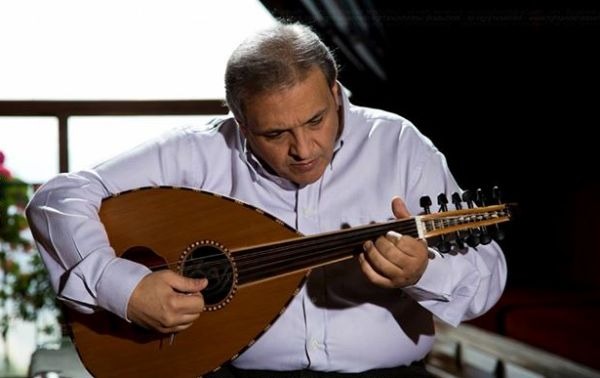
A composer and creative talent taken by death in the prime of his productivity. Musical composer Wajdi Chaya, a native of the town of Sofar in Mount Lebanon, carried art in his heart and soared high with it.
He came down from Sofar to Beirut at the age of 18, and in 1981 presented songs written and composed by him and performed by Adnan Fakher El-Din, including “Hadaytak Wardi w Ghanniya” (I Gifted You a Rose and a Song) and “Menni Inta Menni” (You Are Mine). Regarding that period, he said in an interview: “I was described as prolific in composing. This success led me to the artist Ziad Rahbani, who praised my talent and began inviting me to his private studio to record whatever I wanted without any invoices. Ziad didn't just open his studio door to me; he gave me the key to his home. I will never forget that I slept there many times, despite it being small.”
Wajdi Chaya left behind musical works that Lebanon is proud of, including the play “Shams w Amar” (Sun and Moon) featuring Assi El Hallani and Nadine Al Rassi, which was performed at the Casino du Liban theater. The play tells the legend of King “Sidon,” after whom the coastal city of Sidon was named, and highlights national values and the meanings of freedom, in addition to undying love.
Art is Higher than Money
Throughout his career, Chaya rejected the idea of commercializing art, as he considered art to be higher and more noble than money. He regretted the existence of artists who earn millions of dollars for a single concert, and he held state officials responsible for the artistic ignorance of the people. He once said: “I weep for a nation that includes officials like the ones it has, and a people who have lost their culture and are lost in the abyss of paid-for art.” He wished to revive musical theater in Lebanon and correct its path. He always considered the true upcoming spring not to be a revolutionary Arab Spring, but rather a different kind of theatrical, artistic, performance, and musical spring. He believed in a modern concept for his theater, unrelated to time and place. He always said that his mission in every musical play was for every person to see themselves for who they truly are after the show and to emerge in a specific state of humanity.
Most Notable Works
Among his most notable works: the anthem “Idha Al-Sha’bu Yawman Arada Al-Hayat” (If the people one day will to live) sung by Latifa Al-Tunisia, in addition to national songs performed by Pascale Sakr, and romantic songs featuring Wael Kfoury, Souad Mohammed, and Nihad Fattouh. He also presented the performance “Layali Al-Sharq” (Nights of the East), which included poetic verses by Lebanese writers such as Said Akl and George Jordac. Among his other works is the play “Ana Sharqiya” (I Am Oriental), which was performed in Jordan. He also presented the play “Ornina,” which won first prize at the Babylon Festival. It is worth noting that he composed the soundtrack and the theme song for the series “Gibran Khalil Gibran” by writer Alexandre Najjar in 2008.
It was his wish to one day become Minister of Information. He was also a member of the Arab League for the Song Festival.
After a struggle with illness, composer Wajdi Chaya passed away at the age of 52, following a health crisis for which he was admitted to the hospital.

First Class in Composition
It is worth mentioning that Chaya was classified as first-class in composition at the Lebanese Radio, in addition to being:
– A member of the Executive Board of the Society of Authors and Composers in Lebanon.
– A member of the Syndicate of Professional Artists.
– A member of the Executive Board of the Lebanese “Ihyaa” association for environment, art, and heritage.
– A member of the jury in more than one session of the Arab Song Festival affiliated with the League of Arab States.
Awards and certificates of appreciation received by Chaya:
– The Lebanese Army Shield for his national works.
– First Prize at the Arab Song Festival in 1997 in Cairo.
– Certificate of appreciation from the General Secretariat of the Cooperation Council for the Arab States of the Gulf.
– Appreciation shield from the Aley Festivals.
– First Prize in musical theater at the Babylon International Festival in 1999 for the musical play Ornina.
– Shield and award from the Lebanese Embassy in Jordan for the musical play Ana Sharqiya in 2000.
– Honorary shield from the National Association for Child and Mother for composing the Lebanese Child Anthem in 2006.
– Honorary shield from the environmental association A.F.D.C. for presenting an artistic work advocating for environmental conservation in 2005.