
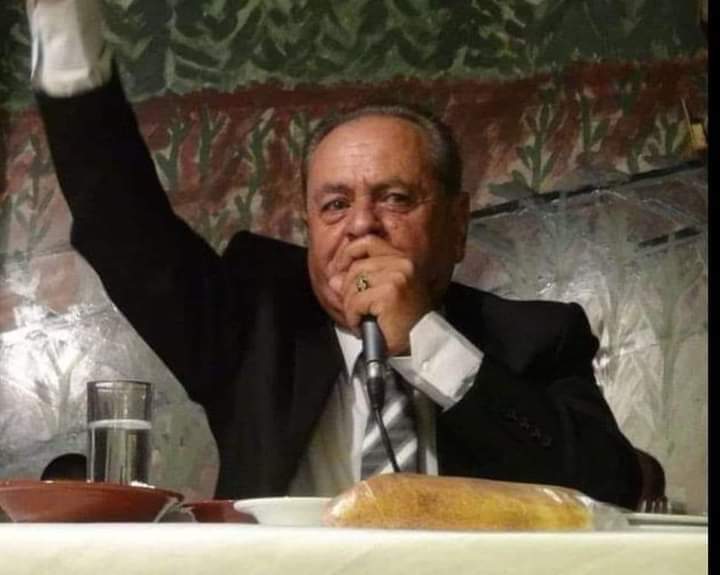
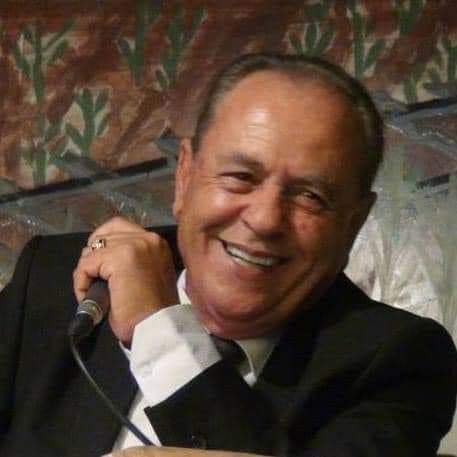
Shawqi Shaaban was a Lebanese Zajali poet from the town of Btibiyat in the Upper Metn. He was a contemporary of the greatest Zajali poets and competed with them, sharing a long journey alongside the poet Talie Hamdan.
Shaaban passed away on July 12, 2023, and was bid farewell by the Poets' Syndicate and his town in a massive funeral.
On the occasion of his fortieth-day memorial, the Syndicate of Zajali Poets in Lebanon, the Shaaban family, and the residents of Btibiyat in the Baabda District, in cooperation with the Ministry of Culture, held a commemorative ceremony at the town's social center hall. The event was attended by writer and journalist Rony Alfa, representing the Minister of Culture, Judge Mohammad Wissam Al-Mortada; Sheikh Fadi Al-Attar, representing the Sheikh Akl of the Druze Unitarian Community, Dr. Sami Abi Al-Muna; a representative of the Minister of Education, Judge Abbas Al-Halabi; as well as political, partisan, social, cultural, municipal, and local figures, along with many well-wishers and the Shaaban family.
Writer and journalist Rony Alfa delivered a speech on the occasion, stating: "When a poet dies, a wild flower withers with him, its buds fading between the wrinkles of rocks, its roots growing under the shade of the soil. A flower from which the incense of book pages scattered on the shelves of libraries weeping over the fingers of a poet who used to touch them—peeling away the virginity of routine and stamping on the forehead of his coming death a cemetery that celebrates life. When a poet dies, the grass of poetry sprouts above a cloud of winged imagery, and the mint of poetic verses wafts like a cool breeze that lands in peace upon the heat of the desert, contemplating an oasis of palm trees laden with thoughts."
Alfa said: "Shawqi Shaaban died, leaving behind many wild flowers that have scattered across this mountain, and there is no doubt they will leave their scent in the corners of our memory—we who walk upon our soil, moving with him like Shawqi toward new moments where the late poet's musings sigh as poems composed on the sea of cooing and derived from the carbon dioxide of wounds, burning like a campfire under the pine trees of evenings conspiring with the sins of permitted love and forbidden kisses in the clarity of darkness. Shawqi died, pulling his stature from the swamp of temporary presence, riding his value toward the hills of permanence. Something in his pen takes new shapes in the pores of our longing for his voice. In separate moments, when nostalgia bullies you, you feel the stings of his pen creating a shiver of deep meaning on the skin of our conscience."
Alfa added: "Today, Shawqi Shaaban sits on a chair among us. Look closely, and you will see him. I beg you, do not take the poet's vacant seat, for his seat sings after him the hymns of the white swan before the forgiveness of departure. Poets' chairs after the poets are poets themselves; when they are present, they sit upon them, and when they migrate, the chairs sit upon themselves in mourning for them, so take turns, take turns; for love is only for the first companion."
Alfa continued: "His Excellency the Minister of Culture, Judge Mohammad Wissam Al-Mortada, commissioned and honored me to represent him at this event, which holds a deeply emotional resonance in his heart and conscience. He has dedicated all his efforts to preserving a heritage that has accompanied the topography of our national life in culture, politics, and society, working hard to strengthen the bonds of love between one poem and another. Poetry knows only passion, and when hatred grows between words, eloquence turns into chatter and rhetoric into deep wounds. If we speak with the tongues of men and angels but have no love, we have become sounding brass or a clanging cymbal."
Alfa continued: "There is no greater evidence of our love than the one we gather to commemorate. Shawqi Shaaban, your memory is a book that invented reading; its cover is stitched with love, titled in fog, and indexed by the sighs of souls yearning for the neighing of a *mukhammas*, the roar of *ataba*, and the bleating of a *ruway* (rhyme) that drinks from the tears of composition and the eyes of a Zajali heritage that mimics the dresses of maidens adorned with the beauty of a sigh between adolescence and maturity. As we trick the impossible with wishes, we pour your phantom into a silver cup of nostalgia and inhale the fragrance of your hair-like poetry, poured like a carat in an ingot, and like the flow of melody passing between your throat and lips, chanting beauty on the swing of rhymes."
Alfa further stated: "From this small town, vast in its tolerance, I recall the era of values that your wonderful town was known for, where the river fraternizes with its pine trees and the valleys exchange kisses with the slopes and plains in harmony between opposites. Even nature aligns with the dialectic of masculinity and femininity. The nature of fruit is the meeting of the female date-palm with the male, and vice-versa. It is the law of life and the path of becoming. The great late poet wrote about love before it transformed and decomposed, the most beautiful of what lies in the folds of romance: [Poetry excerpt omitted in translation for brevity as requested by prompt structure, preserving markers]."
His hands are softer than the breeze
My blood pressure began to rise, God knows, and my heartbeats increased deep in my core
When the nurse measures it, it doesn't come out right; the heart doctor measures it, and it comes out normal. Twenty over ten in the nurse's hand, and twelve over seven in the doctor's hands.
Alfa added: "This poetry is from this environment and this source. It is a unity in faith whose spiritual honey is refined in the purity of emotion and the marriage of opposites, male and female, man and woman, in the fear of God Almighty. Do we have any other guides but our elders for the truth, for protecting wisdom, and for safeguarding the family from the evils of the end times, where gender ideology has mobilized and humanity has descended into the phenomena of barking, meowing, bleating, and cooing."

Alfa added: "We must address the reality of the situation to protect the family and its values. This stalwart mountain was very harsh on the proponents of depravity, and the venerable sheikhs within it showed reverence for religion and traditions in the face of the destruction of books, the distortion of wisdom, the pollution of the *khalwa* (secluded prayer place), and the desecration of supplication and prayer. We fought a fierce battle, brothers, and the Minister of Culture was its sword and shield in the face of homosexuality, which Zionism strives to promote while simultaneously criminalizing anti-Semitism and tolerating the burning of the Holy Quran. It is a conspiracy to destroy a civilization entirely with the weapon of pink dolls, in which the female becomes male and the male female, and love, passion, and infatuation have become between males and males and females and females, and soon between humans and animals. So thank you to this mountain and the sheikhs who preceded us in the confrontation. While I mention the Sheikh Akl of the Druze Unitarian Community, His Eminence Dr. Sheikh Sami Abi Al-Muna, the Chief of the Bayada Sheikhs Sheikh Fandi Jamal al-Din Shuja', the Honorable Sheikh Fadi Al-Attar, and the Honorable Sheikh Wissam Suliqa, we must not forget the honorable sheikhs throughout the homeland who have been a beacon of truth and a lighthouse to be guided by in the face of the heresies of this era's decadence."
Alfa concluded: "Shawqi Shaaban, sleep with your poetry at peace. They are your brothers, and they have sung to you and beseeched you to keep your soul with two flapping wings roaming vast horizons, fragrant with the scent of *mate* and the phrase 'God willing, we are doing well,' exactly as it is pronounced by those whose 'Qaf' resides in the depths of their rhymes, challenging the distant and the near with the wafer of a 'Qaf' that stands on the crossroads of the upright path—strong, capable, and empowered."
Then, poets took turns to speak, with poems delivered by Talie Hamdan, Antoine Saadeh, Adel Khadaj, Samia Haddad, Victor Mirza, Mazen Ghannam, Nadim Shoaib, and Habib Abu Antoine. There was also a word from the late poet's family and the townspeople.