
Exclusive to “Kayan 24”
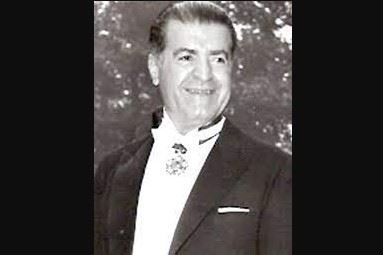
The life of the short story writer, author, and diplomat Khalil Takieddine was divided between the diplomacy of his functional and political career and the diplomacy of literature in its regenerative and visionary dimension, which transcended the prevailing and familiar norms during the formation of Arab modernity.
Between his chosen path of constant travel and soaring through the world's capitals as Lebanon's ambassador to several countries—especially in Europe—and his path of literary writing in its various complex genres as an ambassador of the word within the orbits of creativity, cultural interaction, and literature, there met the pulse of national sentiment to represent Lebanon in the truest way, and the pulse of ink, which harmonized with the beating of his heart in moments of being torn between alienation and nostalgia, love and romance on one hand, and contemplation, description, and revelations with philosophical and mystical dimensions on the other.
Khalil Takieddine the poet, author, and storyteller overshadowed Khalil Takieddine the employee and diplomat. This is because his literary and intellectual presence and his written output made him a powerful figure on the literary and writing scene during the formative stage of modern consciousness in both poetry and prose. He mastered writing measured and rhymed poetry, utilized the classical prosodic patterns of Al-Khalil, and knew how to delve into the prose poem influenced by his Western education without compromising the poetic quality of the phrasing or the musicality of the text. Thus, he grasped the threads of diplomacy in the politics of poetry, through his deep insights, his contemporaneity with great Western and Arab poets and writers, and his civilized understanding of the issue of renewal since the mid-1940s. This modernist understanding extended to his prose through his articles and stories published in Lebanese, Arab, and Western magazines and newspapers. His language in writing prose carried new ideas and opinions, which were the product of his contemporary culture; hence, his writings pulsed with that novelty and were adorned with the mirror of his era and the modernity of the West.
His Birth and Upbringing
In the town of Baakline in the Chouf region, on March 3, 1906, Khalil Takieddine saw the light. He was born into an educated, knowledge-loving family belonging to the Unitarian Druze community. He was the brother of the politician, playwright, and short story writer Said Takieddine, the politician Bahij Takieddine, and the diplomat, military officer, and writer Mounir Takieddine.
He spent his early school years in the schools of Baakline, where he learned the Arabic language and the principles of arithmetic. He then joined a school affiliated with the French Secular Mission, where he mastered the French language alongside his native Arabic. He continued his studies in Beirut at the Lycée (Laïc) school, where he obtained the French Baccalaureate, before pursuing his academic path at the Faculty of Law at Saint Joseph University in Beirut, graduating with distinction in 1926.
Diplomatic Work
From the classrooms and academic achievement, Takieddine moved into employment. In the year of his graduation, he was appointed as a clerk in the Lebanese Senate, which was later merged with the Parliament, and he continued in the same role until he was appointed Director General of the Parliament in 1943.
In the same year he graduated from law school, the great writer was appointed as a clerk in the Lebanese Senate, and he remained in his position until the Lebanese Senate was merged with the Parliament. He then moved to work as a clerk in the Parliament, continuing his service until he was appointed as Director General in the Parliament in 1943.
After Lebanon's independence and the withdrawal of foreign armies from its territory, Khalil Takieddine moved into diplomatic work. In 1946, he was appointed Lebanon's ambassador to Moscow, which was then the capital of the Soviet Union. He then moved between several countries, serving as Lebanon's ambassador to Norway, Finland, Guatemala, Honduras, Mexico, El Salvador, Costa Rica, Nicaragua, Libya, Egypt, Sudan, Turkey, and then Britain, before being retired in 1970. He had traveled to most countries of the world, leaving bright marks in representing Lebanon, presenting a shining image of his country, safeguarding the interests of his state abroad, and following up on the affairs of Lebanese citizens in those countries, in addition to the wide and important network of relationships he left behind in most of those nations, without ever stopping his writing, authorship, and publishing of articles.
After his retirement, he was drawn to journalism at Dar Al-Sayyad. He then contracted with the Lebanese Ministry of Information as a cultural advisor until 1982, when he resigned and decided to devote himself to authorship, writing, his family, and his town, as well as giving his social relationships the necessary time, as he was linked to a wide social network.
On the cultural level, Takieddine was one of the founders of the "League of Ten" (Usbat al-Ashra) cultural group along with his friends Elias Abu Shabaki, Michel Abu Shahla, and Fouad Hobeish.
Takieddine received the Order of the National Cedar, in addition to numerous medals and awards in Lebanon, the Arab world, and abroad, and in most of the countries where he served as Lebanon's ambassador.
Authorship and Writing
In terms of authorship and writing, he had dozens of books, articles, and poems to his credit, including: "Ten Stories from the Heart of Life," "Naïve Thoughts," "The Execution," "Karen and Hassan," "Tamara," "The Returnee," "From Hitler to Riad Al Solh," "Short and Concise," "Stories from My Life," and "Beginnings."
The press of his time took an interest in his distinguished poetic output, which reflected the spirit of the age and touched the reader's conscience and intuition. Many of these works were published, such as: "Wadi al-Araish" in Al-Ma'rad magazine, "Conversation with a Beauty" in Al-Usba magazine, "The Writing Lips" in Al-Usba magazine, "Come to Me." The prose poem also had a share in his poetic output, including: "The Candle, A Dance of the Soul," "Oh Freedom," and other poems that had a beautiful impact on the souls of readers and followers. The Al-Makshouf magazine also published nearly a hundred of his articles.
He was a lover of reading and study; he read the heritage and grasped it, and he read the West and absorbed it without drifting into a current of total fascination with that output, and without drowning in the heritage; rather, he dealt with it with a critical mind and a visionary intellect.
On July 9, 1987, the writer and diplomat Khalil Takieddine passed away in Beirut and was buried in his town of Baakline. The Lebanese state named a street in the Saifi district of the capital, Beirut, after Khalil Takieddine in his honor. Takieddine the diplomat departed, but Takieddine the poet and author remained.