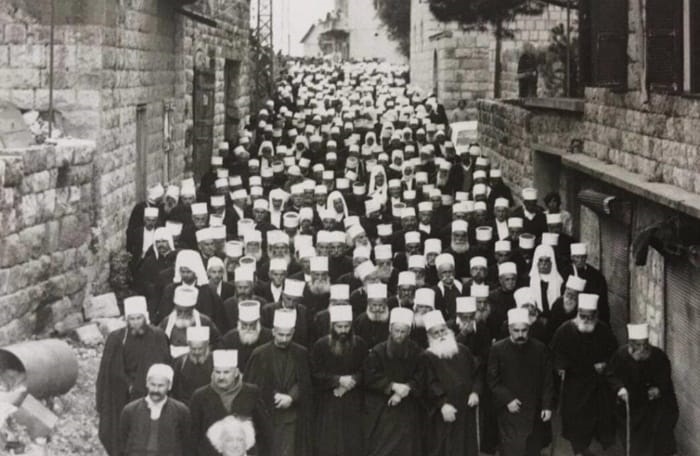

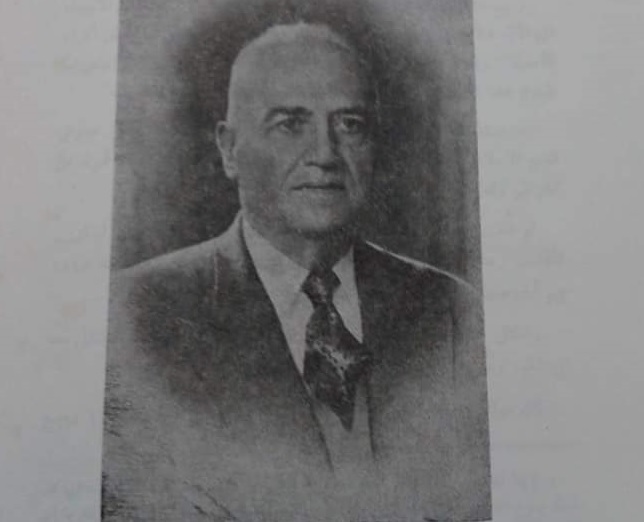
Since the 1940s and throughout the decades that followed, southern Mount Lebanon had not witnessed an educational renaissance in its social, humanitarian, and mission-driven dimensions like the one established by the late judge, politician, and man of letters, Aref Bey Al-Nakadi. One day, he harbored a dream of founding an educational institution to assist orphans and the needy among the Druze Unitarian community and beyond. With unyielding determination, solid will, and a resolve to confront challenges, he was able, after just a few years, to turn the dream into reality. With the support of benefactors and his own efforts, he founded the "Druze Orphanage," which began in Beirut and later established its headquarters in Aabey. In addition, he established other schools, revived Al-Dawoudiya School, and affiliated dozens of schools with it.
Al-Nakadi, who knew how to reconcile the high offices he held in Syria—from presiding over the State Council and heading the Syrian Police during the era of President Shukri al-Quwatli, to his appointment as Governor of Jabal al-Druze in 1948—with his efforts to spread science and knowledge and open schools, especially in Mount Lebanon and among his community, also knew how words could have the impact of water in a parched desert. He devoted great attention to writing and authorship, excelling in diverse literary fields and enriching the Arab library with dozens of books and works. He supplied leading magazines and the Arab press with hundreds of articles on many subjects, particularly on the Arabic language and its origins, becoming one of its distinguished authorities, as well as a researcher into linguistic, critical, and literary issues. He was elected a member of the Arab Scientific Academy and served the Arabic language, defending its integrity and supporting Classical Arabic. He also authored historical articles, reviews of authored and translated books, in addition to several volumes and translations.
Birth and Upbringing
On January 13, 1887, Aref Amin Said Hammoud Al-Nakadi was born in Baabda, Mount Lebanon, tracing his lineage to the Al-Nakad family, a well-known Druze clan historically tracing its descent to the famous Arab tribe of Taghlib. He embarked on his pursuit of knowledge initially in the schools of Beiteddine, then specialized in law, obtaining a license to practice before Lebanese courts in 1911. He was appointed clerk at the Court of Appeal, an examining magistrate before the indictment division, and later a member of the Criminal Court. With the outbreak of World War I in 1914, he became Chief Judge in Baabda alongside his work in journalism, having launched the monthly magazine Al-Mithaq, followed by the magazine Al-Yawm.
In Damascus
Aref Al-Nakadi headed to Damascus following an invitation from Syrian Minister of Justice Jalal Zuhdi after the fall of Ottoman rule and the establishment of an Arab government led by Prince Faisal bin Al-Hussein in 1918. He was appointed Assistant Public Prosecutor at the Court of Appeal and an inspector in the Syrian Ministry of Justice. In February 1928, Minister Subhi Nayyal appointed him Director of Legal Affairs at the Ministry of Justice until 1937, when he took over the ministry's general administration.
Aref Al-Nakadi wrote for Al-Ayyam newspaper, the mouthpiece of the national movement in Syria, and lectured at the Faculty of Law at Damascus University. He also founded a dedicated annual exhibition for Syrian industries following the election of Muhammad Ali al-Abed as President of the Republic in 1932, where Prince Mustafa al-Shihabi was appointed director, and Aref Al-Nakadi was named deputy and vice-director of the exhibition, which opened at the Al-Tajheez School on May 31, 1936. President Al-Abed awarded him the Order of Merit, Excellent Class, for his role in making the exhibition a success.
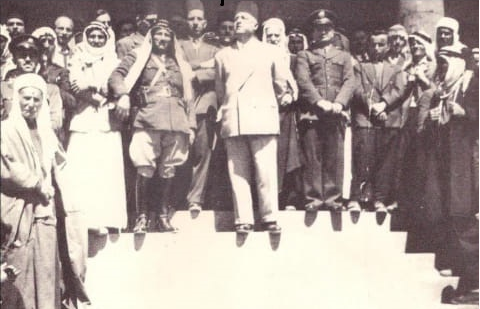
Governor of Jabal al-Druze
Due to his pro-liberation writings and staunch positions against the French Mandate over Syria and Lebanon, French authorities arrested Aref Al-Nakadi, and he was imprisoned in Lebanon. In 1945, President Shukri al-Quwatli issued a decree appointing Al-Nakadi as Director of Police and Public Security, before naming him President of the State Council on August 1, 1946. Later, he was named Governor of Jabal al-Druze in November 1948 and was tasked with ending the existing dispute between the Al-Atrash family and their rivals, who were supported by Prime Minister Jamil Mardam Bey. Days after Husni al-Zaim came to power, a decree was issued appointing Aref Al-Nakadi as Deputy Military Governor in As-Suwayda starting April 9 until his retirement on July 31, 1949.
Spreading Knowledge
Al-Nakadi spread knowledge among the members of his community, as Druze villages were yearning for the opening of schools, and they received what they wished for. He then founded Al-Duha magazine, which served as a platform for the voice of free thinkers and for writing and expression. He had established the Druze Orphanage in Beirut in 1941 before relocating it to the town of Aabey. He later established another home in As-Suwayda, which he handed over to the Syrian government upon his retirement in 1949. In Lebanon, he also renovated the Druze Dawoudiya School and affiliated 33 elementary schools with it, established a school for girls in Aabey named Al-Tanukhiyah School, and a coeducational school in Beirut named Al-Maaniah School.
The Academy of the Arabic Language
After his retirement, Al-Nakadi dedicated himself to writing and publishing, and worked at the Academy of the Arabic Language, where he had been elected an active member on March 26, 1923. He delivered numerous lectures, most notably "The Judiciary and Islam," "Andalusia: A Lesson and a Remembrance," and "Classical Arabic and the Vernacular." He was also entrusted with supervising the Academy's publications.
Aref Al-Nakadi authored and translated several works, including: The Dilemma of the East: The Liberated Arab Countries: Syria-Iraq-Lebanon (originally written in French by Khairallah Khairallah, and translated by Aref Al-Nakadi), printed at the expense of Al-Haqiqa newspaper, Beirut, 1920; Judiciary in Islam (a lecture delivered at the Arab Scientific Academy), Al-Maktaba Al-Arabiya, Damascus, 1922; A Summary of Sociology (a collection of lectures delivered at the Arab Law Institute), Al-Mufid Press, Damascus, 1925; Banu Ma'ruf in Lebanon; History of Prince Abdullah Al-Tanukhi; The Three Lebanese Movements in the Years 1841, 1845, and 1860; Economic Life (translation); Life of Muhammad (translation); Umar ibn Abd al-Aziz; and The United States of Europe.
Aref Al-Nakadi's articles attracted the interest of many leading magazines in the fields of literature and media. He published more than 140 articles across various journals, including: Al-Adeeb, Al-Thaqafa, Al-Irfan, Al-Muqtataf, and Al-Mawrid, in addition to what he published in the Journal of the Arab Scientific Academy in Damascus.
Aref Al-Nakadi passed away on March 23, 1975, and was laid to rest in his hometown of Aabey in Mount Lebanon. The Syrian Ministry of Education named a school in the Al-Midan neighborhood after Aref Al-Nakadi, and a street in the city of As-Suwayda was named after him in honor and appreciation of the distinguished services he rendered to the nation in the fields of science and knowledge.