
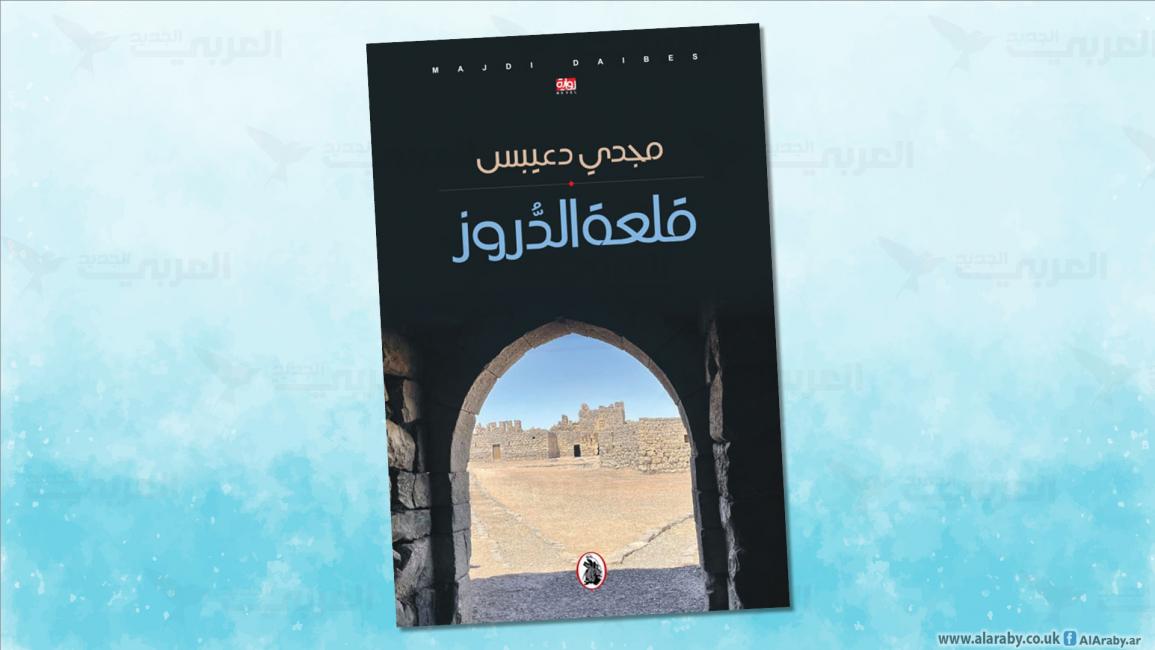
Due to its direct title, many readers mistakenly assumed that the novel “The Druze Castle” (Arab Institute for Research and Publishing, Beirut, 2021) by Jordanian author Majdi Deibes delves into the depths of the Druze faith and satisfies curiosity about its surrounding mysteries. While the narrative does make passing references to aspects such as the religious leaders (Sheikhs of the Mind), the five boundaries, and various customs and concepts of generosity, courage, chivalry, and aiding the distressed—part of the strict moral system that has long distinguished the Druze community—the novelist takes a different path. He reveals an exceptional talent for approaching history cognitively, creatively, and aesthetically, while breathing life into the setting as a fundamental element of the text.
The novel is the second part of a trilogy; the first, “The Salty Burden,” won the Katara Prize for Arabic Novel in its fifth edition. In “The Druze Castle,” Deibes continues to wander through the history of the Levant, telling the story of the Druze diaspora—those fleeing from Jabal al-Arab to the Azraq Oasis in northeastern Jordan. He highlights their role in revitalizing the region, investing in its resources, and establishing the city of Azraq at the beginning of the 20th century following the Ottoman withdrawal from Syria and the establishment of the Arab state under King Faisal. This was before the French Mandate arrived, killing and displacing the region's inhabitants, which sparked the Great Syrian Revolt led by Sultan Pasha al-Atrash in Jabal al-Arab. The author relies on historical documents, such as the memoirs of Abd al-Rahman Shahbandar, a key figure of that era and the strategic mastermind of the Great Syrian Revolt, as well as Farid Fayyad’s book, “Sultan Pasha al-Atrash: History of a Nation.”
Deibes tracks the features of this pivotal stage in the history of the Levant, showcasing the spirit of rebellion and resistance, as well as the harsh living conditions and the imbalance of power favoring the occupier—armed with the latest weapons—against the primitive arms and meager resources of the revolutionaries. Through the story of the Ajaj Abu Atta family, who lived in the village of Amtan in the southern Syrian mountains, the narrative unfolds. When the son, Nayef, accidentally kills a French soldier, the simple rural family overnight becomes hunted by a brutal superpower. This forces them to flee to the Azraq Oasis, a distant safe haven where some families from the mountain had already settled. It becomes their new homeland, as they trade their familiar life of farming for the profession of salt extraction and trade with neighboring villages. Nayef emerges as a free hero when he is captured, led away in chains by French soldiers to prison, only to escape his captors, hunt down a traitor, and kill him in revenge for his free comrades who were led to the execution block due to that traitor's tip-off.
Through the family's story, the author takes us on a compelling and enjoyable journey through time and space. He avoids playing the role of the omniscient narrator, instead leaning on the voices of the novel's characters to provide an integrated narrative where historical events serve as a backdrop for the characters' movements within a skillfully held space. This succeeds in drawing the reader into fast-paced events filled with suspense and excitement, making the work easily adaptable into a full-fledged television or cinematic drama, reminiscent of the project by the late Jordanian novelist Ziad Qasim in his masterpiece, “Sons of the Castle.”
The writer moves with great agility between eras, taking us back to the Roman period when the engineer Arneso built the Azraq Castle using slave labor on the ruins of a fortress built by the Nabataeans in an ancient time filled with passion. The aim was to create a fortress as an architectural masterpiece to protect the Roman Empire in the vast, stretching desert. The castle stands to this day as a witness to the greatness of human imagination and its ability to create beauty.
Majdi Deibes is a novelist in command of his tools, characterized by simple, profound, and dense language, and the ability to weave a tight narrative. At under two hundred pages, “The Druze Castle” is a stunning achievement, an important addition to the Arabic novel, and a work deserving of attention.
Source: Basma Al-Nsour – Al-Araby Al-Jadeed