
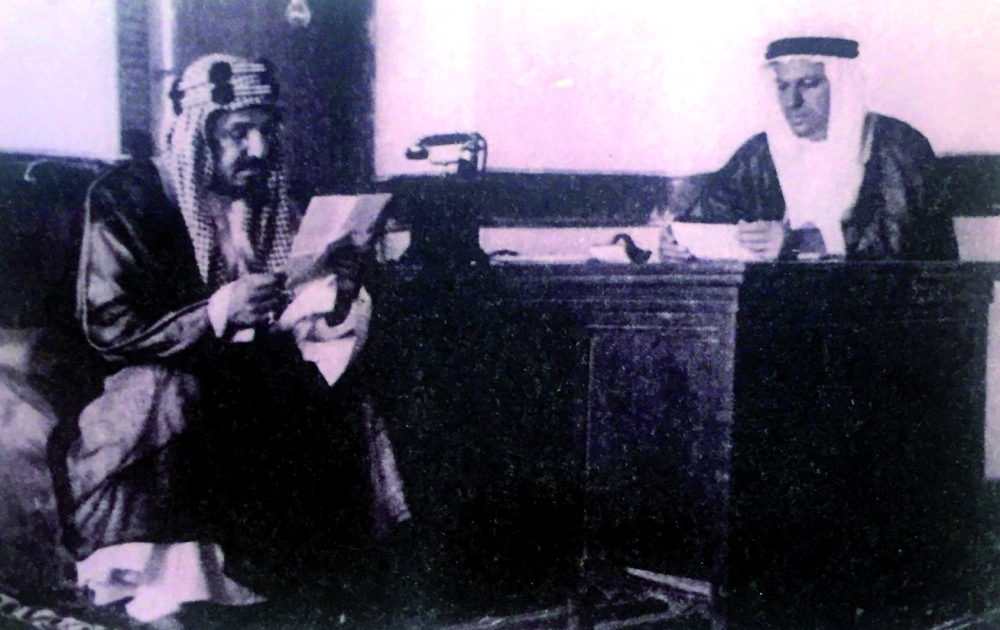
The Egyptian intellectual Mohamed Galal Kishk (d. 1993) said: «King Abdulaziz was the strongest individual to appear in the Arab nation during the past hundred years, believing that an individual does not build a state nor decide the fate of a nation. He knew that empires and great states were not established thanks to a talented leader, but rather a group of competent men at all levels, and this is what made him keen to win every talent and include it in his state».
King Abdulaziz realized early on his need for help in organizing the affairs of his nascent state from employees and advisors. He reached out to everyone who wanted the best for the Arabs and sought Arab independence, welcoming every Arab and considering his country a homeland for all Arabs. Among those whom King Abdulaziz recruited to work in his state was the Lebanese Fouad Hamza (1899-1951), whose memoirs and documents were recently published by the King Abdulaziz Foundation for Research and Archives (Darah) in two volumes totaling nearly 800 pages. On this occasion, we will shed some light on this Arab figure who was politically and culturally active in modern Saudi history.
His name is Fouad bin Amin bin Ali Hamza, and his nickname is (Abu Samer). He was born in 1899/1317 AH in a village in the Aley District of Mount Lebanon called (Abey). Fouad Hamza received his primary education in the village school, after which he moved to the Ottoman Teachers' College in Beirut, where he received his certificate with distinction. It appears he joined the American University of Beirut but did not complete his studies there.
He worked in the teaching profession during the Ottoman rule and was appointed director of the Model School in Tripoli, Syria. Later, due to harassment by French colonialism, he left for Syria in 1919, which was under the umbrella of Arab rule at the time, where he worked in teaching and was then appointed Inspector of Education in Damascus. He soon moved to Palestine due to the fall of Arab rule and the French seizure of Syria in 1920. There, he worked in education in several places, the last of which was as a teacher at the Rashidieh Secondary School in Jerusalem, while continuing his study of law, earning his degree in 1926. During that time, he was in contact with the Great Syrian Revolt led by Sultan Pasha al-Atrash in 1925. He did not realize it until one day he received a warning about the British Mandate authorities' intention to arrest him, so he left Jerusalem in a hurry for Cairo and remained there until relief came in the form of a telegram requesting him to come to the Hejaz to work in the independent state of King Abdulaziz Al Saud.
His Arrival in the Kingdom
Sources agree that the well-known Syrian leader Shukri al-Quwatli (d. 1967) was the reason behind Fouad Hamza joining King Abdulaziz's service, which Fouad Hamza confirms in his diaries, writing: «Shukri Bey had introduced me to His Majesty about a month ago while negotiations were underway between him and the British. The King asked him if he knew a young man who mastered both English and Arabic, and he informed him of me, so he instructed him to cable me to come here at once.» Indeed, he left Egypt when he received al-Quwatli's telegram to the Hejaz, arriving on 25/12/1926, corresponding to 20/6/1345 AH.
His Work After Arrival
Contrary to what some sources have stated and others have repeated—that upon his arrival he worked as a translator for King Abdulaziz—documents confirm that the first position Fouad Hamza held was (Assistant Director of Foreign Affairs) in Makkah, whose director was Abdullah Al-Damluji. His appointment was on 3 Rajab 1345 AH, only about two weeks after his arrival in the Kingdom.
He continued to serve as Assistant Director of Foreign Affairs until Al-Damluji resigned in 1347 AH/1928 AD, when a royal order was issued by King Abdulaziz appointing him Director of Foreign Affairs. He remained in his position until the royal order was issued to convert the Directorate of Foreign Affairs into the Ministry of Foreign Affairs, thus becoming the first ministry in the state's history. The position of Minister was entrusted to King Faisal bin Abdulaziz when he was a prince, and Fouad Hamza was appointed Undersecretary of the Ministry effective Tuesday, 26 Rajab 1349 AH/1930 AD.
He continued as Undersecretary of the Ministry of Foreign Affairs for about nine years until 1358 AH/1939 AD, when a royal order was issued to establish a legation of the Kingdom in Paris and appoint Fouad Hamza as Envoy Extraordinary and Minister Plenipotentiary. He spent more than three years in Europe, during which he was an eyewitness to its conditions during World War II, until the order was issued to appoint him Minister Plenipotentiary and Envoy Extraordinary to the Republic of Turkey in 1362 AH/1943 AD.
King Abdulaziz said to Fouad Hamza after his return, imagining that the King could have left him stranded in Europe during World War II: «By God and by God, we will not neglect you, God willing, and if something happens to you, we will not neglect your children, and we will instruct our children and our family not to forget your children and your family.»
On 6 Jumada al-Awwal 1366 AH/28 March 1947 AD, a royal decree was issued stating that based on the importance of the construction and development projects that were decided to be implemented for the benefit of the country, His Excellency Fouad Bey Hamza was appointed Minister of State and seconded to the Ministry of Finance for construction and development works and investment companies.
During his work, he held membership in a number of political and administrative councils and committees, including: the Inspection and Reform Committee 1346 AH, the Committee for Drafting Regulations 1346 AH, the Executive Committee to Assist the Attorney General 1347 AH, the Standing Committee at the Royal Court of King Abdulaziz 1349 AH, and the Council of Agents in 1350 AH.
His Political Role and Diplomatic Missions
If we know that Fouad Hamza, since his arrival in the Kingdom in 1345 AH/1926 AD, worked primarily in foreign affairs as assistant, then director, and finally undersecretary of the ministry until 1358 AH/1939 AD, it becomes clear to us that he was one of the pillars of building the state's foreign affairs apparatus, an eyewitness to the growth of relations, and a contributor to negotiations, agreements, and treaties. In his memoirs, he indicated that when he began his work in the Foreign Affairs Directorate, he found it consisted of only two rooms, as he devoted his efforts to finding an entity founded on a sound structure for a civilized and sophisticated government administration and worked to organize it.
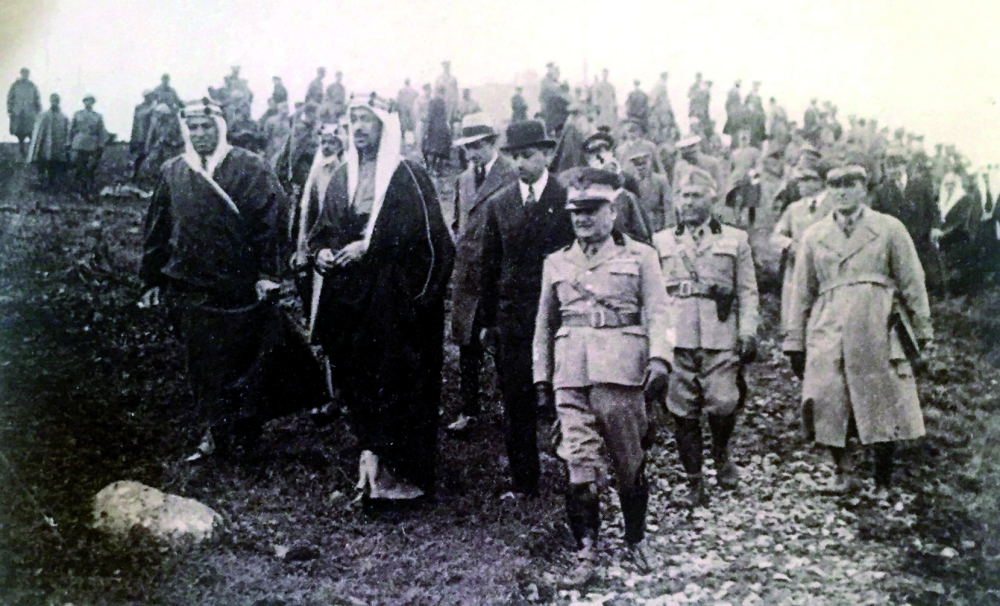
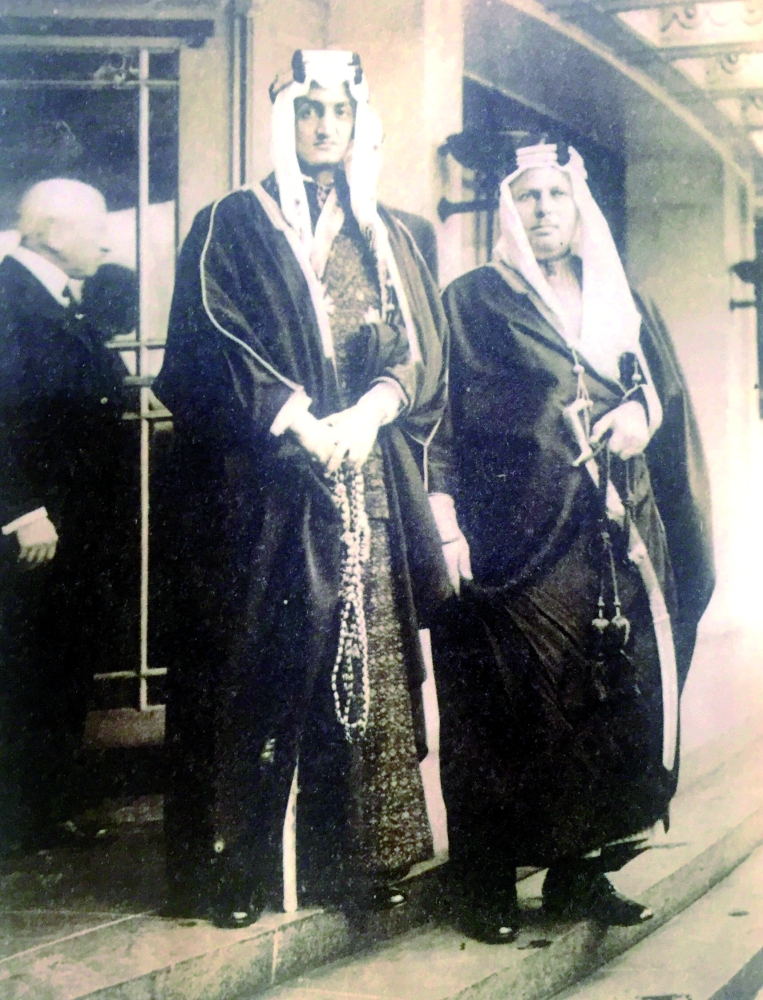
Among the most prominent political missions he undertook, in addition to being one of King Abdulaziz's advisors on state affairs, were: participating in the Saudi delegation to conduct preliminary official talks with the Iraqi government held in Kuwait in 1348 AH/1930 AD; attending King Abdulaziz's meeting with King Faisal, King of Iraq, in the waters of the Gulf aboard the ship Lupine; accompanying King Faisal bin Abdulaziz when he was a prince on his official trip to Europe in 1350 AH/1932 AD; representing the Saudi government in negotiations with the Emirate of Transjordan held in Jerusalem and signing the Treaty of Friendship and Good Neighborliness in 1352 AH/1933 AD; chairing the Saudi delegation at the Abha Conference in 1352 AH/1934 AD between the Saudi and Yemeni governments; accompanying King Saud when he was Crown Prince on his trip to Europe in 1354 AH/1935 AD; representing the Saudi government to discuss establishing official relations with Egypt and signing the Treaty of Friendship and Good Understanding in 1355 AH/1936 AD; membership in the Saudi delegation headed by King Faisal when he was a prince to participate in the Palestine Conference in London in 1939/1357 AH; membership in the official delegation accompanying King Abdulaziz on his visit to Egypt in 1365 AH/1946 AD; accompanying King Saud bin Abdulaziz when he was Crown Prince on his official trip to America in 1366 AH/1947 AD; and chairing the Kingdom's delegation to the UNESCO conference held in Beirut in 1367/1948 AD, among others.
His Cultural Interests
Fouad Hamza is considered one of the rare figures who combined politics, culture, administration, and law into one mold and dealt with them simultaneously, achieving clear accomplishments in each. He was undeniably a highly knowledgeable intellectual, and there is no doubt that his proficiency in several languages (English, French, and Turkish) helped him broaden his horizons and increase his knowledge. He published some articles in Arab newspapers before joining King Abdulaziz's service, and he continued writing and publishing afterward, noting that he published some of his articles under pseudonyms. In reality, Fouad Hamza was not just a writer, but a capable researcher with a clear interest in history, geography, and a penchant for maps and antiquities. Al-Zirikli points out that he was very diligent at work; no sooner would he finish his government work than he would take up research in history or politics to address. He was also a supporter of culture and intellectuals, which is evident through his known connections and close relationships with Arab scholars, writers, and orientalists, as well as his keenness to gift books to individuals and libraries.
His Works and Publications:
A- Heart of the Arabian Peninsula (Qalb al-Jazira al-Arabiyya):
This is his first printed book, published in Egypt in 1352 AH/1933 AD. He mentioned that what motivated him to write this book was his feeling that the Arab library lacked a comprehensive volume of the latest geographical, natural, and social information about the Arab countries, so he decided to fill this void. He included in his book the information readers need regarding general information about the Kingdom of Saudi Arabia, its provinces, and its dependencies. He indicated King Abdulaziz's encouragement for him to author this book, and the King ordered his Minister of Finance (Ibn Sulaiman) to purchase 500 copies of the book.
B- The Saudi Arab Countries (Al-Bilad al-Arabiyya al-Sa'udiyya):
Printed in 1355 AH/1937 AD, this was a book he wanted to make a concise guide to the conditions of the Saudi Arab countries. It contained unprecedented information about King Abdulaziz, his Crown Prince and deputy in the Hejaz, the royal family, and the conditions of the government, its departments, and its regulations. Because he noticed during his travels a lack of information about these countries, he saw fit to start filling this gap by creating a work indispensable to writers, merchants, travelers, literary figures, editors, pilgrims, and politicians. His book has become one of the most important historical sources in its category to the present day, and it gains reliability in what it conveys about King Abdulaziz directly, most importantly the story of his recovery of Riyadh.
C- In the Land of Asir (Fi Bilad Asir):
This book is considered travel literature because it is a vivid description of Fouad Hamza's trip to the land of Asir on an official mission in 1352 AH. His journey started from Taif through Khurma, then Rania and Bisha, to Asir. It is a comprehensive study of the social, geographical, and historical life of Asir. The manuscript of the book remained in the drawers and was not printed until 1370/1951 AD when Ibrahim Al-Shura convinced him to release it.
D- Description of Kemalist Turkey (1943-1945):
This book was printed with the care of his son Omar more than 60 years after his death, and it is one of the benefits of his work at the Kingdom's legation in Ankara. He delved into describing the new Republic of Turkey—language and creed—and the old—heritage and dreams—with the eye of an expert. He recorded his observations and sightings with precision and care, documenting them in this book which remained a manuscript until it was published by Dar al-Jadeed in 2013.
E- Papers, Documents, and Memoirs:
This has a story recounted by his son Omar, who stated that after his father's death in 1951/1371 AH, King Abdulaziz instructed the Saudi ambassador in Lebanon at the time to ask the family for some papers related to the Buraimi Oasis because they were precise and urgent papers. The response was made, but they did not ask for any other documents at that time. Thus, his papers remained in their drawers. Days and years passed (about 23 years) until the family friend, the mujahid, diplomat, writer, and Saudi researcher Fahd Al-Mark came to them in late 1974, delegated by King Faisal, who informed them of the King's desire to see Fouad Hamza's papers. As soon as possible, Omar collected and copied what he could and went to meet the King accompanied by Fahd Al-Mark and his uncle Tawfiq Hamza. He thanked him after contemplating the papers and recognizing his father's handwriting and ordered the formation of a committee composed of Rashad Pharaon, Midhat Sheikh al-Ard, and Tawfiq Hamza to study the memoirs and consider the possibility of publishing them. After a month, the committee recommended not to publish, citing the permanent Arab concealment: «Not everything known is written, and not everything written is published.» Thus, the memoirs were buried again and remained so until Jumada al-Akhirah 1422 AH/September 2001, when his son Omar bin Fouad received a letter from the patron of Saudi history, the Chairman of the Board of the King Abdulaziz Foundation, King Salman bin Abdulaziz—who was Governor of Riyadh at the time—including a request to deposit his father's papers and documents at the Foundation. Omar responded to the request, and then his son met King Salman in his office in the Riyadh Emirate and presented him with a printed draft of about 100 pages, explaining that it was part of his father's memoirs and that he wished to publish it. He referred it to the Foundation and requested it to communicate and coordinate to obtain the full memoirs and for the Secretary-General, Dr. Fahd Al-Samari, to prepare them for publication. The Secretary-General confirms that the Hamza archive is extremely rich, containing, first, his private correspondence, and second, hundreds of Ministry of Foreign Affairs and Political Division files as a result of his practical connections to them.
The King Abdulaziz Foundation published Fouad Hamza's memoirs at the end of last year, which are diaries he used to record in his notebooks, containing extremely important information about King Abdulaziz's personality, private life, councils, and daily program in Riyadh and outside it. It also touches on his style of management, governance, positions, policy, and how he dealt with his advisors. It also adds new information regarding international events during World War II and their relationship to the Arab world, as well as the political dialogues that Fouad Hamza held with politicians in Europe. Al-Samari points out that he did not exclude from the memoirs anything except the private aspects. However, it is noticeable that the memoirs/diaries are full of large time gaps that omitted dangerous political and historical events, and we know nothing about the reality of the gaps because they were not mentioned in the introduction to the memoirs. The memoirs came in two volumes, the first of which occupied 385 pages, while the second was attached with a large collection of photos and documents that occupied 220 pages. We can say that many of the documents are of great importance for the biography of Fouad Hamza in particular and for Saudi history in general, and their selection was very successful.
F- Manuscript Works:
Fouad Hamza left a considerable number of manuscript works that indicate his wide knowledge and diverse interests. However, some of these works are drafts that need editing, and some are incomplete research, including: a collection on the esoteric sects that worked their chisel into the structure of Islam; he intended, if God extended his life, to address their subject in a comprehensive, broad manner, provided that what he wrote would remain buried until God destined someone to publish it after his death because it would undoubtedly provoke the anger of many against him. We do not know where this dangerous collection went, as it was not mentioned among the drafts of his books and research preserved in the Foundation mentioned in the introduction to the memoirs. Among them is a letter about Souq Okaz, which includes a definition of Okaz in language and terminology, and in Arab history and literature, dated 1352 AH. Among them: The Origins of Writing, Snippets on the Arabian Peninsula, Summary of Roman History, History and Science of Civil Politics, Geography of the Mediterranean Region, Emirs of Makkah, Antiquities of the Peninsula Before Islam, and he also has research on dialects.
It is worth noting that Fouad Hamza's library, which was gifted to the Foundation, contains a collection of printed books totaling 1,257 titles, as well as 30 original rare manuscripts in various sciences and arts. Among them is a very rare manuscript, (Nashr al-Thana' al-Hasan al-Munbi' bi-Ba'd Hawadith al-Zaman min al-Ghara'ib al-Waqi'a fi al-Yaman) by Ismail bin Muhammad al-Washli, which is in the author's handwriting, and comments and seals in Fouad Hamza's handwriting were found on the margins of some of its pages. Among them is a manuscript of the Diwan (Saqt al-Zand) by the poet Abu al-Ala al-Ma'arri, a manuscript on jurisprudence titled (Al-Ahkam al-Mutadammina li-Fiqh A'immat al-Islam), a manuscript (Ghinyat Dhawi al-Ahkam Bughyat Durar al-Ahkam), and a manuscript (Al-I'lam bi-A'lam Bayt Allah al-Haram) by Muhammad bin Ahmad bin Muhammad al-Nahrawali, among other manuscripts that form an addition to the heritage and scientific library in Saudi Arabia. His library also contained a large collection of original photographs, most of which were taken outside Saudi Arabia as a result of Fouad Hamza's work in the diplomatic corps.
His Death
Fouad Hamza lived through a long struggle with illness from the prime of his youth due to a heart weakness, to the extent that he predicted in 1925/1343 AH that his life would not be long. He passed away on 22 Safar 1371 AH/22 November 1951 AD while receiving treatment in Lebanon at the age of approximately 52. He was buried in his village, Abey. Philby said: «His death was a great loss for Saudi Arabia, the country that adopted him.» Meanwhile, the official state newspaper mourned him and spoke of his virtues and deeds. He was known—may God have mercy on him—for Arab chivalry, political wisdom, and broad-mindedness. He was friendly, loved, and a lover of good deeds, and he was known for donating to charitable works and building mosques, schools, and others.
Source: Saudi newspaper Okaz – Saudi writer and researcher Qasim al-Ruwais