
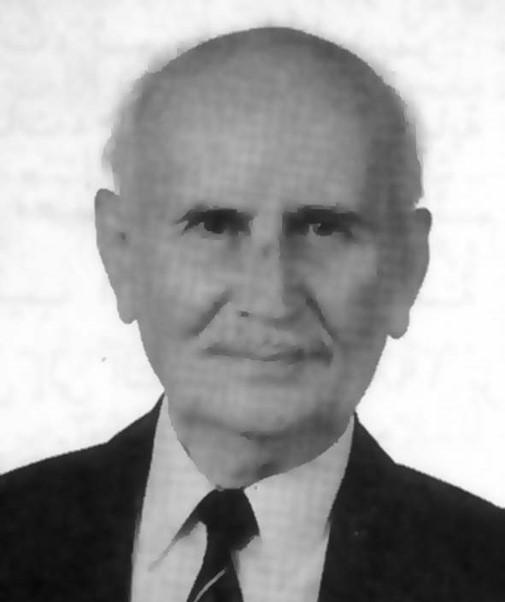
Mohammad Khalil Al-Basha, a Lebanese intellectual (1914-2009), was born in the town of Deir Baba in the Chouf region.
He completed his secondary education at the Patriarchal College in Beirut, and his university education at the Institute of Oriental Letters at the Jesuit College and the American University.
He worked as a French language teacher in several schools, then established the Agricultural Economy Company in Beirut, serving as its director and Chairman of the Board (1940-1943). He was then appointed to the Office of Statistics and Liaison, tasked with establishing the Regional Office of Statistics and Liaison in South Lebanon, and was appointed as its head, later serving in the same position in North Lebanon.
In 1949, he was appointed head of the Ministry of Supply in Beirut, then head of the Corporate Supervision Bureau, then head of administrative guardianship over investment interests, and finally Director of the Lebanese National Lottery in 1966. He retired in 1980 with the rank of Director General.
He ran for parliament in 1964 but withdrew. He was very active culturally, publishing articles, giving lectures, and participating in seminars and interviews. He holds the National Order of the Cedar, rank of Knight, among other decorations. He was a permanent honorary member of the American Scientific Academy and was awarded an honorary doctorate in recognition of his work.
He was a member of the Lebanese Writers Union, the General Union of Arab Writers, and the Pen Club.
Several celebratory events were held in his honor, and he authored a large number of books, the most important of which are: Dictionary of Druze Notables, Dictionary of Authors, Reincarnation and the Secrets of Life and Death, Man and His Wanderings in the Horizons, among others.
He wrote about notable figures and celebrities, and is counted among them in his book, "Dictionary of Druze Notables." He wrote about Monotheism and its characteristics, and reincarnation and its manifestations. He dedicated himself to pursuing knowledge, delving into philosophy, and keeping up with language, drawing profound wisdom and clear vision from sources of knowledge. In his writings, he formed a distinct hallmark in how to reconcile the love of learning with the love of giving, making him a prolific and diverse producer, as Judge Abbas Al-Halabi wrote about him in his book, "The Druze Monotheists."