

Exclusive to Kayan 24
Wonder inhabits you, and silence amazes you when poetry descends, translucent, from a cloud residing between the heart’s intuition and the soul’s eye, showering you with a barrage of meaning in its purest moments and most eloquent flashes, like an abduction into a celestial realm that does not descend. It is as if the wonder, often associated with a poetic moment, has with Talieh Hamdan surpassed the limitations of the moment to usher you into a permanence of wonder. As you hear him recite a Zajali poem, it flows from the nuances of a voice that keeps company with light in its highest degrees of brightness. He kidnaps you to the center of a ray of light and its pivot point, dazzling you with images that pour down upon you like a waterfall, increasing in intensity the more they are felt through love, passion, defiance, or spiritual expression.
A Poetic Exception
Thus, the giant poet Talieh Hamdan is a poetic exception in the art of Zajali and colloquial poetry. He pelts you with refined light, the fragrance of jasmine, and its deep whispering. He stirs within you a sense of perfume and scent as if, for the first time, you are hearing words charged with this sensation, taste, and poetic sensibility that make you feel a world of magic. He draws you into the chemistry of the moment, where the space of vision and the world of dreams intertwine, only for you to return from that poetic rapture to your own self, present among the audience of Zajali listeners and the readers of its soaring meanings. You then ask yourself the question that haunts your silence: Why, before Talieh Hamdan said those words in their captivating poetic context—with such delicacy, loftiness, and beauty—did we pass by them so normally? What did Talieh Hamdan do with those words that made them seem as if they were being born for the first time, inhabited by genies, girded with the abundance of expression, and the musicality of vocal tone that fraternized with Talieh Hamdan's voice, which rises above description? It is as if in his voice are the secrets of the gods of earth and sky, which Talieh Hamdan reveals to captivate the listener and leave them free, unafraid to fly, possessing the sensation to grasp the charms of splendor in their most magnificent manifestations.
Talieh Hamdan, who sang the poem and introduced it into every heart so that it might inhabit the listener, infiltrating their depths through the pores of the soul, sang for all people—lovers, dreamers, the intoxicated, militants, the wounded, the suffering, and the joyful. He did so with a talent that sat upon the throne of Zajali pioneering for six decades, contemporary in his beginnings with the greatest poets, and participating in the finest and most eloquent Zajali troupe ever known in Lebanon: the Zaghloul Al-Damour troupe, which also included the poets Zein Shuaib and Edouard Harb.
Talieh Hamdan possesses a large and vast poetic lexicon belonging to the field of spring, with an abundance of vocabulary such as spring, springs, trees, water, air, sun, daytime, and nature in all its elements. Therefore, Talieh Hamdan named the troupe he founded the "Spring Troupe," which was an icon of the platforms and the pearl of the depths of poetry and its immortal symphony.

His Upbringing and Birth
In the village of Ain Anoub in the Aley District, on January 19, 1944, the mountain and Zajali had a date with the birth of Talieh Hamdan. His father, Najib Hamdan, a native of the town of Ain Anoub, worked in agriculture, and his mother was Fatini Yahya.
Talieh Hamdan grew up and was raised in a family of 11 children. Like his father, he loved people and doing good; he inherited from his parents a love for people and living in the fear of God.
Talieh Hamdan was influenced by the characteristics of his village and its atmosphere, which historically was famous for its abundance of water springs—reportedly equal to the number of days in the year—and also famous for poets such as Elias Harb, Jamil Shujaa, Shafiq Shujaa, and George Harb.
Talieh Hamdan lived a life rich in beauty and poetry, where weddings in Ain Anoub were held amidst the presence of Zajali troupes. The *Qarradi* (a style of poetry) would flow on such occasions just as water creeps into thirsty land.
His memory fraternized with images of the masterpieces of Ain Anoub's nature, and within the folds of that nature, he wrote his most beautiful poems, beginning to recite them at village park parties by the light of a lantern with poets Saeed and George Harb. His memory also stored early on the *raddat* (poetic responses) of the Zajali poets Shahrour Al-Wadi and Ali Al-Hajj.

Poetic Genius
Talieh Hamdan began his education at the Ain Anoub Public School, and he often skipped school to attend the entire parties of Shahrour Al-Wadi, which negatively affected his studies, for which his father had warned him. However, the features of his poetic genius soon erupted in his debut parties, which he held with the poet Zein Shuaib, who had heard him singing at one of the village parties and admired his voice. That party was a duel between the two men at the Khalde Casino on the seashore in 1964. Talieh Hamdan's name emerged in the realm of poetry and Zajali. Then came the effective and influential breakthrough in 1965 with the Zajali poet Zaghloul Al-Damour, who admired him at that party, and they decided to work together in the Zaghloul Al-Damour troupe, which included the poets Zein Shuaib and Edouard Harb alongside them.
Since that time, most Lebanese regions had a near-daily date with that troupe to hold Zajali parties, which occupied a prominent position in celebrations that met with exceptional popularity in most Lebanese regions and countries of the world, where thousands of Zajali lovers would flock to them. It achieved a global leap in the diaspora countries such as the United States, Brazil, Argentina, Canada, Australia, and others, as well as in Arab countries such as Kuwait, Dubai, and Qatar, especially among the Lebanese and Arab communities, as it brought to the Lebanese longing, nostalgia, and Lebanese customs and traditions.
In 1959, he married Mrs. Salwa Eid, and they were blessed with four children: Shadi, who holds a degree in accounting; Zeina, a degree in business administration; Sahar, a degree in political science; and Khuzam, a degree in history.
The Spring Troupe
With the outbreak of the civil war in 1975, the troupe stopped its activities, and the parties were no longer held—the last of which was in the city of Ottawa, Canada, where its members bid each other farewell.
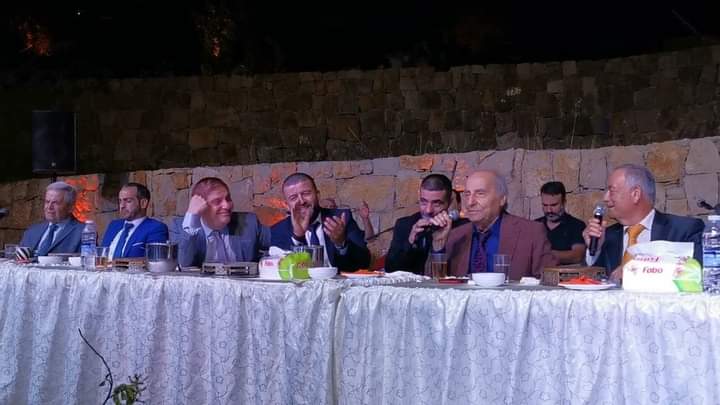
In 1976, the poet Talieh Hamdan established his own troupe and named it the "Spring Troupe," consisting of poets: Talieh Hamdan, Khalil Shahrour, Antoine Saadeh, and Nazih Saab.
The troupe held wonderful Zajali parties in various Lebanese regions, as well as in diaspora countries such as Canada, America, Australia, and the Arab Gulf. Hamdan also had challenge parties with poets Gerges Al-Boustani (in Batroun), Moussa Zoghbi (in Ain Saadeh and Amman, Jordan), Asaad Saeed (in Kfarhim), Sayyid Muhammad Al-Mustafa (in Ghazieh, Btater, and Khalde), and Zein Shuaib and Zaghloul Al-Damour (in Beiteddine).
The Spring Troupe shone in holding parties in Lebanon and abroad, and today it includes, alongside Talieh Hamdan, the poets: Victor Mirza, Nadim Shuaib, and Mazen Ghannam.
Most critics and writers consider Talieh Hamdan to be one of the greatest poets of Lebanese Zajali, distinguished by his possession of all the pillars of a platform poet, the most important of which are: voice, performance, and poetry.
Enthusiastic Poetry
Talieh Hamdan is distinguished by his enthusiastic poetry, his emotional tone, and his enchanting images, in addition to his compassionate voice. He became famous for two colors that characterized his Zajali personality: the first is romantic poetry addressed to women and nature, and the second is lamentation, which has moved millions to tears.
Hamdan confirms that Zajali for eighty years (i.e., since Shahrour Al-Wadi) has remained the same: the opening, then the *Qarradi*, followed by the dialogues, romance, *Ataba*, and *Shruqi*.
The poets Khalil Rokoz, Zein Shuaib, and Zaghloul Al-Damour each added two verses to the *Radda*, which was originally composed of two verses. The poet Khalil Rokoz also added the musical instrument, such as the *rababa*, which Mahdi Zaarour used to play in the fifties.
Until not long ago, the pen of the poet Talieh Hamdan was flowing, and he created the most beautiful romantic and descriptive poems. As the poet says, "He creates from his soul a renewal of the poetic image, or an image or a new idea that has not yet been addressed." He confirms that people are returning to listen to beautiful traditional colors, including Zajali.

Days and Memories
The poet Talieh Hamdan has several works and poetry collections, including:
"Rose Buds" (1990).
"Tables of Fragrance" (1995).
"Night and Moon" (1999).
"Wait for Me, I'm Coming" (2011).
"Openings of Talieh Hamdan" (2017).
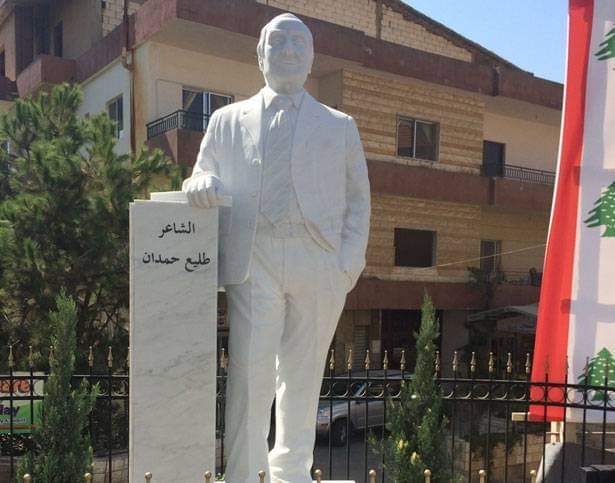
In recognition of his poetic contributions, unique talent, and creativity, a commemorative monument was erected for him in his hometown of Ain Anoub. The Zajali poet Talieh Hamdan has received several shields and medals, including:
The Order of the Cedar from President Emile Lahoud (2001).
An honorary shield from Prime Minister Rafic Hariri (2002).
A shield from the World Cultural University in Sydney, Australia (2007).
The Kamal Jumblatt Medal, presented by the National Library – Baakline (2013).