

As the Ottoman grip on the provinces within the Levant region loosened, and with the outbreak of uprisings in various places, the geography and terrain of the land became the deciding factor in containing insurgent movements and those fleeing authorities that had ruled for three centuries.
The Druze Unitarian community is one of the sects that rejected the restrictions imposed by most of the authorities that ruled the Arab region. Mount Hauran, or as it is known, Jabal al-Druze and Jabal al-Arab, located in the far south of Syria, was not a habitat for the followers of the Druze faith before the eighteenth century. However, after the intensification of revolutions, it transformed into a stronghold for those rebelling against Ottoman rule and the governors who ruled the country, and later a base for those rising against the French Mandate.
During the eighteenth and nineteenth centuries, Mount Hauran turned into a headquarters that attracted rebels from three provinces known for their defiance of the Ottoman Empire, where they fortified themselves in this stronghold—impenetrable to regular armies—which became known as the As-Suwayda Governorate after independence from the French Mandate.
Groups arrived in Mount Hauran from Mount Shouf after the famous Battle of Ain Dara between the Qays and Yaman factions in 1711, as well as after the events of the civil war between Christians and Druze in Mount Lebanon in 1860. Then, groups arrived from the Palestinian Galilee, from Safed, coinciding with the expansion of Sheikh Zahir al-Umar al-Zaydani in the Galilee provinces, from Safed to Acre, where the Druze had rebelled against him in those areas. He then pacified them before brutally cracking down on them and displacing them, committing horrific massacres, including the Tarbikha massacre in 1721. The third migration formed from Jabal al-Summaq in Idlib Governorate after 1810, and those groups were then called the "Aleppo groups." Despite their small numbers, they took control of the leadership of Mount Hauran, where the Al-Atrash family ruled, having wrested the leadership from the Shouf-based Hamdan family.
Ibrahim Pasha's Control
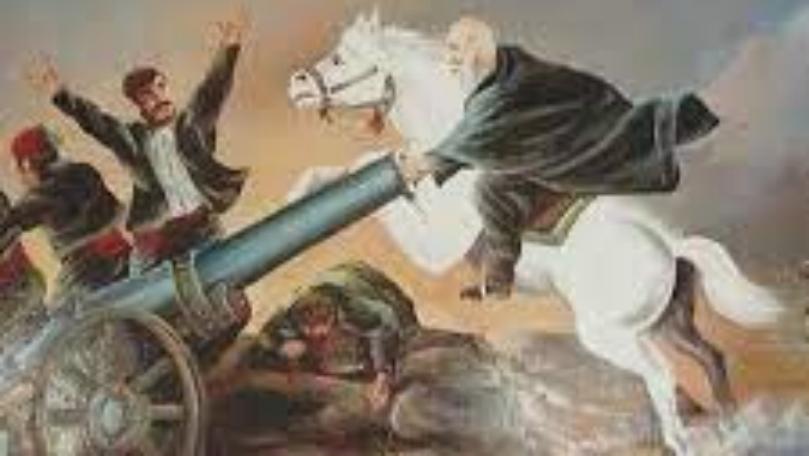
The forces of Ibrahim Pasha the Egyptian (1789 – 1848) were able to impose their control over the Levant. In 1831, a decision was issued for mandatory conscription of residents in cities and villages. This decision triggered a strong reaction from the inhabitants of the north and south of the Levant, who revolted against it. The largest of these revolutions was in Mount Hauran, which exhausted the Egyptian forces that suffered heavy losses—losses sufficient to dim the star of the Muhammad Ali dynasty's rule over the Levant. Stories of the heroic confrontations of the Druze are still told to this day, perhaps the most wonderful of which is the heroism of Sheikh Abu Ali Qassam al-Hanawi and his blocking of the cannon with his turban.
Perhaps the vivid literary description recorded by the Russian diplomat and eyewitness Konstantin Bazili, in which he briefly reviewed the facts of this revolution and its contribution to the retreat of Ibrahim Pasha and his army, and the shattering of his quasi-legendary image that shook the throne of the Sultans of Istanbul, is sufficient to visualize that era and the Druze's desperation in defending their dignity and prestige, as he says: "In 1837, the government requested seventy recruits from the Druze of Hauran. Their elderly sheikh was summoned to Damascus, and he tried in vain to plead for the exemption of his people from conscription. The Pasha's retinue insulted the sheikh insolently, so he intended to take revenge on the Egyptian soldiers and make them pay dearly for the insult they inflicted on his beard. The sheikh announced his willingness to help the government gather the recruits, but he requested for this purpose that they be accompanied by the largest possible military detachment. Ibrahim Pasha sent four hundred irregular cavalrymen with him to Hauran, who were received there with hospitality and welcome. On the first night, they were all slaughtered. Only the head of the detachment survived, who, while sleeping, heard the groans of the dying. He managed to escape through the window and informed the Pasha in Damascus of what had happened. Then the Druze began to move to the impenetrable Al-Lajat region."
Battles of Al-Lajat
Bazili recounts the events of the bloody battles in the rugged volcanic terrain of Al-Lajat, which cost Ibrahim Pasha's forces more than 15,000 of his regular army, a senior officer with the rank of Pasha, four officers with the rank of General, and sixteen commanders of regiments and battalions.
Bazili continues in a narrative style, adding: "The war dragged on, and by the order of Muhammad Ali, Mustafa Pasha, the governor of Crete, rushed to Syria to rescue Ibrahim Pasha with two infantry regiments and three thousand Albanians. The Albanians, who were raised on guerrilla warfare in Rumelia, were the only ones capable of fighting the Druze. However, after they were unable to defeat them inside Al-Lajat, Ibrahim Pasha decided to besiege the region from all sides and starve the rebels to death, which he failed to do. Light squads of Druze, wearing the uniforms of the killed Egyptians, would march in formation and deceive the army despite its alertness, seizing its provisions. Then Ibrahim Pasha resorted to another method: in one of his campaigns inside the dangerous area, he filled with stones and gunpowder explosions the only spring of life-giving water in the whole region, then advanced under the cover of heavy artillery to the bank of the ponds and filled them with the corpses of men and horses. This was in the hot summer of 1838. The water stank, but the Druze did not stop quenching their thirst and did not care about the taste of the foul water. Ibrahim Pasha found a way to poison the water; he threw several pitchers of mercury into those ponds, so terror gripped the Druze as they saw the sudden death of those who were still drinking water from the poisoned ponds..."
Pressure Tactic
The water war constituted a major pressure tactic to end the rebellion, as the Egyptian forces clashed with the Druze population and defeated the main rebel force in Wadi al-Taym. Intense efforts were made to convince the Druze leaders to negotiate peace with Ibrahim Muhammad Ali Pasha, as the Druze Sheikh Hassan al-Bitar from Rashaya and the Christian Jiries Abu al-Dibs mediated the agreement. Ibrahim Pasha agreed to grant amnesty to the rebels in addition to placing the Druze into forced labor instead of exempting them from conscription, in exchange for the Druze handing over weapons and Egyptian captives.
The agreement was signed on July 23, 1838. The Druze handed over their weapons willingly, but they were not the same weapons used in the fighting, which prompted Ibrahim Pasha to send his officers to demand the immediate surrender of the entire Druze arsenal, which took a long time. Meanwhile, small groups remained that refused to surrender their weapons, including Sheikh Hussein Abu Assaf in Al-Lajat, and Shibli al-Aryan in Mount Hermon, who later returned and took refuge in Baalbek before surrendering himself to the Egyptians.
When Shibli al-Aryan met Ibrahim Pasha, he offered his services as an irregular, and he was accepted into the Egyptian service. Shibli al-Aryan was later sent out of the country where he was appointed in Sennar, and later, 400 more Druze rebels joined the last 100 Druze rebels in the Lajat by 1839, and it was reported that they destroyed a village near Hasbaya.
Ibrahim Pasha's hegemony over Ottoman Syria shrank with the 1840 Convention, which was signed during the Second Egyptian–Ottoman War (1839–1841).