
Poetry confronts life with all its latent energies within poetic language, beginning the process of creation with a motive that may be obscure. If the poet were able to encompass everything within his soul, the poem would not exist, nor would poetry be born. Thus, the poem becomes the latent truth within his being, leaving the poet to collide with a great challenge: what are the limits of language? And to what extent is it capable of encompassing the poetic experience? This leads to another challenge represented by inherited methods of poetic expression, the flexibility of adapting language, and the modernization of these methods to suit contemporary issues, concerns, and interests.
As the beginnings of the last century formed a stage for the escalating intensity of the conflict between conservatives and reformers regarding the Arabic poem, especially in the second half of the Renaissance era, the poet and writer Amin Said Taqi al-Din made his poetic contributions to crystallizing a modernist concept of the poetic poem. Although his poems were dominated by the character of classical vertical poetry in terms of unity of meter and rhyme, the central question remains: what was Taqi al-Din's position in this conflict? And how connected was his poetry to the wave of renewal two decades before the appearance of modern poetry and the prose poem, or what is known as free verse? Was Taqi al-Din one of the poets who paved the way for poetic modernity in Lebanon?
Founders of the New Renaissance
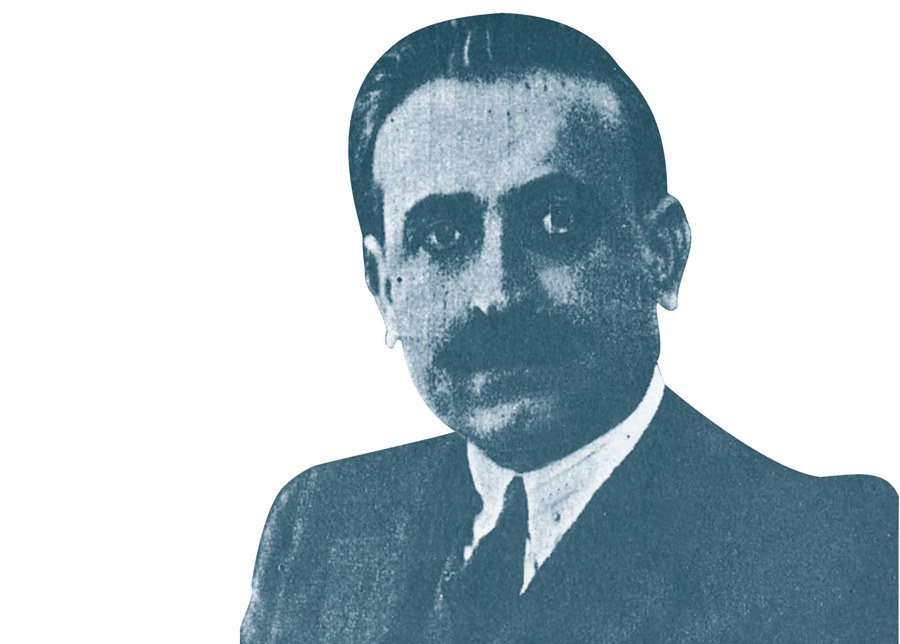
Amin Taqi al-Din is considered one of the founders of the new Renaissance and at the forefront of reformers regarding poetic language and the issues that preoccupied that era. If he had been able to devote himself to writing, Taqi al-Din would have been one of the most famous modern poets, but he was sparing in his poetic output on one hand, and his early passing had a fundamental impact on the fact that his poems were folded after they had reached maturity and begun to occupy an important space in public opinion and the press, as he was a journalist and writer in addition to writing poetry.
There is no doubt that the uniqueness of Amin Nakhleh lies in the sweetness of his words, the fluidity of his poetic visions, and his possession of a deep, at times pictorial and revealing language in many of his poems that took on a subjective and existential dimension, especially in the few poems in which he dealt with death in its existential dimension as if he were sensing his fate and feeling that life was slipping through his fingers. Meanwhile, the pictorial dimension manifested in his descriptive poems and his romantic poetry that dealt with nature, life issues, and the homeland. He enriched poetry with the captivating images that his genius possessed, which one can feel but cannot grasp the secrets of their charms. He did not abandon tradition nor did he drift into the current of imitating Western poets; rather, he was a reformer with extreme caution and precision, until readers began waiting to see what he would write next.
Upbringing and Birth
In the town of Baakline in the Chouf district, Amin Said Taqi al-Din opened his eyes in a house of science, culture, and literature, from a Druze family. He was born on November 7, 1884. His father, Said Taqi al-Din, held the position of President of the American University Alumni Association in Beirut. He entered school in his town, then moved at the age of seven to the Abey school, where he had the opportunity to learn the Arabic language at the hands of the linguist Ali Nasser al-Din. He then moved to the Hikmeh High School in Beirut, where he continued learning Arabic from the Arabic grammar scholar Abdullah Bustani. His talent for Arabic and French emerged, and then Taqi al-Din began studying English at the Syrian Protestant College, now known as the American University of Beirut. His knowledge grew richer, and his longing for freedom and independence increased. He then became a writer, poet, journalist, and lawyer all at once. After that, he traveled to Egypt and published the magazine Al-Zuhur there with Antoun Gemayel.
Persecution
Taqi al-Din traveled to the heart of the Ottoman Empire, Istanbul, which had been disturbed by the Arab Renaissance movement. He then went to Egypt, where he studied law at the office of Iskandar bin Amoun between 1910 and 1912, and collaborated with Antoun Gemayel in publishing Al-Zuhur magazine, which was a platform for prominent contemporary poets and writers and strengthened the national spirit.
Before the outbreak of World War I in 1913, Taqi al-Din returned to his homeland and stayed in his village, but the military authorities soon summoned him, as he had been sentenced to death in absentia. At that time, the authorities secretly advised Taqi al-Din to hide, as the commander of the Beiteddine gendarmerie was on his way to fetch him. Taqi al-Din took refuge in a farm owned by his parents on the outskirts of Baakline. There, he devoted himself to writing articles and poetry and translating a novel titled "The Story of a Poor Young Man" from French to Arabic. Before he could finish the translation—with only ten pages left—he passed away from a heart attack, so his nephew Khalil Taqi al-Din completed the translation.
He returned from Egypt to Lebanon in 1912 and married Nabiha Abd al-Malik, the daughter of Sheikh Amin Abd al-Malik, his cousin. Sheikh Abd al-Malik was attached to customs and traditions and requested that his daughter remain in Lebanon with her future husband, while Amin Taqi al-Din preferred to move with her to Cairo. Thus, Amin returned to Egypt alone and began corresponding secretly with his fiancée through his younger brother, Fouad, and Zafer Khalil al-Mashalani, who was a friend of Nabiha.
A Rich Career
After the end of the war and the imposition of the French Mandate on the country, the French authorities tasked him with supervising relief, and he was later appointed as a member of the court established to examine real estate sales and purchase transactions that took place during the war. Taqi al-Din spent two years in this position. Then, Taqi al-Din moved to Beirut and worked in journalism. He began writing for the newspaper Al-Bayraq, then the newspaper Al-Barq. He then established his own law firm in 1919 with his friend Gabriel Nassar, and it succeeded brilliantly until he became one of the most powerful criminal lawyers in Lebanon. In 1921, he served as Secretary of the Beirut Bar Association and also participated in founding the "Lebanese Youth Association" in 1920. He also joined the "Arabic Literature Society" and participated in founding the "Literature League," which Bechara El Khoury called for, alongside many scholars and writers with the goal of bringing together writers in Lebanon and the Arab world. He also participated in founding the "Hikmeh School Alumni Association," where he held the position of Vice President. He was also a member of the Druze Community Council. Taqi al-Din ran for parliamentary elections in 1925, 1927, and 1931, but he did not succeed. He also contributed to founding several local political parties and was involved in some of them for a period, including the "Democratic Union Party," of which he was a member, and the "Lebanese Front Party" alongside Youssef al-Sawda, Elias El Khoury, and Elias Baaklini, and the party's goal was to demand Lebanon's independence.
Amin's pleadings in court were characterized by his rhetorical brilliance, to the point that the head of the Criminal Court, Sheikh Mohammed al-Jisr, once told him: "Your rhetorical skills make me fear for the justice system. By using your arguments, you can make the wrong argument seem right."
Taqi al-Din was famous for his book Adab al-Muhamah (The Ethics of Advocacy) and his translation of Les Secrets Sanglants (The Bloody Secrets) from French by Jean de Castaigne.
Some of his poetry was collected by his son, Waseem. It was later lost during the bloody events of Beirut and was collected again by Najib al-Ba'ini recently. His drafting was described as carefully selected and elegant.
Death
In Beirut, on May 31, 1937, Taqi al-Din passed away due to a heart attack. His funeral was held in Baakline, and his name was given to one of the streets of Beirut in Tallet el-Khayat.
On January 10, 1968, a memorial festival was held for him at the UNESCO hall in Beirut, in which a group of poets and writers spoke about the thirtieth anniversary of his passing.