
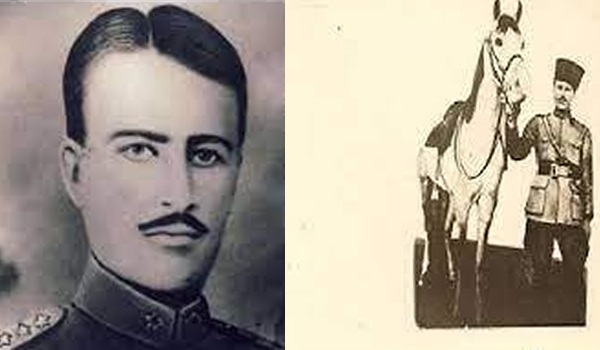
The brilliant leader Fouad Salim Bey published many articles in Arab newspapers and magazines, especially Egyptian ones, defending Syria and the Arabs. Prince Shakib Arslan mentions these writings in his eulogy, titled “A Powerful Voice for Fouad Salim,” stating: ” He was, in the field of battle, a roaring lion and a devoted hero; and in the field of debate, a profound scholar and a brilliant writer. Who among Arab readers did not admire his engaging and superb articles, which revealed extraordinary intelligence, logic of brilliant reasoning, wide-ranging knowledge, refined linguistic style, a spirit of unmatched high-mindedness, and a head filled with pride and dignity like no other? Whoever read his words knew his stature, even if they never knew his face.”
What Prince Shakib Arslan mentioned in this expressive piece, which encapsulates the journey of a leader and fighter who courageously confronted the Mandate, is enough to offer a glimpse into an exceptional personality who was strongly present on the stage of military and liberation events during the French and British colonial periods, until his martyrdom in the village of “Suhayta” in the northern Golan, before the southern slopes of Mount Hermon. There, a Lebanese woman would travel on a specific day from Lebanon to that place to place blooming flowers on a marble grave inscribed with the name of the martyr “Fouad Salim,” the father of that woman who used to cross distances and dangers so that her father's name would remain immortal, and her feelings and affections toward him would remain aflame, before the annual visit was interrupted by the occupation of the village of “Suhayta” by the Zionist entity in 1967, the displacement of its inhabitants, the total destruction of the village after leveling it to the ground, and consequently, the destruction of her martyr father's grave.
Among the images that remain etched in the mind and conscience... is the sight of a middle-aged woman who would travel on a specific day every year from Lebanon to Damascus, and from there westward to the northern Golan before the southern slope of Mount Hermon, specifically to the village of (Suhayta)... and stand before a grave with marble slabs, placing a bouquet of fresh flowers on the headstone upon which the name of the martyr “Fouad Salim” was written.
His Upbringing
Fouad Salim was born in Baakline, Shouf, Lebanon in 1894, and his family's village was (Jbaa Al-Shouf). His father was the official physician of the Shouf district. Fouad Salim received his education at the American University of Beirut, then worked as a teacher for several years. After the outbreak of the “Great Arab Revolt” against the Turks in 1916, he joined it. He achieved this after the armies of “Faisal bin Al-Hussein” entered the city of Aqaba in July 1917, so he set off from Mount Lebanon to Jabal al-Arab, where his relatives from the village of (Al-Mujaymir) helped him reach eastern Jordan, and he presented himself to Prince “Faisal,” who assigned him to clerical work in the army command.
Fouad Salim was not satisfied with staying away from the battles, so he requested a transfer to the army's combat units and the sabotage detachments, which targeted the Hejaz railway line to prevent the Turks from using it.
Magnificent Heroism
Fouad Salim recorded magnificent feats of heroism in battle, which led to his promotion to the rank of Captain, and he remained an officer in the Arab government army that was formed in Damascus after the defeat of the Turks.
Fouad Salim continued the struggle against the French, leading rebel factions in the Bekaa and Wadi al-Taym (Rashaya, Hasbaya, and Marjeyoun) against French forces. Fouad Salim's name appeared in the clauses of the famous (Gouraud Ultimatum), which was directed to the Arab government in Damascus, demanding that the government stop the activities of these rebels.
In the Battle of Maysalun on July 24, 1920, Fouad Salim was at the forefront of the fighting officers who held their ground amidst the intensity of the battle. On that day, the heroic leader “Yusuf al-Azma” was martyred, and he himself was exposed to bullets and death several times, but he miraculously survived.
The leaders of the Arab rebels moved to eastern Jordan after the French crushed the walls of the nascent state in Damascus. He continued his work in the “Arab Army” and became the Chief of Staff of that army with the rank of Colonel, leading the officers belonging to the Independence Party, which worked to organize ranks to fight the colonialists.
British colonial influence exerted pressure to expel these free men from Jordan, including Fouad Salim. He headed to the Hejaz and then to Egypt, where he resided in Cairo and wrote for its magazines and newspapers.
The Syrian Revolt
Fouad Salim joined the Great Syrian Revolt in the summer of 1925. The British tried to prevent him from traveling, but he left in his own way, crossing the Sinai desert on a camel. He reached Palestine, swam across the Jordan River, and entered Jordan secretly. From Amman, he took his brother Nasri and they left for Jabal al-Arab, where he joined the leadership of the revolution and participated in the Battle of (Al-Musayfirah), becoming one of the pillars of the revolution.
He began working with a number of rebels to expand the revolution to include most of the Syrian territories. It was agreed that Fouad Salim would undertake the organization of rebel movements in the Al-Balan region and Wadi al-Taym, on both sides of Mount Hermon, so that the French forces would be disrupted and forced to distribute their troops and efforts across more than one front.
The revolution in the Al-Balan region and the southern slopes of Mount Hermon, connected to the northern Golan, had erupted, and the rebels of the Al-Balan region, led by the Mujahid Asaad Kanj Abu Saleh, requested reinforcements from the General Command of the Revolution.
These reinforcements were sent in the form of a campaign of rebels led by the Mujahid “Zaid al-Atrash” (brother of Sultan Pasha al-Atrash). Colonel “Fouad Salim” assumed the role of Chief of Staff of the campaign. The campaign made the village of “Majdal Shams” its headquarters and expanded from there into the northern Golan and towards Wadi al-Taym, liberating Hasbaya, Marjeyoun, and Rashaya in magnificent heroic battles to which Fouad Salim contributed all his experience and courage. He was the mastermind behind the national leaflets issued by the campaign to explain the goals of the revolution under the wonderful slogan: "Religion is for God, and the Homeland is for all."
Following these victories achieved by the rebels, the French armies launched a campaign to occupy Majdal Shams, the rebels' base. The French campaign also launched from Quneitra towards Majdal Shams, occupying the villages of (Buq'ata and Majdal Shams) and destroying them despite the heroic resistance of the rebels. As they approached Majdal Shams, the rebels fortified themselves, and “Fouad Salim” oversaw the organization of rebel defenses around the village. Clashes began on 1/12/1925, and decisive heroic confrontations occurred in which the rebels showed great courage.
Martyrdom
On the third day of this battle, Fouad was leading the rebels on the eastern flank of the defense front for Majdal Shams, west of the village of Suhayta, when he was hit by an artillery shell in his head. He was received by the campaign leader, Zaid al-Atrash, and breathed his last in his arms. This was on Thursday, December 3, 1925. His blood watered the soil of the Golan, and the French forces were defeated and pursued until Quneitra, suffering 500 casualties at the time.
Dr. Abd al-Rahman al-Shahbandar said in his eulogy: “If a sound mind is joined by rare courage, and sincerity is the link between them, it appears before us in the person of the nation's martyr... Fouad Salim.”
The martyr commander (Muhammad Saeed al-Aas) also eulogized him, saying: “Fouad was a hero among the noble, gallant champions, and one of the best men of the cause. He defended the entity of his homeland with his sword, his pen, and his mind. He was an example of sacrifice; he sacrificed his life, his position, his wealth, and everything dear to him for the sake of the freedom of Syria in particular, and for the sake of the independence of the Arabs in general. If we weep for Fouad, we are weeping for knowledge and sacrifice; we weep for chivalry and courage; we weep for loyalty and generosity; we weep for pride and dignity; we weep for ambition and nobility; we weep for steadfast determination and eternal courage. We have lost a trained, wise, and seasoned leader, and time is stingy with his like. May God have mercy on my heroic colleague and grant him paradise.”
Fouad Salim triumphed over the French weapons that killed him and over the Zionist bulldozers that destroyed his grave, transforming into an immortal historical and intellectual symbol.