

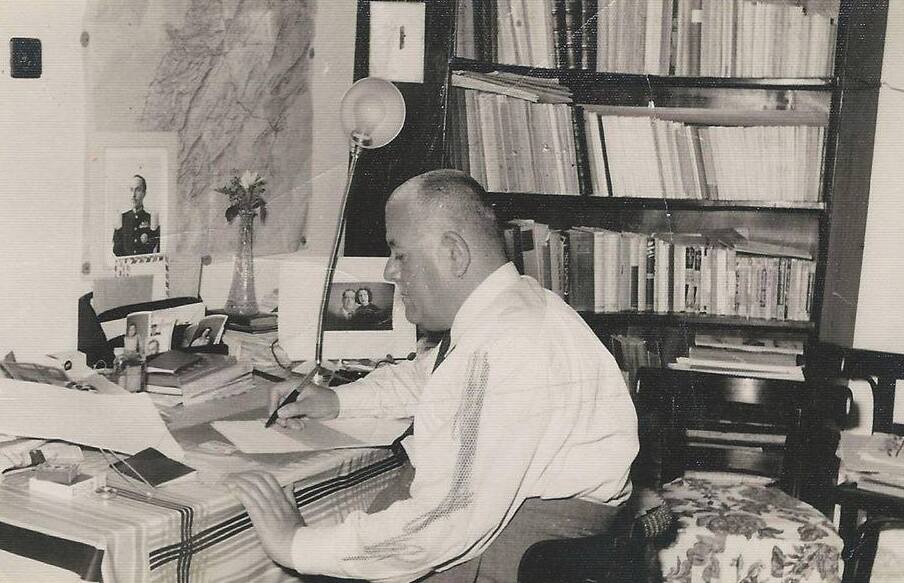
Many events rocked the Arab region as a result of major transformations witnessed by the world, which directly affected the Arab territory during a historical era subject to major turning points, the most dangerous of which was the division of the Arab region and its subjection to the French and British Mandates.
The Lebanese historian, writer, journalist, and translator, a native of the town of Ras al-Matn, did not look at those events and transformations as a mere recipient of events or someone in harmony with the de facto authority. Rather, he chose to be at the forefront of the intellectuals and writers who resisted with their positions and words, and resisted with their ideas and rifles against the Mandate, and later against colonialism.
The Arab National Movement
Perhaps his book is one of the most important and first books that addressed those issues and confronted them, as he did not stand idly by in the face of what was happening. He was one of the most prominent men of the Palestinian Arab national movement and a key player in founding the Arab Independence Party and in providing the elements for Palestinian-Jordanian unity through the central conferences that were held at that time. He lived in Jerusalem for a quarter of a century of struggle and fighting against colonialism.
Ajjaj Nuwayhed, who traveled to all Arab countries, never set foot on Western soil; he did not visit any European or American country, but he had achievements and stories in every Arab country, starting from his birthplace in Lebanon, passing through Damascus where his political journey began, reaching Jerusalem, which embraced him and opened its heart and arms to him to spend the prime of his youth and his revolution in those places, and not ending with Amman, the capital, which he made his refuge after the 1948 Nakba, before returning in the late 1950s to the land of the cedars until his death.
Historical Memoirs
Ajjaj Nuwayhed has historical memoirs characterized by realism, objectivity, and accuracy. These memoirs are closely linked to the march of the Palestinian people and their struggle against colonialism, as they narrate events as the author lived them, and with the fervor of those who made them, from Palestinian and Arab figures. He was aided in documenting and experiencing them by his presence alongside the Mufti of Palestine, Haj Amin al-Husseini, who appointed him Secretary-General of the Supreme Muslim Council in Palestine and then Inspector-General of the Sharia Courts. He also participated in a conference in Mecca as Secretary-General of the Palestinian delegation headed by Haj Amin al-Husseini.
The "Memoirs of Ajjaj Nuwayhed" are considered the reliable reference for covering that period with its events and occurrences, and for reading and understanding contemporary history with a critical and conscious eye that later great historians relied upon. It documents the movement of political forces that had an influential role in the fate of what was happening, whether they were local or foreign forces, from prominent personalities, political leaders, opinion leaders, men of thought, literature, religion, media, and leaders.
Ajjaj Nuwayhed documented these memoirs with the help of his daughter, Bayan Nuwayhed al-Hout, in the spring of 1980, as he dictated to her what his remarkable memory had retained, stopping the dictation of the memoirs at the borders of the 1948 Nakba. As for the period after the Nakba up to 1980, his daughter, Dr. Bayan, found it in his private files and papers. These memoirs were introduced by his son, Dr. Khaldun Nuwayhed, who was a prominent intellectual who immigrated to Venezuela as a result of the Nakba events and was able to secure a leading position at the cultural, media, and academic levels.
Moving to Damascus
Ajjaj Nuwayhed was born in the town of Ras al-Matn in the southern Mount Lebanon in 1897 and finished his studies in its schools. He then moved to Damascus upon the arrival of Prince Faisal to Syria, where he joined the Arab Club, which included influential personalities and figures such as Adel Osseiran, Ali Rida al-Rikabi, Sati' al-Husri, Abdullah al-Najjar, and others. However, after the French occupation of Syria and their mandate over it, and as a result of the events of the Battle of Maysalun, he moved to Jerusalem out of his belief in the necessity of resisting the colonization of Palestine after the conspiracy against it was revealed. He completed his studies there at the Institute of Law in Jerusalem and worked as a lawyer. He married "Jamal Salim Nuwayhed," and they had their daughter, Bayan, and son, Khaldun.
After the Nakba, four conferences were held, culminating in the establishment of unity between what remained of Palestine and Jordan in Amman, Jericho, Ramallah, and Nablus. Ajjaj Nuwayhed had a pivotal role in their convening, especially in the Palestinian conference held on October 1, 1948, in Amman to discuss the unity of the two banks, with a large Palestinian, Arab, and Jordanian presence. A Palestinian executive committee emerged from it to follow up on the idea and implement it, and resolutions were issued, most notably calling for Jordanian-Palestinian unity, calling on Arab armies to continue fighting in Palestine, calling on Arab governments to supply Palestinians with weapons, and calling for a (broader) Palestinian conference in which the people of Palestine announce their allegiance to King Abdullah as King of Palestine.
Then, the second conference was held two months later at the invitation of the Military Governor-General Omar Matar in the city of Jericho, chaired by Sheikh Muhammad Ali al-Jaabari. It came up with proposals calling for the annexation of what remained of Palestine, i.e., what became known as the West Bank of the Jordan River, to the East Bank under the Hashemite crown. The delegation went to the Al-Musalla Palace in Shuna, and Ajjaj Nuwayhed delivered a speech before King Abdullah in which he said: "The conferees in Jericho have agreed to pledge allegiance to Your Majesty so that the remainder of Palestine may be under your throne." Then the other two conferences were held in Ramallah and Nablus, respectively, until the unity was achieved under the banner of the Hashemite crown in the name of the Hashemite Kingdom of Jordan in 1950.
Al-Arab Magazine
Ajjaj Nuwayhed founded Al-Arab magazine in Jerusalem, which was published for three years, then he refrained from it upon the advice of the Mufti. He also worked as a correspondent for the Egyptian newspaper Al-Ahram, as director of the Arab Radio in Jerusalem during the Second World War, and held the position of Director of Publications and Publishing in Jordan.
As a result of the occupation of Jerusalem and the displacement of Palestinians, as his home was in West Jerusalem, he moved to live in Jordan until 1959, when he decided to return permanently to Lebanon until his death in 1982 during the occupation of Beirut. He was not buried in his town until five days after his death, where he was buried in the garden of his house in Ras al-Matn.
Dar Al-Istiqlal for Studies and Publishing issued, on the occasion of the twenty-fifth anniversary of the passing of Ajjaj Nuwayhed, a book titled "Ajjaj Nuwayhed - Ras al-Matn: History and Memories." Among his works are "The Tanukhids," "Sixty Years with the Arab Caravan" (published by the Arab Institute for Research and Publishing), "Abu Jafar al-Mansur and the Arabism of Lebanon," "The Conquest of Jerusalem," "Men from Palestine: From the Beginning of the Century until 1948" (Al-Karmel Press, 1981), a number of articles, two volumes, translation (Arab Institute for Research and Publishing), and the translation of the book "The Present of the Islamic World" by the American Lothrop Stoddard.