
Prince Al-Sayyid Jamal al-Din Abdullah al-Tanukhi was born in Abeih in the ninth century AH (around 1417 AD). He was a descendant of an ancient, noble family that traces its origins back to the Buhtur and Tanukh clans. Nu'man ibn al-Mundhir ibn Ma' al-Sama', one of his ancestors, was one of the greatest kings of al-Hirah and a descendant of Qahtan, the progenitor of the Arabs. His mother, Princess Rima, hailed from the same family. He was named Abdullah and later adopted the title Jamal al-Din.
The Prince Al-Sayyid was born into an authentic Arab house belonging to a high social and political stratum, in the political capital of the Buhturid Tanukhid Emirate. Although born into a noble Arab family, he was raised by his mother's family after losing his father at a young age.
Exceptional Ability
From childhood, he was distinguished by sharp intelligence and an exceptional ability to learn. He devoted himself to studying sciences and religious biographies, gaining a good reputation in the eyes of religious scholars who discovered in him ideal abilities and exceptional qualifications.
The Tanukhids ruled Lebanon throughout the Middle Ages in a thorny political climate. They were among the first to respond to the call of Tawhid (Monotheism) and the Druze mission.
The Tanukhids
In fact, the Tanukh tribe was formed from three Christian Arab families: Bahra, Taghlib, and Tanukh, from which the Tanukhids emerged, settling in northern Syria and western Lebanon in the areas of Beirut since the beginning of the Arab conquests.
They converted to Islam in 165 AH (741 AD), and then embraced the Druze faith in the early eleventh century. However, despite everything, they never ceased to defend their Arab identity and their belonging to Islam.
In the eleventh century (408 AH / 1017 AD), in Fatimid Egypt, the call of Tawhid emerged. This era, and the one that followed, was marked by hostility between the Fatimid Caliph and the Caliph of Baghdad, who struggled politically and religiously, vying to secure control over the Arab world. In the heart of this conflict, the Levant suffered from the weight of the ambitions of its powerful neighbors, serving as a gateway for the Fatimids to Baghdad, as it was an inevitable passage in the center of the Islamic world. Sovereignty over the Levant was contested successively by the Seljuks, the Crusaders who arrived in Syria in the late eleventh century, the Mongols, and the Tatars, until the Mamluks reached power.
The scene we have reviewed shows the thorny conditions in the Arab world where chaos, wars, and divisions prevailed. This historical overview allows us a deeper understanding of the repercussions of this difficult situation on the Druze Unitarians, who had not yet formed an independent community. In addition to the impact of this chaos on the social level, the followers of the Druze faith themselves adopted many concepts foreign to their doctrine.
The Emergence of the Prince Al-Sayyid
In the midst of the current situation, the stature of the Prince Al-Sayyid grew due to his wisdom and distinction, and people flocked from everywhere to be enlightened by his advice. He urged people to build and restore mosques, ordered the recitation of the Quran according to its rules and principles, and called for the rejection of forbidden acts and the acquisition of good qualities.
He dedicated one day a week to his students to preach and teach them the Druze path, so they would in turn become qualified to spread the mission and preach in their villages. His extreme kindness extended to other religious groups because he considered that all humans are children of God.
This brilliant success and his vast knowledge aroused the envy and anger of the wicked, but he did not seek to confront them; rather, he chose to move to the Levant to spread his wisdom and offer advice to the men of Sharia and scholars. He resided in these lands for twelve years, gaining the respect and appreciation of all.
Prince Al-Sayyid possessed a very rich library that contained about 340 manuscripts, and he had numerous writings. His most famous work is known as "Sharh al-Amir al-Sayyid" (The Commentary of the Prince Al-Sayyid), which is a 14-volume work.
In the history of Bani Ma'ruf, he holds the top position among those who donated their legacy to a charitable foundation, and he is the one who established the Druze Endowment Foundation (Waqf).
The Prince's Work in Reviving the Tawhidic Path
1 The Druze Endowment Foundation
Prince Al-Sayyid noticed the increasing number of people wishing to learn, yet most of them did not have the means of living. This situation raised his concern that people would fall prey to ignorance, corruption, and illiteracy. He was overcome by a struggle between the desire to quench these people's thirst for knowledge by establishing schools in villages—and the associated costs and teachers' salaries—and letting the social and religious situation head toward the abyss. This, he would never accept.
Upon his appointment as the spiritual leader of his community, his focus shifted to the values of the society in which he lived, considering that all reform must pass through education in schools and mosques, and by inviting people to follow the spiritual path.
In order to cover the high expenses resulting from this project, Prince Al-Sayyid decided to donate his properties, so he transferred the ownership of his wealth to the Endowment Foundation and named the beneficiaries of the usufruct rights, under a document certified by the Sharia Court. If we read this document, we perceive unparalleled generosity, complete detachment from material matters, and a readiness to give that has few equals.
For example, Prince Al-Sayyid expressed his desire to dedicate his houses for the residence of students attending the school, especially orphans, and to donate the usufruct of his properties to the poor and miserable so they could cover their needs. He indicated the purpose of his donations: teaching the Quran, restoring mosques, and building water springs. He also specified the categories of people and the exceptional conditions that entitle them to benefit from these donations: miserable and orphaned Muslims regardless of their origins or affiliations, widows who did not remarry, and prisoners and captives.
2 Reviving the Tawhidic Path
After several centuries had passed since the call, the Druze Unitarians found themselves confused by various interpretations. On this very level, and within this delicate framework, the work of Prince Al-Sayyid proved essential, whether in terms of morals, Druze personal status, or the organization of the Tawhidic path.
On the Level of Morals
The construction and rehabilitation of mosques, in addition to the establishment of schools that opened their doors to everyone without any charge, contributed to a true educational renaissance. When it was impossible to build new schools, Prince Al-Sayyid sent his students to teach the illiterate, both children and adults. He also sent them to meet with sheikhs and officials to exchange knowledge related to the affairs of the path and spiritual sciences.
Prince Al-Sayyid recommended certain rules of conduct, and he was keen to adhere to them himself before anyone else. He forbade lying, false oaths, mockery, adultery, murder, alcohol, usury, and especially following governments without any opposition. He also advised against wearing luxurious clothes and excessive enjoyment of transient gains, and urged people to act with humility and not to object to God's will, especially when losing a relative. In conclusion, he established the foundations of religious tolerance that ensure social justice.
As for the religious level, he emphasized the principle of justice throughout his life and in his writings—thanks to which the Druze Unitarians always boasted that they were the sword of Islam—he established a social system for the Druze Unitarians that puts the "good of the community" above all concerns and interests, in realization of a concept launched by Prophet Muhammad himself.
On the Level of Personal Status
Prince Al-Sayyid directed a cultural message to his contemporaries among the followers of the path, urging them to fulfill the "binding condition from the Imam." Every Druze or Unitarian responsible for a female Unitarian should consider her his equal, sharing everything he possesses with her.
Prince Al-Sayyid, having lived among the members of his sect and known their social conditions, noticed that many of them rejected the Imam's text and avoided applying it, ignoring the wife's rights and treating her without the duty of equality ordered by the Imam. Since there was no written text dealing with the issue of relations between husband and wife, and defining the rights and duties of each, the Al-Tanukhi Prince worked to draft legislation that commits to justice and equality. He established the legislation on a religious basis, a duty imposed by God, and a pillar of certainty, which is mutual consent and the free choice of the spouses. This condition became essential for understanding, compatibility, harmony, love, affection, tolerance, and forgiveness between spouses.
Without detailing the marriage laws, we would like to confirm here that this institution, i.e., the family, is the primary means for the connection between man and woman. Marriage embodies their commitment to respect their duties toward each other and their keenness to fulfill them. It carries within it the legislation that defines the framework of the relationship between spouses, which if neglected, the spouses are no longer safe from the injustice and transgressions of the other partner, and marriage no longer remains a means of cooperation and participation in bearing the burdens of married and social life.
On the other hand, the Prince directed his interest and thought toward the subjects of personal status. He defined the will as everything we order to be executed ("we bequeath it"), and everything we leave behind ("we inherit it") during our lives and after our death. He left the Druze Unitarian the full and absolute freedom to bequeath his properties to whomever he wishes, whether a direct heir or an indirect one, a Druze Unitarian, a stranger, or from another sect.
Since the Prince always adhered to everything he commanded in order to provide a good example, he was keen to bequeath a house, lands, a portion of the olive harvest, and oil revenues to persons who were not entitled to that, to a Christian family from the Sarkis clan.
All of the above highlights the visionary dimension that characterized this prince who has few equals: 600 years ago, he said that a woman is equal to a man, at a time when European society, for example, did not consider women capable of responsibility; and he granted full freedom regarding wills and inheritance, according to a rule with no equal in the law of any other sect, at a time when other sects prohibited the transfer of ownership to persons belonging to another sect, except in the case of reciprocity.
On the Level of Organizing the Tawhidic Path
The work of Prince Al-Sayyid focused, fundamentally, on organizing and reviving the Tawhidic path. Without expanding on this subject, I will suffice with mentioning the main headings covered by this "revival" process:
- Establishing a spiritual evaluation system on the behavioral and cognitive levels based on the apparent meaning.
- Clarifying the issue of the relationship of the Druze path to other Islamic jurisprudential schools.
- Reinterpreting the concepts of the Druze doctrine in general, through his commentaries and interpretations.
- Establishing a comprehensive cultural curriculum, through his method of interpretation.
- Emphasizing the possibility for the Druze Unitarian to attain perfection in the midst of society and the world, not by isolating himself from them.
- Emphasizing the internal balance of the Unitarian in the face of rigid external behavior.
- It is mentioned in his biography that the states of his era distinguished between school learning, memorization, and science. This means that he launched a cultural renaissance that solidified the foundations of spiritual and social reform.
In our day, the Druze Unitarians consider Prince Al-Sayyid a great Imam. Therefore, they honor and revere him as one of their saints. No one else among his contemporaries possessed a sharpness of intelligence that qualified him to spread the message of Ijtihad (independent reasoning). He called for the openness of Ijtihad and its liberation because he considered that every law must be interpreted according to the conditions of the time and place of its application, that is, according to the development of the customs and ideas of its era and environment.
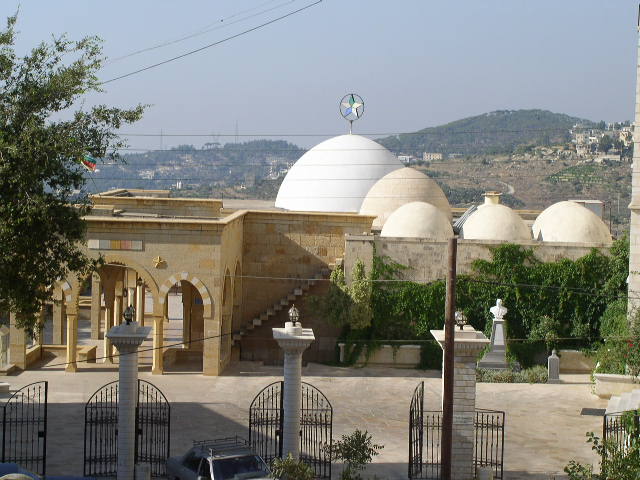
The shrine of Prince Al-Sayyid in Abeih constitutes a primary destination for the members of the sect around the world.
Reference: An excerpt from the book "The Druze Unitarians: Culture, History, and Mission" – Minister and Judge Abbas Halabi