

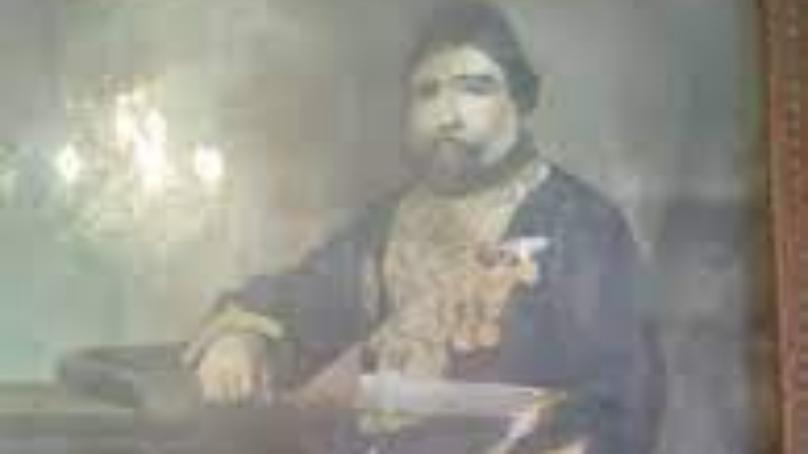
Sheikh Shibli al-Arian spent a significant part of his life in battles and confrontations on the fields of combat, defending dignity, honor, and land, while rejecting all forms of dependency, subjugation, and submission. He lived his youth as a rebellious insurgent and a courageous hero on the fields of war, struggle, honor, and pride. He answered the call of duty on more than one occasion, even managing to form an irregular Druze army to confront the dangers that the Bani Ma'ruf were often exposed to, whether in Syria, Lebanon, or Palestine.
Shibli al-Arian, a son of the town of Rashaya, his birthplace and the home of his family, was distinguished by moral qualities, values, and stances that made him a symbol among the great leaders, men of opinion and counsel, and a knight among the knights of heroism and chivalry. He lived adorned with religious upbringing, which is why he was titled "Sheikh." He possessed a calm and balanced nature and was a man of vast influence, having fought in Wadi al-Taym, the Iqlim al-Ballan region, Hauran, and Al-Jah. He stood against Omar Pasha the Austrian in Lebanon when he arrested a large group of Druze notables and dignitaries in 1842 AD.
Shibli al-Arian fought Ibrahim Pasha when he attacked the Druze in Hasbaya, Rashaya, and Banias. He divided his group into three divisions in preparation to repel the attack; in Banias, he relied on his cousin Khuza'i al-Arian, and he appointed his other cousin, Ahmad al-Arian, as commander of the second division in Rashaya. Together with Sheikh Mahmoud Talhouk, he oversaw the defense of Hasbaya. Those divisions succeeded in inflicting defeat upon Ibrahim Pasha's army, which was a mixture of Arabs from Nablus and Upper Egypt.
Following the withdrawal of the Egyptian campaign from Syria, the Ottoman Turks appointed him in Iraq and granted him the title of Pasha as a reward for repelling the armies of Ibrahim Pasha the Egyptian. He became a governor (Wali) in the Amara province. Thereafter, he was appointed ruler of Baghdad, where he initiated urban and social projects whose traces remain visible to this day. The Turks also commissioned Shibli Pasha to confront the Kurdish movement that was unsettling the state.
Upon his return to Lebanon, he was welcomed as a heroic champion, which frightened the officials in the Turkish government due to his growing influence among the people of Lebanon in general and the Druze in particular. Consequently, Turkey worked to ignite the fires of sectarian war.
A Plot Against the Druze
Omar Pasha the Austrian, who was the governor of Mount Lebanon, proceeded to draft petitions attacking the Shihabs, the rulers of the country under the authority of the Sublime Porte. A number of the local inhabitants signed these petitions under duress, bribery, and forgery. The conspiracy failed, and the governor soon denied it, as the forgery of those petitions became clear and the role of the Ottomans behind them was exposed. At that time, the cooperation between the Lebanese Patriarch and the Druze leaders intensified, and they declared their rejection of Omar Pasha's request to send Druze divisions to fight the Christians in Zahle and Keserwan. This wise, national stance became a cause for the distancing between the Ottomans and the Druze. Omar Pasha then decided to organize a plot against the Druze leaders, requesting to meet them in Beit ed-Dine. Upon their arrival, he arrested them, disarmed them, and sent them to prison in Beirut. They were Emir Ahmad Arslan, Emir Amin Arslan, Sheikh Naaman Jumblatt, Sheikh Said Jumblatt, Sheikh Daoud Abd al-Malik, Sheikh Yusuf Abd al-Malik, Sheikh Hussein Talhouk, and Sheikh Nasif Nakad. With the help of some Christian officials, some of them escaped, which angered the Pasha, so he sent letters to the Christian districts warning them of the dangers of the Druze. However, a number of Druze and Christians met with the Patriarch and issued a joint statement affirming that it was in the interest of the Druze and Christians to ensure mutual peace in Lebanon, and they established a pact among themselves.
Following this, Shibli al-Arian sent a letter to the Ottoman governor demanding the release of the Druze leaders imprisoned in Beirut, the restoration of the situation in Lebanon to how it was under Shihab rule, and recognition of the pact established between the Christians and the Druze for love and brotherhood. This forced the governor to send a delegation to negotiate with Shibli al-Arian, composed of Said Fatiha and Muhammad Pasha. They asked al-Arian to withdraw from the Chouf to avoid a catastrophe for Lebanon. Shibli al-Arian stipulated, in return, the release of the Druze leaders, a three-year deferment of tax collection in the Mountain, a halt to the decision to disarm the Mountain, and the restoration of the country under the rule of the Shihab family.
The governor rejected these terms, and fighting broke out between the Ottomans and the Druze in the south, and between the Ottomans and the Christians in the north. The country practically united, and both sides agreed to appoint Emir Asaad al-Shihabi as ruler of the country. The Turks and the British were furious at the unity of the people of that land. Thus, the influence of Shibli Pasha and his men succeeded in establishing security among all Lebanese, despite the Ottoman occupier. The Ottoman governor returned and requested negotiations. Shibli said to the negotiating delegation: "The Druze know that the Sublime Porte wants nothing but to destroy them." Shibli Pasha explicitly accused the head of the delegation, Salim Pasha, of being the mastermind behind the strife between the Lebanese, and that the state must immediately pay for all losses incurred by the Druze and Christian villages.
He said: "As Druze, we cannot lay down our arms until after Omar Pasha is removed and the Druze leaders detained in Beirut are released." Indeed, the Ottomans retreated, released the Druze leaders, and Omar Pasha was recalled to Istanbul and dismissed immediately at the end of 1842 AD. The battles had lasted for months at that time, in addition to other battles he fought in defense of Druze dignity and chivalry. History records that he was one of the heroes of the Bani Ma'ruf, the son of Sheikh Ali al-Arian and his mother, Sitt Nour-Bariq. Thus, Shibli al-Arian spent the prime of his youth and most of the years of his life on the fields of battle and war.
It was said that he always recited Al-Fatiha before mounting his horse. He passed away at the age of eighty in the year 1870.