

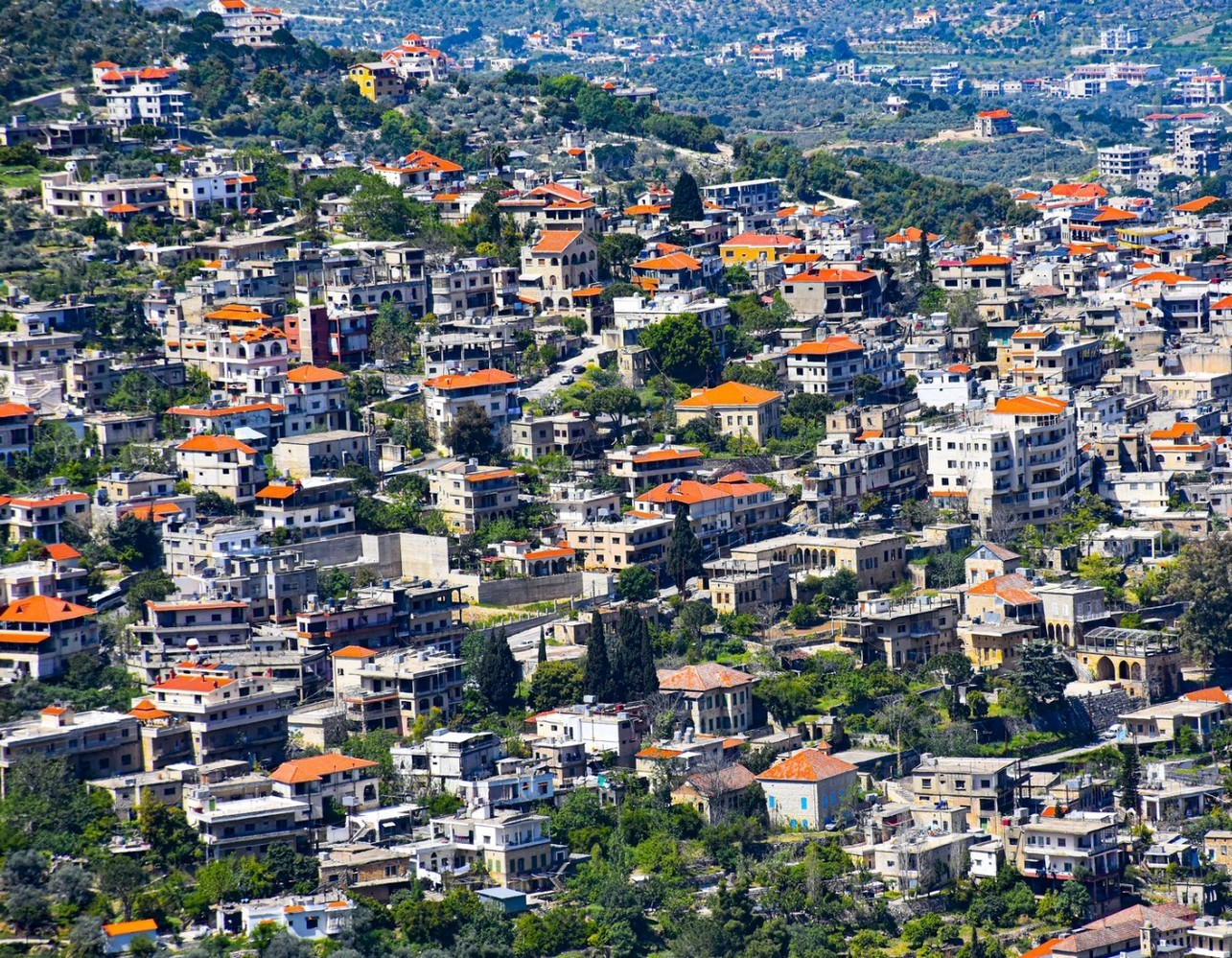
Perched on a slope opening onto the horizon, at the gateway to Southern Lebanon, facing the towering Hermon with its lofty Sheikh mountain, and within sight of the Galilee and occupied Palestine, amidst the expanse of the Marjeyoun plain and the heights of Mount Amel, stands the city of Hasbaya with its glorious history, strategic location, and sacred status—a sanctity derived from the noble Khalwat al-Bayada, the qibla and Kaaba of the Druze monotheists, along with its serene hermitages in Hasbaya and its villages, and its ancient churches. It settles peacefully between hills, mounds, plains, and streams, opening its heart to all the civilizations that passed through, stretching its arms to everyone who sought it as a visitor or resident from families deeply rooted in history, ingrained in belonging, living in fraternity with the enchanting beauty and nature, and rising above the enemies who invaded and destroyed some of its landmarks but could not break it. Thus, it remains embracing the mountains, befriending the hills, and harboring the history it has accumulated in monuments and architecture, with towering ancient stones, castles, palaces, houses of worship, markets, and tiled roofs.
Origin of the Name and Location
The writer Anis Frayha mentioned that the name Hasbaya is derived from a Syriac word meaning "land of pottery" or "village of jars."
Hasbaya was also mentioned in the Old Testament, in the Book of Joshua, as the land of the sons of Gad, referring to the religious monument erected at its base, which was an altar to the god Gad or Baal-Gad. During the era of the sons of Jacob, Hasbaya was called the land of the sons of Reuben, one of the brothers of Joseph the Just, whose tomb remains a place of pilgrimage for blessing at the bottom of the town.
It was mentioned in the Book of Joshua that the inhabitants of the land of the sons of Reuben stood against the Hebrews, confronted their king Saul, and prevented them from advancing toward Hama, as they fought fiercely to defend their sanctities, including the altar of Baal-Gad. The French historian René Dussaud says: "Hasbaya was a center for the worship of Baal among the ancient Syrians, where a large monument was erected to Baal-Gad, or Gad, which is the same as Baal-Hermon, which gave the mentioned site its great name."
A number of Roman and Greek historians spoke about the holiness of Baal-Hermon to the inhabitants of those lands, where its importance lies in a sanctity equal to that of the cities of Jerusalem and Mecca.
The historian Ibn al-Ibri points out that the Prophet Seth, son of Adam, upon the arrival of his son to the happy life that his parents had in Paradise, retired to Mount Hermon for worship and asceticism. This confirms that Hasbaya is one of the major towns whose name is linked to the symbol of heavenly unity in Lebanon; it includes four churches representing all Christian denominations, as well as a synagogue for the Jewish faith, a mosque for the Sunni sect, and the Khalwat al-Bayada for the Druze Unitarian sect.
Multiple Civilizations
Hasbaya knew multiple civilizations, from Canaanites, Phoenicians, and Hebrews, then Arameans, Assyrians, Persians, and Greeks, followed by Arabs and Nabataeans—who gave their name to Nabatieh—then Romans and Byzantines, whose آثار (remains) are clearly visible in sections of the Shihabi Serail.
The writer Ghaleb Saliqa mentions in his book "History of Hasbaya and Its Surroundings" that Jesus Christ might have visited the town of Hasbaya and blessed it during his missionary travels, reaching Sidon and Tyre, and stopping by the Mount of Transfiguration, Mount Hermon."
It is believed that the Crusaders, led by Count Raymond of Saint-Gilles, entered Hasbaya in March 1099 before continuing their way to Jerusalem.
In the same book, the historian Saliqa recounted that he heard from some reliable Sheikhs that Hasbaya was initially a small monastery at the site of the Shihabi Serail, located at the head of the town, which confirms that Baal-Gad was the site of the aforementioned Serail. The Crusaders transformed Hasbaya into a barony administratively linked to Sidon and militarily to Beaufort Castle (Qalaat al-Shaqif).
A relationship of friendliness and friendship prevailed between the Shihabi Emirs and Sultan Saladin. When alienation prevailed between the Sultan in Egypt and his master, King Nur ad-Din Mahmud Zengi, whose center was in Damascus, the Shihabis expressed their fear and anxiety and made a decision to go to Egypt. But the King reassured them, so they changed their minds and settled in Wadi al-Taym, in the desert of Dahr al-Ahmar, while the southern part of the valley was under the Crusader barony of Hasbaya.
The Crusaders brought about 50,000 fighters after their suspicion of what happened, and the Shihabis also prepared for the battle. The fighters of both sides met at Souk al-Khan, and a fierce battle took place. After a few days, the Shihabis were able to enter Hasbaya, occupy its castle, and expel the Crusaders, which earned the admiration of Sultan Saladin, who took power in Damascus, so he appointed Emir Munqidh al-Shihabi over Hasbaya.
In the early 14th century, the Mongols swept through Wadi al-Taym, but Emir Saad al-Shihabi confronted them. He returned to Hasbaya after the Mongol wave calmed down in the face of the Mamluk blows, after they had burned Hasbaya. He lived with his family outside the village and began repairing houses and resisting a severe epidemic that killed many of them, led by Emir Saad, who died in 1321.
After the Battle of Marj Dabiq in 1516 and the Ottoman takeover of our lands, Sultan Selim I granted Emir Mansour al-Shihabi the rule of Wadi al-Taym, just as he did with the Ma'ni Emirs in the Chouf. In 1618, Emir Ali al-Shihabi rushed from Hasbaya to Sidon to welcome Emir Fakhr al-Din II al-Ma'ni returning from the lands of the Franks. When Emir Fakhr al-Din decided to fight the Sayfa family, Emir Ali supported him at the head of a group of Hasbaya's sons in that great victory.
A dispute occurred between the brothers Ahmed and Ali al-Shihabi, so Emir Fakhr al-Din intervened and mediated peace between them in Machghara. Ahmed received the upper part of Wadi al-Taym in Rashaya and its villages, and Ali received the lower part of Wadi al-Taym, i.e., Hasbaya and its villages.
In the Battle of Ain Dara in 1711, the Shihabi Emirs supported Emir Fakhr al-Din II with more than a thousand fighters from the inhabitants of Wadi al-Taym. The victory went to the Great Ma'ni, who, in recognition of the valor and courage of the Wadi al-Taym fighters, especially Emir Ali, the Emir of Hasbaya, presented the largest share of the spoils of war to the Shihabis.
On his way to Banias and the Ajloun region in 1628, Emir Fakhr al-Din II stayed as a guest of the Shihabis in Hasbaya.
When the Ottoman Sultan Murad IV ordered the elimination of Emir Fakhr al-Din II and his future aspirations, two large naval and land campaigns were launched against him. When Ahmed Kuchuk, the commander of the land campaign, arrived in Sa'sa' in Syria, he sent a large part of his forces to Hasbaya with the intention of punishing the Shihabi Emirs, many of whom fled to the Chouf. Then he burned Hasbaya and some of the surrounding villages and stationed himself at the Khan near the Hasbani River. On the opposite bank of the river, Emir Ali bin Fakhr al-Din II camped, and the terrible battle of Souk al-Khan took place between the two parties, in which Ahmed Kuchuk was victorious. When the news of the battle reached Emir Fakhr al-Din II, he hid in the cave of Shaqif Tiron and then moved to the cave of Jezzine, where Ahmed Kuchuk found him and captured him along with the rest of his children and sent them guarded to Istanbul, where he was killed two years later.
The Shihabis
The Shihabis returned to Hasbaya after it was burned and destroyed, and after power was secured for Emir Melhem al-Ma'ni in the Chouf. In 1660, the Wali of Damascus, Ahmed Pasha Köprülü, rose to fight the two Shihabi Emirs in Wadi al-Taym, Ali, Emir of Rashaya, and Mansour, Emir of Hasbaya. They fled with the Shihabi family to Keserwan, while the Wali's forces swept through Hasbaya and Rashaya, destroying their buildings, burning them, and wreaking corruption and ruin. In 1666, after the rule of the Ma'n family was secured in the Chouf, the Shihabis returned to Hasbaya and Rashaya.
In 1684, Emir Musa, Emir of Hasbaya, died, leaving behind Emir Haydar, who is considered the founder of Shihabi rule in the Chouf.
After Emir Haydar bin Emir Musa al-Shihabi al-Hasbayani took over the Emirate of the Chouf, Hasbaya remained politically and administratively independent from this emirate.
The French Mandate
At the beginning of the twentieth century, the notables and sheikhs of Hasbaya enlisted under the banner of the Arab Kingdom when its establishment was announced in Damascus under the presidency of King Faisal, son of Sharif Hussein. This was preceded by the departure of delegations of the town's notables on June 7, 1919, to meet the King-Crane Commission resulting from the Paris Peace Conference and to demand complete independence for Lebanon and Syria together. When Hasbaya was brought under the French Mandate, some of its inhabitants rebelled and entered the government Serail and burned the records.
By virtue of Decree No. 299 issued on August 3, 1920, by General Gouraud, the French Governor in Beirut, the four districts of Hasbaya, Rashaya, Bekaa, and Baalbek were separated from the Vilayet of Syria. Then, by Decree No. 318, Gouraud announced on August 31 the establishment of the State of Greater Lebanon from the Mutasarrifate of Mount Lebanon, the four aforementioned districts, and the Sanjaks of Sidon, Beirut, and Tripoli. The first signs of the French Mandate's interference in the internal affairs of the State of Greater Lebanon was the decision of the French Governor in Sidon, Charpentier, in 1920, to attach Hasbaya to the Qaimaqamiyah center, which was officially established in the new administrative division in 1925 by making Jdeidet Marjeyoun the capital of the district. At that time, the people of Hasbaya submitted a protest petition signed by most of the townspeople from various sects.
During the Druze Revolution of 1925 against the French Mandate, the Hasbaya district had a fair share of revolutionaries who used the town of Hasbaya as a base for them. The French army entered the village and set fire to many of its houses in addition to stealing and looting it. The people of Hasbaya did not sleep on injustice, so strong men among them launched repeated attacks on the French occupiers and inflicted heavy losses on them. After nine months of their forced departure from their village, they were able to return to it at the beginning of July 1926 after negotiations with the military governor and at the instigation of the higher authorities in Paris. During the Second World War, Hasbaya was a refuge and haven for the people of the region who were exposed to the harshest ordeal as a result of the conflict between the Allies and the Vichy forces. Pastor Hanna Hardan wrote in his book "Delicious News about the Marjeyoun-Taymi Families," describing that stage: "When the people of Marjeyoun fled to Hasbaya, among those who opened their hearts before their homes in particular were the Druze of Bani Ma'ruf, people of chivalry, aid, generosity, and gallantry. They provided the greatest evidence that the sons of the homeland are equal in adversity."