

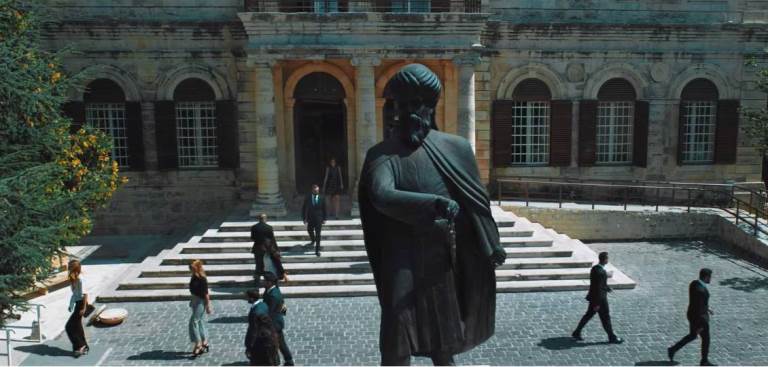
The town of Baakline in the Chouf District houses the largest library in the entire country, containing 140,000 books and about 300,000 publications. It dates back to the Ottoman era, when it was a palace built during the time of Sultan Abdul Hamid II in 1897, then it transformed over the years into a court, then a municipal center, and then a prison, before being renovated and turned into a library with the support and supervision of the former head of the Progressive Socialist Party, Walid Jumblatt, who restored the building, founded the National Library in Baakline, and gifted it to the state. This remained the case until 1996, when the government decided to place the library directly under the Ministry of Culture.
In Baakline, which is about 45 kilometers south of the capital, Beirut, and rises about 900 meters above sea level, the Ottoman Serail, inaugurated in 1897 during the reign of Sultan Abdul Hamid II, still stands in the center of the town as a witness to many historical stages of modern Lebanese history. It was built to be a seat of government, and in 1986 it was converted into a public library after having been used as a school, a courthouse, and a municipal center.
Visitors to the library, which is considered the largest and richest public library in all of Lebanon, are greeted by the Ottoman seal and emblem that still adorn the entrance of the building, accompanied by two lines of Arabic poetry about the date of the construction of the "Ottoman Serail." They then enter the corridors and sections which, despite their restoration and renovation, still exude the fragrance of history blended with the "Lebanese, Arab, and Islamic heritage" found in the library.
In addition to the library, Baakline is home to the "Hamidi Sabil" (a water fountain), which still stands tall on one of the hills, dry of water and in need of much restoration, maintenance, and attention. It is topped by a plaque confirming that it was built during the reign of Sultan Abdul Hamid II in 1308 AH (circa 1890 AD).
Like the Hamidi Sabil, a historical cemetery dating back to the same era sits on the slope of the same hill that houses the water fountain.
Additionally, a statue of the historical leader, Prince Fakhr al-Din al-Ma'ni II the Great, stands in the library's courtyard.