
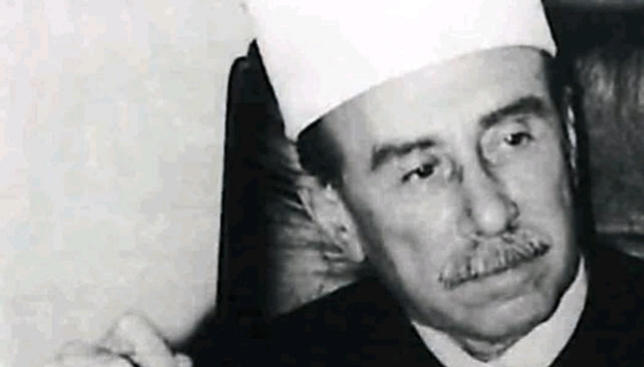
Sheikh Halim Takieddine is considered a beacon of thought, a leader of opinion, and one of the Druze and national figures who left clear marks on building the state and developing its systems. He was a prominent scientific, intellectual, and academic figure whose works left an important impact on the fields of culture, religion, society, and politics. During his time, he played a prominent role in the history of the Druze community, its organization, and the development of its administrative, regulatory, and judicial affairs, as well as enriching its library with publications that occupied a significant space in Druze public opinion, personal status, inheritance, and the relationship of the Druze with other sects, leading up to the nature of the Druze judiciary and its development between the past and the present.
Sheikh Halim Ahmed Takieddine was born on January 18, 1922, in Baakline, Chouf District. His father was the well-known poet Ahmed Takieddine.
Sheikh Halim Takieddine studied at Al-Hikmat School in Beirut. After graduating, he worked in teaching and continued his university education, obtaining a degree in history from the Lebanese University in 1955. Prior to that, he had obtained a certificate in Public Administrative Law and a certificate in Political History from the Lebanese Academy in 1951. Takieddine continued his scientific career, obtaining a law degree from the Lebanese University in 1962. He practiced law as a trainee and as a lawyer in the Court of Appeal and the Court of Cassation between 1962 and 1968. Between 1966 and 1968, he was a member of the Druze Confessional Council, later serving as its secretary. He also held the position of Secretary of the Lebanese University and subsequently became a professor at the Institute of Social Sciences.
Head of the Druze Judiciary
On May 4, 1968, he was appointed President of the Supreme Court of Appeal for the Druze Confessional Judiciary, and in this capacity, he became the head of the Druze Confessional Judicial Council. He ran for parliamentary elections in the Chouf district in 1964 but was unsuccessful. He participated in establishing the Permanent Office for Druze Institutions in 1982 and was one of its active members. He also participated in drafting the Ten Islamic Constants with the Grand Mufti of the Lebanese Republic, Sheikh Hassan Khaled, the Vice President of the Supreme Shiite Islamic Council, and a number of senior Islamic figures in 1983.
Assassination
He was assassinated on December 1, 1983, at his home in Beirut. Brigadier General Issam Abu Zaki stated in his memoirs: "I believe the reason for his Eminence's assassination was his participation in the joint Islamic prayer at the Municipal Stadium, which was called for and led by Mufti Hassan Khaled." A grand funeral was held for him at the Druze Community House. The funeral prayer was led by the Grand Mufti of the Republic, Sheikh Hassan Khaled, alongside the President of the Supreme Shiite Islamic Council, Mohammad Mahdi Shamseddine, and Abu Hamoud Yahya al-Daroub. His body was transported to Baakline, where another funeral was held, attended by several of the country's senior figures, and he was buried there. A memorial service was held for him at the American University of Beirut on the anniversary of his death on December 1, 1984.
He married Dr. Adele Hamdan Takieddine in 1965, and they had three children: Osama, Hala, and Makram.
His Works
Among his publications are: The Judiciary of the Monotheists in its Past and Present, The Druze Monotheists and the Aspects of Divergence with Sunnis and Shiites in Source and Jurisprudence, Personal Status Among the Druze, and Wills and Inheritance Among the Druze Monotheists.
He collected the poetry anthology of his father, Sheikh Ahmed Takieddine. He also had a number of lectures, speeches, and articles on various topics. His wife, Dr. Adele Hamdan Takieddine, collected his statements, declarations, and what was said about him after his assassination in a large book with an introduction by Mohammad Khalil al-Basha.