
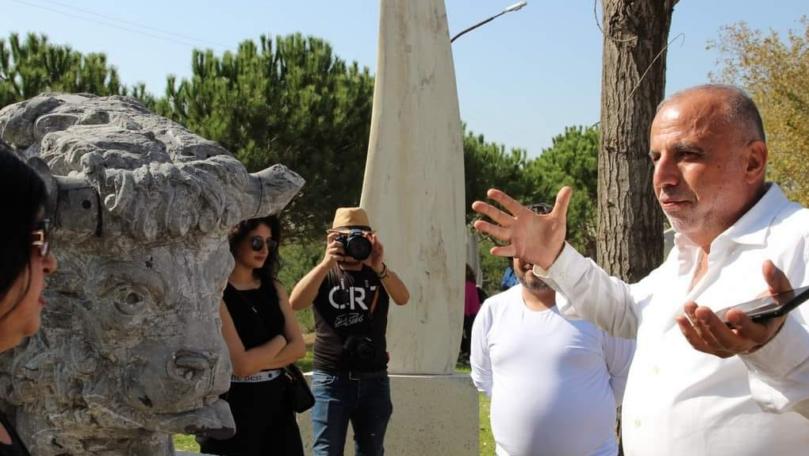
Organized by the 'Association avec Expat' and in cooperation with the Municipality of Aley, a group of media professionals conducted a full-day tourist tour in the "Capital of the Mountain and Bride of Summer Resorts, Aley." During the tour, the media personnel became closely acquainted with all the services and the heritage, cultural, and recreational sites hosted by the city, as well as its spaces where civilizations, nature, and a clean environment meet, making it an undisputed tourist destination.
The activity was held under the patronage and presence of the Mayor of Aley, Wajdi Murad, who accompanied the media delegation along with several members of the municipal council.
The "Aley Balconies" (Balkin Aley) were the first stop on the tour; a premier tourist center adorned with a number of artistic sculptures that overlooks the capital and a number of towns and suburbs scattered around it, as well as the depth of the Shouf region, extending all the way to Rafic Hariri International Airport and its clearly visible runways.
From the vue panoramique of the balconies to the splendor of beautiful art represented by dozens of sculptures spread across a wide area of the "Aley International Sculpture Symposium." This project began from an idea conceived by the painter, artist, and sculptor from Aley, Aref Rayess, to later materialize into an open-air art oasis divided into three parts within the city. The second part of the symposium is located on the outskirts of the Aley mountain peak, near the "888" hill—a hill that entered the lexicon of military locations during the Lebanese Civil War, with the name derived from its elevation of 888 meters above sea level.
The third stop was at "Ain El-Tufaha" square, which contains thirteen water springs and serves as a resting point and gateway to the Old Souk. The delegation toured the area on foot, hosted by the "Aley Merchants Association," who welcomed the media professionals as they visited various shops and commercial establishments.
The "walk" in the Old Souk was accompanied by the glow of fire emanating from the "Black Stove" (Wojak Aswad), made of cast iron and spread in rows along the sidewalks of the market. It is known by other names in several Lebanese regions, such as "Sobia," "Stove," and "Qatrji." Notably, craftsmen in Aley used to rely on riveting (without welding) and manual cutting for its production, which began nearly seventy years ago. However, after the introduction of many modern modifications and improvements, this profession transformed from a manual craft into an advanced, high-tech mechanical industry.
After the Old Souk tour, the media delegation headed to the "Nathalie Kid's Academy" nursery, which welcomes children and their parents in an atmosphere of psychological comfort and assurance regarding the safety of their children, based on the accumulated experience of the management in modern education that provides a suitable and safe environment for children.
Healthcare was the objective of the visit paid by the delegation to the Druze Women's Association, which was founded in 1962 and is currently headed by Mrs. Camilia Halima. The delegation was briefed on the health and social care provided by the association, toured the center's rooms and departments, and listened to a detailed explanation regarding the medical services, consultations, examinations, medicines, and vaccines offered throughout the week to visitors from all regions.
The tour concluded with a banquet of generosity, hospitality, and recognition at the Aley Equestrian Club. The club offers several sports activities, including horse riding, motorcycling, and rope climbing, and features the largest swing in the Middle East, which stands approximately 12 meters high.