
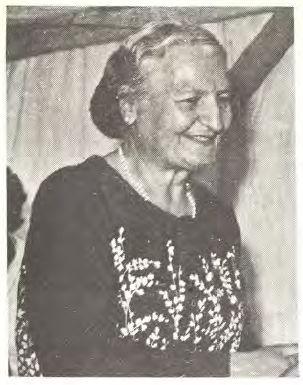
In 1979, the International Year of the Child, the virtuous lady, social activist, and human rights fighter Zahia Makassed Salman was titled the "Mother of Lebanese Children," as a woman who advocated for the well-being of children in Lebanon for fifty years and managed to establish day-care centers across the country since 1937. One of her most prominent achievements was establishing March 22nd as Children's Day, even extending the celebrations for a full week.
She was a believer in the principles of children's rights declared in 1975 and the Declaration of the Rights of the Child issued by the UN General Assembly in 1959. She worked to realize and dedicate them within the Lebanese environment with all seriousness and sacrifice. She followed the finest details to protect childhood and grant them the privileges that would fortify them at all levels. She declared her loyalty to this humanitarian cause and carried it not only in Lebanon but also traveled to many countries, invited to represent Lebanon in major forums and conferences concerned with childhood. She presented dozens of lectures and constructive ideas in this field and left unique marks in developing media, health, social, and educational programs that enhanced children's culture, protected them from violence and exploitation, and demanded the well-being that boosts their capabilities and talents while providing positive climates to nurture their imagination and health.
Humanitarian Work
Zahia Makassed Salman was born in 1914 into a family that loved knowledge and sanctified freedom and humanitarian work. She dedicated her life to achieving her noble goals, even participating in many demonstrations and sit-ins demanding human and child rights as well as other struggle-related causes.
Zahia Salman began her activities for childhood in Lebanon in the 1930s and continued until her death in 2000, after life and experience had exhausted her, and long struggle, effort, and continuous work had incapacitated her, before old age did.
For the Sake of Childhood
Among her most prominent achievements, in 1985, during a press conference at the Lebanese Press Syndicate, she demanded the adoption of the following policies on the occasion of Children's Day:
On the media front: To stop broadcasting violent programs, monitor harmful films, create a national fund for producing educational and useful programs and films, and mobilize official institutions in this regard.
On the health front: She demanded the adoption of a national policy based on prevention before treatment, coordination among all types of health services provided to children, and ensuring they reach residential communities.
On the educational front: She demanded the adoption of a national educational policy, the approval of compulsory free education until the intermediate level, the generalization of kindergartens in all elementary schools, the establishment of nurseries in rural areas, the support of literacy programs, the encouragement of specialized education to rehabilitate and integrate the disabled into their environment, giving school health sufficient attention in cooperation with the Ministry of Health, and achieving health insurance for children.
She also recalled the principles of children's rights announced in 1975 and the Declaration of the Rights of the Child issued by the UN General Assembly in 1959.
Gold Medals
Mrs. Salman was awarded gold national medals, including the medal of the International Foundation for Science, and a medal from the Life Awareness, Culture, and Social Services Foundation, which elected her as honorary vice president.
Former Prime Minister Selim Hoss pinned the Gold Order of Education on the chest of Mrs. Zahia Salman, president of the Lebanese Child Welfare Association.
For fifty years of teaching, instruction, and struggle in the field of education, and in honor of her career, works, and struggle, one of the Ghobeiry high schools was named after her, now known as the Zahia Salman Mixed High School, which is one of the most successful high schools. She had also run for parliamentary elections in 1972 but withdrew to pave the way for other women who entered the political arena.
Zahia Salman passed away, but her works remained immortal in the memory of generations, especially as she became a symbol of the struggle for childhood.