
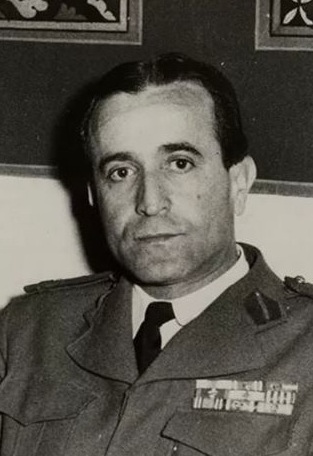
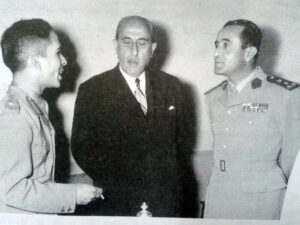
Shawkat Fouad Shuqair (May 21, 1912 – November 2, 1982) was a Lebanese-Syrian military officer. Born in Arsoune, he joined the Military Academy in Damascus during the French Mandate as a sergeant. When the country gained independence, he volunteered for the Lebanese Army and was appointed to the General Staff. He later obtained Syrian citizenship and was appointed to the Syrian Army with the rank of third-degree Colonel, eventually becoming Chief of the General Staff. In this capacity, he headed the Syrian delegation to the conference of Arab army chiefs of staff. He retired in 1956, returned to Lebanon, and participated in the popular revolution against the regime of President Camille Chamoun alongside Kamal Jumblatt.
His Biography
Shawkat Shuqair was born in Arsoune on May 21, 1912. After completing his secondary education at the Patriarchal School in Beirut in 1925, he entered the French Secular School in 1926, followed by the Military School for Special Levant Troops in September 1930. He graduated as a Second Lieutenant in September 1932, was promoted to First Lieutenant in 1936, and to Captain in 1942. In 1946, he was promoted to the rank of Lieutenant Colonel in the Lebanese Army following the dissolution of the Special Levant Troops and the separation of the Syrian and Lebanese armies due to the independence of both countries.
In June 1949, he resigned from the Lebanese Army and joined the Syrian Army, where he was appointed Head of the Military Office at the Presidency. He was then promoted to the rank of Colonel. In 1949, he was appointed Second Assistant to the Chief of the General Staff in the Syrian Army. In 1959, he was appointed Commander of the Fourth Infantry Brigade. In 1953, he was promoted to the rank of Zaim (Brigadier General) and became Chief of the General Staff of the Syrian Army, where he remained until July 8, 1956, the date of his retirement at his own request.
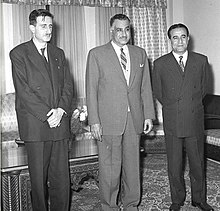
He attended a staff course in France in 1945, and in October 1947, he was appointed as the Lebanese Army delegate to the Military Committee of the Arab League. During his tenure as Chief of the General Staff of the Syrian Army, he established the Joint Field Command for the Egyptian and Syrian armies, which served as a precursor to the union that subsequently took place between the two countries.
Positions
In addition to the military duties he performed in Lebanon and Syria, he held the following positions and adopted the following stances:
He held the position of Chief of Staff of the Arab Salvation Army, which he helped organize and which was led by Taha al-Hashimi and then Fawzi al-Qawuqji. He fought in several battles in Palestine, most notably the Al-Qadisiyah and Al-Jabal battles.
He contributed to the establishment of the Joint Field Command between the Egyptian and Syrian armies, a precursor to the union between the two countries.
Shawkat Bey was at the forefront of the Syrian men who prevented Syria from joining the Baghdad Pact.
He led a successful coup in Damascus, handed power to a civilian, and resigned, returning to Lebanon.
He was the Supreme Commander of the Armed Forces during the 1958 revolution and the 1953–1954 Syrian protests.
Shawkat Shuqair married the Damascene lady Qamar Wafai, and their son, Ayman, is a member of the Lebanese Parliament.
His Death
Shawkat Shuqair passed away in Beirut on Tuesday, November 2, 1982. Due to the bloody events unfolding in the Metn region at the time of his death, he was temporarily buried in the Druze cemetery. His remains were later transferred to his hometown of Arsoune on Sunday, November 4, 1984, in a large public ceremony. A memorial service was held for him in Arsoune, attended by Mustafa Tlass, Walid Jumblatt, and a number of army officers and popular delegations.
Shawkat Shuqair was awarded a large number of medals, the most important being the War Medal with Palm from Lebanon, the Syrian Order of Merit of the Excellent Degree, the Order of the Republic of the First Class from Egypt, and the Order of the Star of Jordan of the First Class.