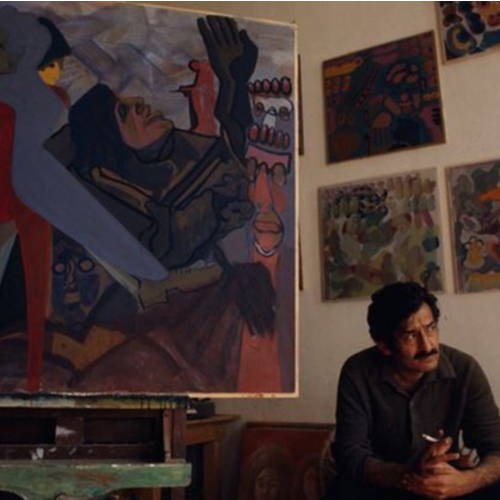


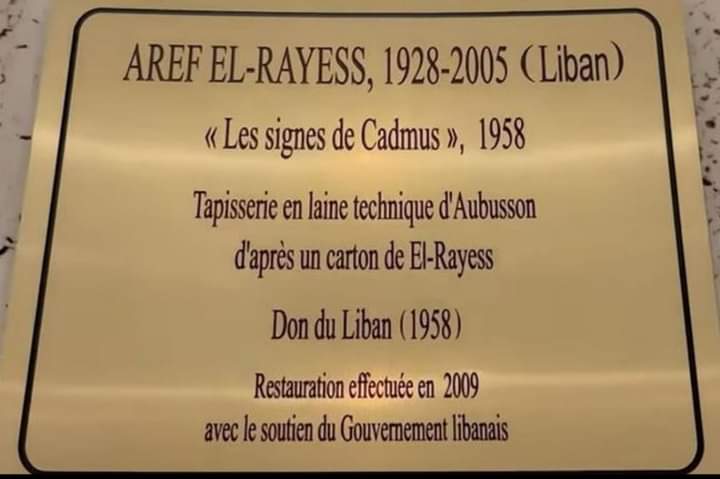
In a prominent location on the basement floor of the UNESCO headquarters in Paris, the hanging works are headlined by a tapestry titled “Cadmus Symbols” by the Lebanese painter Aref El Rayess (1928-2005). It was gifted by Lebanon in 1958 to the international organization and is made of synthetic wool woven in the French city of Aubusson, famous for its tapestry craftsmanship. The rug was restored in 2009 with support from the Lebanese government.

Artistic Details
In an interview for the website Ici Beyrouth with the Cultural Attaché to UNESCO, Bahjat Rizk, he explained the artistic details of the tapestry. At the bottom, there is a display of the Phoenician alphabet with its 22 consonants, to which the Greeks later added vowels. This was the first phonetic alphabet; before it, alphabets were pictographic, as seen in Egypt and Mesopotamia (Sumerian, Akkadian, etc.).
Interspersed among the Phoenician alphabet letters at the bottom of the piece is a Phoenician warship built from cedar wood, which in ancient times covered the entirety of the Lebanese mountains. In another part of the tapestry, the murex shell appears (“murex” means red in Greek), which was discovered by the Phoenicians, who were then called Sidonians or Byblians after their royal cities.
Phoenician Heritage
In the center of the tapestry: the winged horse, alongside a special Phoenician astronomical instrument that was a revolution in the world of communications at the time. Above the instrument is an image of the sun, which relates to the name Cadmus; his name, “Qadm,” means the east or sunrise. Beside him is the image of his sister Europa, who gave her name to the European continent. In Phoenician, Europa is “Urb,” meaning sunset—hence the etymological connection between Europa and “ghurub” (sunset), implying that this alphabet came from the lands where the sun rises. At the top of the tapestry are illustrations of various sizes of a number of cedars.
This tapestry, through the creativity of Aref El Rayess, summarizes the heritage that the Phoenicians spread, which Herodotus referred to as “Cadmean symbols,” acknowledging that the Phoenicians disseminated this alphabet as they were intermediaries of civilization and trade. They navigated the Mediterranean starting from the Lebanese geography, making history on one hand and geography on the other the two main factors in the spread of Phoenician civilization.