
Every society has its own authenticity, culture, and ethics, just as every profession has its own ethics and conduct. Journalism stands at the forefront of professions that reflect the image of society with all its experiences, problems, and phenomena. It is incumbent upon all forms of journalism—whether written, audio, visual, or electronic—to respect the cultural environment of society.
Furthermore, journalism should not overstep recognized principles and values in order to perform its function in a way that responds to people's needs and aspirations, granting them the opportunity to have a clearer vision of their reality.
Not everyone who practices the profession is a journalist if they are stripped of its principles and lack its ethical standards. Neither technical skills nor academic degrees will advocate for them before the public if they lack integrity and credibility, or if they stray from independence and objectivity.
Some may believe that adhering strictly to ethics, being excessively constrained by them, and committing to the limits of the profession's social responsibility might hinder the journalist and weaken their resolve to earnestly seek to uncover the truth as it is, to the best of their ability. This, they argue, would result in dull, rigid journalism that is completely disconnected from people's reality and serves no purpose for them.
The journalist's mission is considered one of the most difficult; they are surrounded by many risks, yet it is a noble mission. The journalist is like a sentinel, monitoring events and uncovering facts to deliver them to public opinion without distortion. They face all the problems and risks that stand in their way to perform their role to the fullest. To achieve their goal of uncovering the truth, serving the public and public opinion, and performing their duties properly, they must be aware, cultured, and possess sufficient experience to write the information they obtain in an impartial and honest manner, and to take into account the interests of an entire nation rather than the interests of a specific group.
The journalist keeps a specific cause in mind and strives to reach the truth; they must preserve the conditions of their profession and follow them, just as they must adhere to its general principles and standards. There is a set of principles and foundations that both the journalist and the institution must adhere to in order to protect the journalist and the journalistic environment, and to ensure the rights of both parties.
- Birth and Upbringing
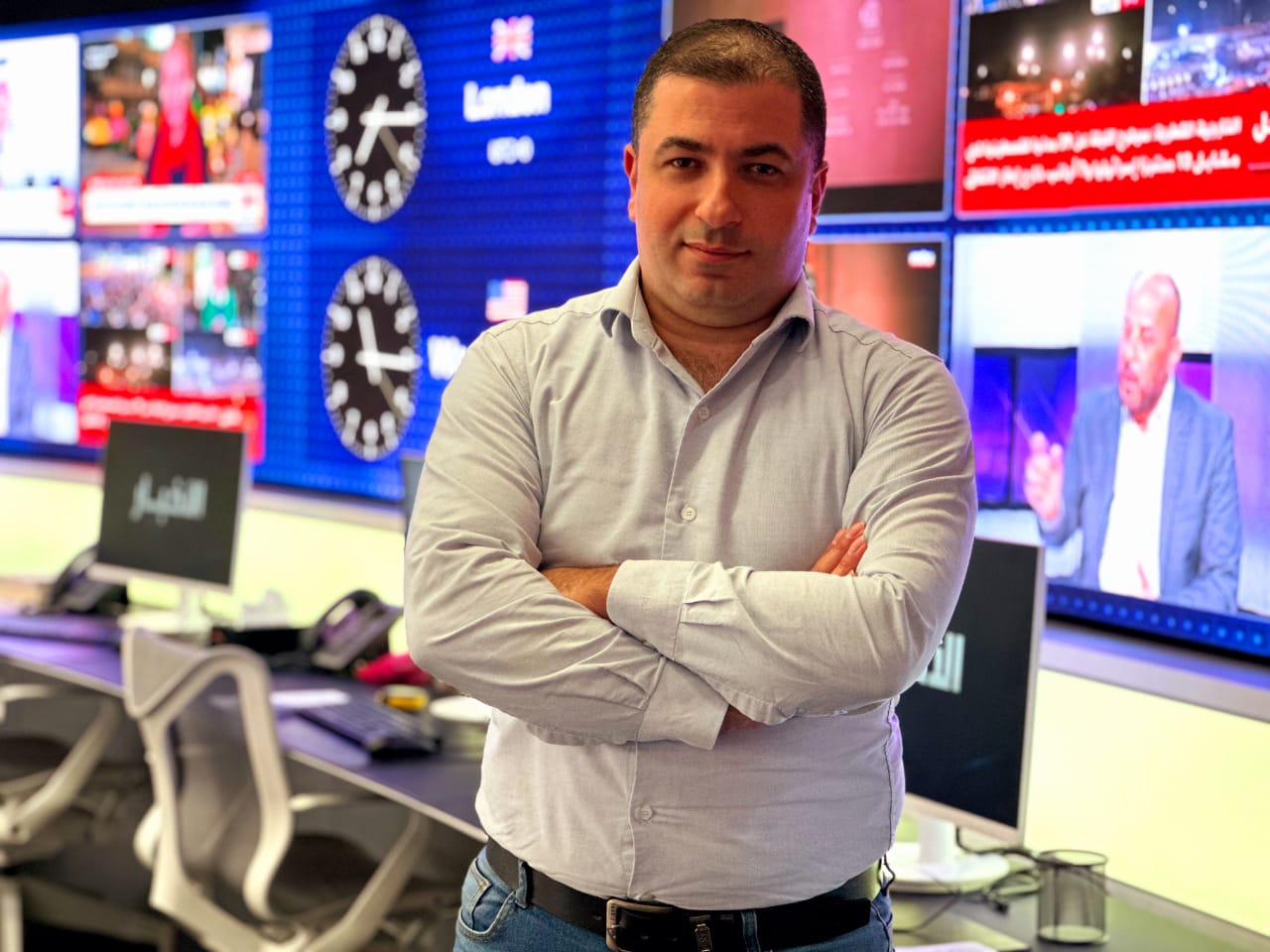
Nader Hijazi, a Lebanese journalist and writer, was born in the town of Bekifa in the Rashaya District on March 6, 1988, to Unitarian parents.
His father immigrated to Latin America when Nader was two years old, having already spent more than 15 years abroad before the Lebanese Civil War. This left a significant impact on his childhood. His literary and poetic talent emerged before he was ten years old, expressed initially through poetry and prose.
He maintained his poetic and literary hobby but did not pursue poetry professionally. He has several unpublished poems, but he is working hard to revise them for future publication.
- Academic Life
He received his primary education, like most children in the town, at the Bekifa Public Intermediate School, where his teachers discovered his great love for reading and helped him nurture this passion, turning books into his constant and most beloved companions, as he puts it.
He then moved to the Rashaya Public Secondary School (French branch), which offered a wider horizon. There, he published his first writings in the school's magazine, issued at the end of each year under the title “Al-Ghial” (The Harvest). Hijazi considers the high school stage to have been the first laboratory for his national, political, and social consciousness, especially as it coincided with major national transformations, represented by the assassination of the martyr Prime Minister Rafic Hariri and the launch of the Independence Uprising on March 14, 2005. Consequently, the event had a profound impact on him and his generation, allowing them to express their opinions and participate in public life at an early age. At that time, he was an activist in the Progressive Youth Organization in the Southern Bekaa.
In light of these exceptional circumstances in modern Lebanese history, he decided to join the Faculty of Law and Political Science, earning a degree in Political and Administrative Sciences from the Lebanese University in Jal El Dib in 2009. He had moved from his village, Bekifa, to Beirut, where he worked and studied.
- Professional Life
After graduating, he chose a career in journalism and excelled in this field. He advanced through the ranks at “An-Nahar” newspaper, and later at “Sada Al-Balad” newspaper, where he worked in the international and local sections, as well as the investigative department. In his early days there, he was in charge of the “Day'at Al-Balad” (Village of the Country), “A'ilat Al-Balad” (Family of the Country), and “Mehnat Al-Balad” (Profession of the Country) pages, through which he toured most Lebanese regions and villages. He later took over the weekly political interview page and interviewed many political figures.
He worked across several media outlets, including “Ad-Diyar” newspaper, “Al-Modon” electronic newspaper, and the “Lebanon Files” website.
Between 2015 and 2017, he took responsibility for the Media Office at the Ministry of Public Health during the term of Minister Wael Abou Faour. It was an important stage in the ministry's history, as Abou Faour launched the food safety campaign, which dominated local attention at the time and attracted Western and Arab media.
Afterward, he moved to “Al-Anbaa” newspaper, where he still holds the position of Managing Editor, and to MTV station, where he works on its news website as a writer and content creator through a weekly segment he prepares titled “Shoo Al-Qissa?” (What’s the Story?), which covers various and diverse topics.
The writer has many political and social articles and personal interviews to his credit. He also participated in numerous training courses, notably with the international agency “Reuters,” alongside dozens of Arab journalists, titled “Towards Effective Health Journalism.” His proposal was among the winning and supported topics at the conclusion of the course.
Despite his distance from his village and his residence in Beirut and later in Sofar, Bekifa retained a special place in his interests. In 2012, he was appointed a founding member of a spontaneous youth movement called “Bekifa Ajmal Balad” (Bekifa is the Most Beautiful Country) or “Bekifa Youth,” which continues to carry out various activities to this day, always with new blood from the town's youth.
- The Book “Al-Zaytouna Al-Maymouna” (The Blessed Olive Tree)
During the COVID-19 pandemic, he began preparing a book that is nearing completion and is about to be printed regarding the history of his village, Bekifa, titled “(Al-Zaytouna Al-Maymouna).” The title was inspired by the historical visit made by our master Al-Muqtana Baha' ad-Din as-Samuqi (PBUH) to Bekifa and his resting under an olive tree there, as recounted by Sheikh Al-Ashrafani in his book “Umdat al-Arifin.”
The book covers important historical eras, especially the relationship of Bekifa with the Tawhid (Unitarian) call and the role it played as a primary hub at that time. This is in addition to other historical milestones and faces and personalities who left their mark nationally and in the diaspora. Regarding village life, he discusses its customs and traditions, which have their own section, as well as many sentimental texts that tell the tales of the village and the authenticity of its people. The writer draws inspiration for many of these aspects from his paternal grandfather, the venerable Sheikh Abu Muhammad Hassan Hijazi, who lived alongside the land and loved it. He was authentic in his belonging and a possessor of a Unitarian path, having spent his life in obedience to God, asceticism, and piety.
Mr. Hijazi believes that life is worth struggling for a better tomorrow, and for a homeland worthy of its children who have excelled across the world. He emphasizes that freedom is Lebanon’s most precious icon, and preserving it is a trust so that this country may remain an oasis in this East.
Prepared by the historian: Makram Al-Masri