
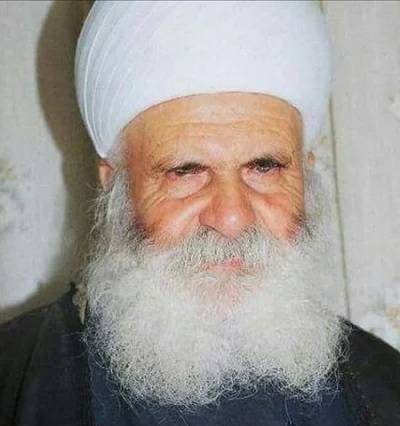
Sheikh Abu Muhammad Saleh Al-Andari was born in the town of Abadiyeh in 1913, in a house founded on monotheism, goodness, blessing, and piety. He was the son of Sheikh Abu Ali Bashir Al-Andari and his mother, the pious Sayikha Umm Ali Zein, daughter of the late Sheikh Mansour Al-Andari. He suffered from the vicissitudes of time, as his father and two older brothers passed away while he was under the age of ten, and he grew up believing in God under the care of his virtuous mother.
He was able to carve his own path and grow up relying on God Almighty, his own abilities and talents, and his adherence to and deep immersion in the faith.
His wife passed away in 1948, and he lived the rest of his life in celibacy despite his early widowhood, devoting himself to religious matters, worship, and the companionship of his brethren in faith. He dedicated a great deal of time to spreading love and reconciliation among people everywhere.
When the Civil War broke out, aggressors attacked religious monotheistic sites. Sheikh Abu Muhammad took a heroic stand, carrying a rifle symbolically, urging the youth and the sheikhs to stand firm for the sake of honor, land, identity, freedom, and religion.
Reconciliation and Coexistence
Sheikh Abu Muhammad spent a long time of his life reconciling differences between people; his primary concern was harmony, contentment, love, and purity in society. He called for coexistence and casting aside the hatreds stirred by sectarianism in Lebanon. He possessed many religious virtues, was rich in his monotheistic character and noble ideas, and was known for his firm and clear positions.
He was also meticulous in maintaining the etiquette of the limbs, truthful in his words and deeds, composed and far from mockery or cynicism. He avoided swearing oaths, and he was deeply pious inwardly for his own soul, and outwardly in his words and actions. He paid close attention to small matters, just as he did to large ones, and was keen on disciplining his soul so that it could overcome contradictory inclinations and be receptive to the ray of divine wisdom. He also held great respect and appreciation for religious orders and was keen to fulfill their obligations and prohibitions. He magnified the status of saints and prophets and leaned towards seclusion and solitude.
He did not concern himself with food or drink; his sustenance was whatever was available, and most of his food came from the crops of his land, for his concern was that his food be lawful (halal). Illness afflicted Sheikh Abu Muhammad's body, which rendered him bedridden, yet he remained vigilant, following the news of his sect's members and acquaintances everywhere. He surrendered his spirit and passed on to God's mercy on the twelfth of December 1992. His funeral was attended by tens of thousands of mourners from Lebanon and Syria, and he was buried in his home in the town of Ba'alchmay. A shrine was built for him which people visit to seek blessings. On the shrine are two markers; on one of them the Ayat al-Kursi is inscribed, and on the other, the date of his death is written in both prose and poetry. Both inscriptions were prepared by Sheikh Abu Yusuf Saleh Abdul Khaliq, and the poem is as follows:
The banner of virtues, since he passed, has covered the people in the adversity of his loss
For Abu Muhammad Saleh, the pillar of piety, has attained his reward
In him, leadership was crowned with the Zakat of knowledge and achievement
To the highest knowledge he ascended; glad tidings to him, what a blessed return
With purity, his effort was dated: the full moon of greatness has disappeared behind the veils
Prepared by Sheikh Makram Al-Masri