
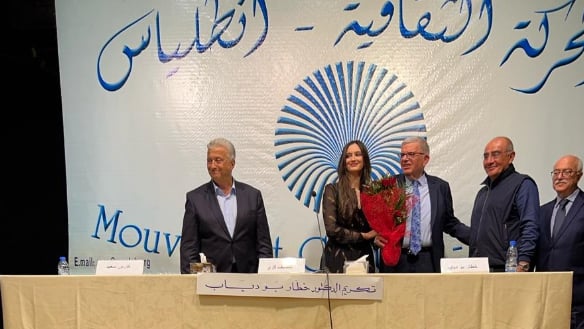
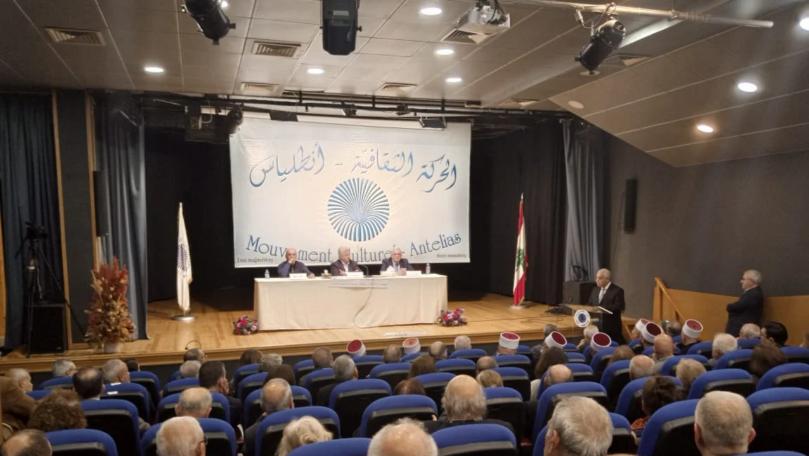
The “Cultural Movement – Antelias” honored writer and political analyst Dr. Khattar Abou Diab in a ceremony held during the Lebanese Book Festival at the Deir Mar Elias in Antelias. During the event, Dr. Nassif Qazzi introduced the honoree, noting that “The Cultural Movement – Antelias has become a guardian of constructive national culture, universal human values, and the principles of democracy, specifically regarding equality among citizens in rights and duties, and a compass for promoting them.”
Qazzi described Khattar Abou Diab’s periodic articles as “comprehensive and methodically crafted, where information is interconnected and integrated to form a semi-cinematic view of the current state of our world, highlighting hotspots and conflicts and linking them together. He adds his own projections, as if he carries a documentary mission that gains such accuracy and objectivity that it reaches the level of the finest articles we encounter in local and international press.”
Saeed
For his part, former MP Fares Saeed remarked that “Khattar Abou Diab is a host without ostentation, elegant in form and substance without affectation, a good speaker and an even better listener—not among those who are incapable of one-way communication. He is an intellectual without pretension, a knowledgeable person who knows how to say: ‘I do not know.’ If he offers you his opinion on any matter, do not exhaust yourself searching for what or who is behind his words; he speaks from his convictions. And if he remains silent, assume that his civility does not permit him to speak.”
Saeed added: “Khattar Abou Diab is one of those who have embodied the complex Lebanese identity, composed of multiple circles of belonging, the center of which is the individual himself who knows how to reconcile them while remaining tethered to a wider horizon. Thus, he lives in harmony with himself and with the ‘different’ other. That is how Khattar is a son of a family, a region, a sect, and a nation. At the same time, he is Arab, French, European, and humanist—all at once.”
Abou Diab
The honoree delivered a speech of thanks, saying: “I am pleased today to come to you from the Chouf to the Metn, from a village that is not unknown, even if its name is Al-Jahiliya, planted in the middle of that green crescent valley, not far from Baakline and Deir al-Qamar, in that area where the Lebanese idea was born and where the struggle for the independence of the Mountain and Lebanon began with the Great Maan.”
He added: “It is difficult to be in the midst of these events and transformations without addressing the national destiny, because it is Lebanon that unites us, and because the lessons of history teach and motivate us regarding the importance of defending Lebanon as an idea, a message, and a state.”
He continued: “There are several historical narratives about a diverse and pluralistic Lebanon, but there is a solid and firm core to the entire national structure. Lebanon is not a decision issued from abroad, nor is it governed by the storms of history and the curse of geography. Lebanon is not a count of years from one centenary to the next; it has become a lifestyle and an oasis of thought and freedom. The Lebanese experience or adventure is no longer the exclusive property of the people of Mount Lebanon, the cradle of its founding, but is the property of the people of Jabal Amel, the plains of Akkar, Tripoli the fragrant, Wadi al-Taym, the prosperous Bekaa, Sidon, Tyre, Beirut the mother, and every hamlet and grain of soil in the homeland.”
He stated: “Lebanese distinctiveness or uniqueness is not measured by the number of its sects or its historical narratives, and this is not the appropriate place to judge the history of Lebanon. What is needed is to possess a long memory.”
Abou Diab concluded that “coexistence is the rule and civil strife is the exception, and dominance is not an option for any party or sect. Only a renewed settlement is the guarantee for survival and reform. The gradual transition from a country of sects to a country of citizenship—with the other pillar of rescue being the distancing from external conflicts and axes, following the example of the pioneering Chehabist experience in balance and positive neutrality—is essential. It is also vital that Lebanon does not remain an arena or theater for conflicts, but regains its geopolitical function as an intermediary Arab country, while maintaining control over its sovereign decision. The state remains the foundation, and the human unity of the people is the criterion.”
He ended by saying: “We follow with pain the death of humanity in Gaza, and the just cause of Palestine concerns us, for the Palestinian people have been sacrificed on the altar of the game of nations. Most importantly, Lebanon must not pay the price, as it has given much since 1969; it deserves the continuity of survival and resurgence.”
Testimonials
Testimonials for the honoree were given by his son Rami, MP Ghassan Skaff, Vice President of the Press Syndicate Salah Takieddine, Dr. Walid Khattar, Bashir Abou Diab, Sheikh Ghassan Youssef Abou Diab, Princess Hayat Arslan, Pierre Attallah, and Dr. Issam Khalifa.