

Researching fasting is not a new endeavor; scholars, scientists, critics, and physicians, both ancient and modern, have approached fasting through various concepts and interpretations. In the fifteenth century, "Ludovico Cornaro" used fasting to treat many diseases that were considered untreatable at the time. He applied his fasting method to himself, lived to nearly one hundred years of age in good health, and in his final days, authored treatises on healing through fasting under the motto, "He who eats little, lives long."
In the twentieth century, medical books appeared in America and Europe, with authors discussing the benefits of medical fasting, such as "The Hygienic System" by Herbert Shelton, "Fasting, the Ultimate Diet" by Allan Cott, "Fasting as a Way of Life" by Henry Tanner, and "Back to Healthy Living through Medical Fasting" by the German doctor Helmut Lützner. In 1941, Buchinger’s book, "Fasting Therapy as a Biological Method," was published, in which he explained how to use fasting to treat many intractable diseases. However, the clearest and most eloquent phrase spoken about fasting came in the Prophetic Hadith: "Fast and you will be healthy." Has modern science discovered the secret in the Quranic verse: "And that you fast is better for you"?
The philosopher Kamal Jumblatt's concept of the human being was not a material, ordinary, or simplistic one; rather, it was a concept tied to a dialectical relationship with the mystery of this universe and its creation. Therefore, one must delve into this concept to understand everything surrounding human actions and their purposes, including any work undertaken or behavior followed, such as fasting or others.
The Master Kamal Jumblatt spoke to us about fasting, nutrition, types of food, methods of consumption, bodily needs, and other matters through which he pointed us toward that dialectical relationship between proper, healthy nutrition and human behavior. He saw fasting as a means to purify the soul, educate the personality, and prepare it completely in all its various aspects—physical, moral, intellectual, spiritual, psychological, emotional, social, and economic. His famous saying is: "Fasting is the internal bath of the body, and it imparts clarity and detachment to the mind and senses."
Kamal Jumblatt considered fasting itself a manifestation of the laws of human internal nature and bodily structure, as controlled internal nutrition and the elimination of waste and toxins give the body's organs a chance to regenerate. To him, fasting has spiritual effects on the human being, and this is because fasting stimulates the gray matter in the brain after cleansing it of the toxins that act as a hidden obstacle hindering brain functions. Believers often mention in their discourse that fasting is a training for the personality, a refinement of physical desires, and a correction of human behavior. Thus, we see in the Master Kamal Jumblatt's philosophical, spiritual view of the human being, and his holistic analysis of the human body, an explicit and necessary call to life in its fullest sense. It is as if, through these words, he is telling us to seek help from our inner healing physician... that is, to heal through fasting. Is fasting not the most effective method for this maintenance?
There is no doubt that the contemporary lifestyle has destroyed many essential aspects related to our physical and psychological health alike. Due to nutritional chaos, poor organization, lack of movement, stress, and the multitude of sources of agitation, there has been an increase in chronic diseases that have become more lethal than others, such as heart and vascular diseases, cancer, rheumatism, obesity, hypertension, diabetes, cholesterol, and other ailments that threaten the health of the individual and society alike.
Based on this, the Master Kamal Jumblatt approached the human being, directed his attention toward him, and set off through him. His goal and the focus of his writings was the human being as a human, who is "a whole whose body and senses cannot be separated from his intellect." Therefore, he believed that food and drink have a profound impact on the formation of the human soul committed to its influence on the nerves, warning against the foods of civilization resulting from modern lifestyles. Hence, he called for the necessity of human harmony with nature and a return to natural food, as it is an inseparable part of its laws and traditions.
In the school of fasting, Kamal Jumblatt linked fasting to the effective process that leads to purifying cells, regulating their microscopic channels and their content, and maintaining the body's health to recover from illnesses. Consequently, it rejuvenates and stimulates vital energy in all organs of the body, maintaining it in youth as much as possible and delaying aging.
Hence, the philosopher Kamal Jumblatt dedicated a chapter in his famous book "The Literature of Life" under the title "The Literature of Fasting," in which he clarified: "Fasting in its true meaning is the literature of life, the literature of all life. In the fasting of the intellect lies the happiness of the spirit, and in the fasting of the body lies the health of the body. Fasting in the psychological, moral, and positive sense—that is, in the existential intent—is not to be attached to anything, not to be pulled by the millstone of the ties of thought and senses, so that we do not become like those who actually and realistically carry the whole world on their backs." He agreed with Imam Al-Ghazali, who said: "Fasting is the zakat (purification) of the soul and the exercise of the body. It is a protection for the human and a safeguard for the community. In the hunger of the body lies the clarity of the heart and the sharpening of insight, because satiety breeds dullness, blinds the heart, and increases strife, causing the mind to become sluggish. Revive your hearts with little laughter and little satiety, and cleanse them with hunger, so they may become clear and refined."
Kamal Jumblatt spoke of a deeper concept of fasting by shedding light on chastity. We have seen how his view of fasting was manifested in the healthy and psychological energy of the human, which enables him to bring about the desired change within himself by developing the human personality and increasing his willpower, because it trains and disciplines the soul for patience and endurance, develops the ability to self-control, overcomes desires, and helps in acquiring noble virtues.
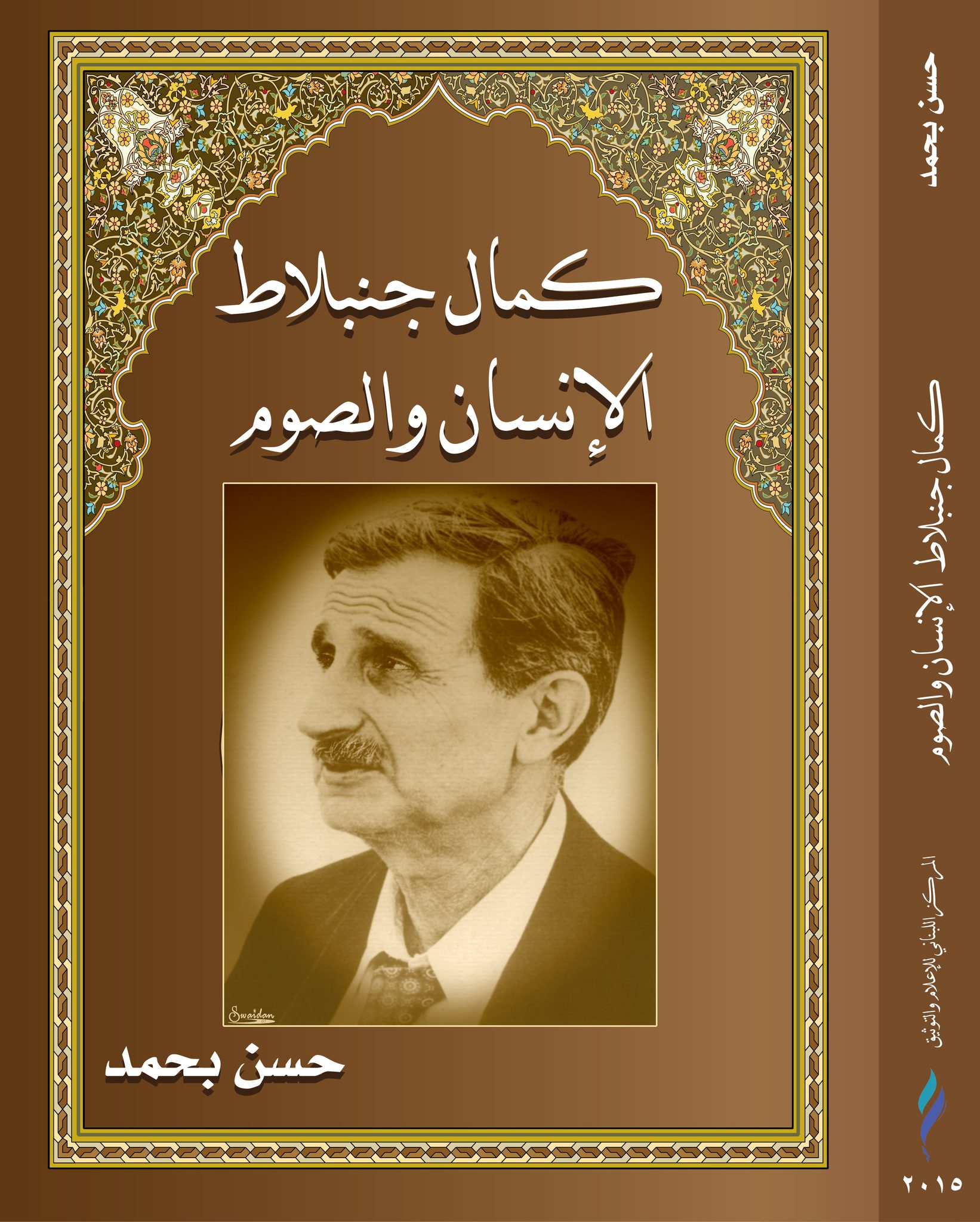
The book "Kamal Jumblatt: The Human and Fasting" is divided into four chapters, each containing several sections, as follows:
Chapter One: Deals with fasting and the human being and contains ten sections, including the definition of fasting, a return to the customs and traditions of nations and peoples, cultural and human heritage, fasting in various religions, fasting in Islam, fasting and asceticism among the Unitarian Muslims, fasting socially, fasting according to Kamal Jumblatt, fasting and mental health, and healing through fasting.
Chapter Two: Deals with the concept of the human being according to Kamal Jumblatt, human psychological energy, human thought and its connection to time, human sacrifice of the ego, and the body and the world of senses.
Chapters Three and Four focus on human nutrition and its environment, nature, earth, and physical education according to Kamal Jumblatt, fasting and the laws of nature, Jumblatt's vision of the importance of fasting in human life, treatment of the body, the healing physician, and chastity as a moral value, and subsequently, human liberation from the slavery of instinct, the urges of desire, and the demands of the body.
As for the conclusion, it states that fasting is a need and a necessity for us to remain healthy physically, psychologically, intellectually, and spiritually, and it is a necessity for elevating the meaning of our existence in this life.
In the book, there is a special appendix highlighting a selection of sayings by sages, scholars, jurists, and physicians who have addressed fasting so that the benefit is complete, along with a list of the most prominent sources and references upon which this comprehensive book was based.
Author: Journalist Hassan Bahmad