
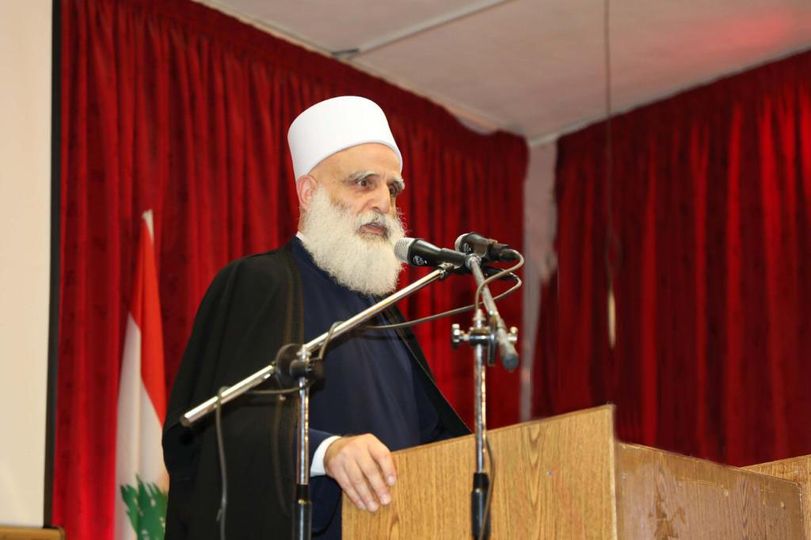
His Eminence Sheikh Al-Aql of the Unitarian Druze community, Sheikh Dr. Sami Abi Al-Muna, emphasized that there is no escape from cooperating in the tasks of our shared life and its common challenges, and confronting them through joint action to save humanity by agreeing on common denominators to face challenges together.
His Eminence Sheikh Abi Al-Muna’s words came in a recorded speech during the convening of the Round Table on Shared Religious Spaces in the Middle East, on the occasion of the Feast of the Annunciation, hosted by the Middle East Council of Churches at its headquarters in Beirut. The speech of His Eminence the Sheikh Al-Aql stated:
In the name of God, the Most Gracious, the Most Merciful.
Praise be to God, Lord of the Worlds, and peace and blessings be upon the Master of the Messengers, his goodly family and companions, and the pure Prophets of God.
Dear brothers and sisters participating in this round table, dear beloved ones,
If the Feast of the Annunciation is an occasion for Islamic-Christian encounter, based on the reverence for Lady Maryam (Mary) enshrined in Christian doctrine and the appreciation for her revealed in the Holy Quran, then there is no doubt that the holiday that brings the two religions together is one of the Islamic-Christian commonalities, but not all of them. Commonalities are many and fundamental among believers, whether they are Christians, Muslims, or of another faith; commonalities: first, those of faith, which affirm the oneness of God Almighty—the One, the Only, the Existing, the Transcendent—and His manifestation in man, who is the noblest of creatures, as he is created in His image and likeness, and the best successor entrusted to cultivate the earth. Second, those of values, for every heavenly law has urged the preservation of moral and social values, foremost among them being honesty, love, brotherhood, mercy, justice, trustworthiness, chivalry, and other values and virtues upon which believers here and there do not disagree. Third, those related to cultivating the earth, preserving nature's resources, and dealing with them with order and respect. And fourth, those of a humanitarian nature related to the establishment of societies, homelands, partnerships, and human relationships aimed at building peace.”
He added: “I do not believe that any of our Islamic schools of thought, nor any of the Christian or other denominations, calls for disbelief in God, or for renouncing moral and social values, or for corrupting nature, destroying the cosmic order, or establishing corrupt civilizations that undermine the foundations of peace. However, it is man—of every religion and sect—and because of the forces of evil within him confronting the forces of good, who often leans towards destabilizing those foundations, and consequently shrinking the space of positive commonalities among human beings, all of whom are God’s creation. This, in turn, makes it imperative to counter such tendencies with rationality, openness, firmness, and partnership among believers, the wise, and the righteous, to consolidate those foundations, preserve the commonalities, expand their space, and meet effectively around them, which is what we call for and work towards.”
He continued: “True faith exists in both Islam and Christianity alike, and its first principle is belief in the One, Unique God, and that is the fundamental common denominator among believers:
Religion brings us together and the Truth is our reference; open the hearts to find the One, the Unique.
Just as human values are one, and upon them, Muslims, Christians, and all humans meet, even if some concepts differ and paths and methods vary in the constant journey towards knowing the Truth. God’s will has ordained acquaintance among people and cooperation in racing towards good deeds and in preserving optimal human values and realizing them by man, first in himself, and then in his relationships with those around him, especially in his relationship with the human 'Other' wherever they may be. Whereas that which is not shared brings us into the field of dogmas, which is a highly delicate field; it is not limited to differences between one religion and another, but extends to deep and painful divisions within the concepts of faith in each religion itself, which is something we do not need in any dialogue.
Therefore, it is more beneficial to meet in the shared space available in practice (conduct) rather than in creed; spiritual and social practice. Its two fundamental pillars are honesty and brotherhood, and these are, for us, the pillars of Monotheism (Tawhid). Monotheism is a common bond, and the true Monotheist is honest with God, with himself, and with his brothers, and also elevates the concept of human brotherhood to the point of selflessness. Meeting also lies in noble humanitarian tasks, in confronting evil, in countering the abandonment of religion, atheism, permissiveness, and attacks on human rights, nature, the environment, the cosmic order, and all human values—that is, in the 'circle of joint action'—to save humanity through integration and solidarity. Common humanitarian issues compel us to agree on common denominators to face challenges together, which are numerous and escalating with the progress of humanity, the increase of interconnections, and the development of sciences; among them are issues of the environment, rights, ethics, and others.”
His Eminence went on to say: “We all in the Middle East, as everywhere, must look at the many positives and human values that Christianity and Islam possess, and address major issues. Muslims, like Christians, must work together in common spaces, 'such as those related to serving the poor, strengthening justice, respecting human dignity, and participating together in life experiences; by doing so, we overcome preconceived notions, and it becomes possible to open channels of mutual respect and reconciliation for the sake of building peace and brotherhood in the one human family.'
On the other hand, there are some similarities and shared life or formal aspects between Muslims and Christians, which are many, due to the nature of shared life and the historical relations between them, including those that bring together the people of the Mountain (the Unitarians) and their Christian brothers, such as social characteristics, customs, and traditions, regardless of the instances of confrontation and conflict throughout history, which had external motives.”
His Eminence addressed the attendees: “Our God is one and the goal of religion is one, which is the human being, and our teachings meet on that goal. We have only to rise through them; we meet to rise. There is no escape from meeting and participating in the dialogue of life—which is part of faith in every religion—and cooperating in the tasks of our shared life and its common challenges. If we are hesitant to face them, they will overcome us, because when we struggle over the heavens, we lose what is on earth and in the heavens.
I delved into my upright religion, and it led me to others, even if they seemed different.
And I realized that Truth is the root, and we are all its branches, twigs, and blossoms.
If worship divides people, the essences unite them above rituals.
May God grant you success in your interventions and discussions, and many thanks to the Middle East Council of Churches for organizing this round table, and to you all. Peace, mercy, and blessings of God be upon you.”