
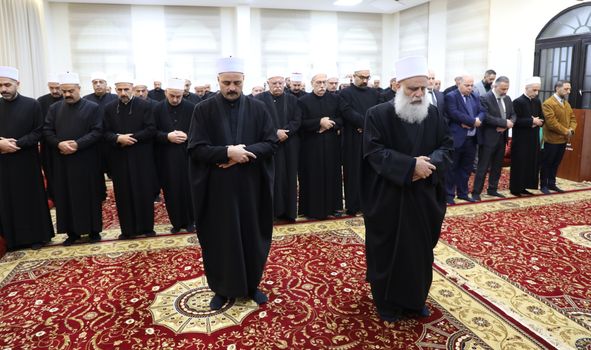
His Eminence Sheikh Al-Aql of the Druze Unitarian community, Sheikh Dr. Sami Abi Al-Muna, led the Eid al-Fitr prayer on the morning of the holiday at the shrine of Al-Amir Al-Sayyid Abdullah Al-Tanoukhi in Abeih, with the participation of sheikhs, dignitaries, heads of committees, members of the Druze Council, and officials from the Sheikhdom of Aql and the Council’s directorates and advisors.
Sheikh Al-Aql
After the prayer, His Eminence Sheikh Abi Al-Muna delivered the Eid sermon in the presence of the venerable Sheikh Abu Mahmoud Saeed Faraj, other sheikhs, and worshippers, in which he said: In the name of God, the Most Gracious, the Most Merciful. Praise be to God, Lord of the Worlds, and peace and blessings be upon the Master of the Messengers, his family and virtuous companions, and all the pure Prophets of God.
My Unitarian brothers, O Muslims performing the prayer of Eid and Tawhid (Monotheism), who break their fast after a long period of fasting and commitment, and who attain happiness through the joy of performing the duty and acts of worship, the striving of days, nights, and hours, the performance of good deeds, Zakat, the purification of the self, and the multiplication of prayers. The Almighty says in His revealed Book: “So whoever sights [the new moon of] the month, let him fast it.” This is a revealed verse that alerts believers to the necessity of fasting the blessed month of Ramadan, just as other verses indicate that “the fasting men and fasting women,” as well as “the men who remember God often and the women who do so,” God has “prepared for them forgiveness and a great reward.” From this premise, and since fasting is a gateway to earning forgiveness and reward, it was imposed upon Muslims as a path for them to fear God (Taqwa), and as a mercy from Him, the Almighty. It was not imposed upon Muslims alone, but was prescribed for them as it was prescribed for those who submitted and believed before them, as per the Almighty’s saying: “O you who have believed, fasting is prescribed for you as it was prescribed for those before you that you may become righteous.” This obligation has religious and worldly importance; it is a command from God, and the human being who complies with God's commands can overcome their desires, control them, take hold of their own self, and direct it towards the right and righteous path. By doing so, they realize that they are a servant to their Lord, not a slave to their greed and desires. That is the most important benefit of fasting, in addition to its health and psychological benefits, as it helps in strengthening will and determination, educating in patience, refining willpower, curbing the reins of whims, feeling with the poor and needy, achieving equality among Muslims, and respecting all people.
If any of us believes that fasting in its meaning and essence is merely abstaining from food, drink, and desire, at known and specific times—that is, refraining from breakfast-breaking acts from the true dawn until clear sunset, in accordance with the Almighty’s saying: “...and eat and drink until the white thread of dawn becomes distinct to you from the black thread [of night]. Then complete the fast until the night...”—if there are those who believe that this is the essence of fasting, we say to them that this is the minimum level required of the believing Unitarian Muslim in compliance with the Almighty's command, and that is the first rank known as the fasting of the common. As for the fasting of the elect, it is the abstaining of the eyes, tongue, hands, feet, hearing, and all limbs from sins, which is a higher degree, but still lower than the fasting of the elect of the elect, which is the heart’s fasting from lowly ambitions and thoughts that distance one from the Almighty, and withholding it entirely from anything other than God Almighty, as Imam Al-Ghazali says. Rather, it is a fast from every evil intention, corrupt belief, false speech, and reprehensible act. Shall we not respect the duty first, as an entrance to what is more exalted? Shall we not advance in fasting from one rank to another, rising through it and achieving its purpose, just as we rise through Zakat, prayer, and all obligatory duties? And shall we not achieve the human goal for which we were created? God created us, caused us to die, and gave us life to test which of us is best in deed, performance, and striving to achieve our humanity, which is the ultimate goal, according to His saying: “[He] who created death and life to test you [as to] which of you is best in deed—and He is the Exalted in Might, the Forgiving.” God created man for His worship and for the cultivation of His earth, with what that task requires of good knowledge of sciences and arts. God the Almighty said: “He has produced you from the earth and settled you in it, so ask forgiveness of Him and then repent to Him. Indeed, my Lord is near and responsive,” and the Almighty said: “And I did not create the jinn and mankind except to worship Me. I do not want from them any provision, nor do I want them to feed Me. Indeed, it is Allah who is the [continual] Provider, the firm possessor of strength.” God Almighty has spoken the truth.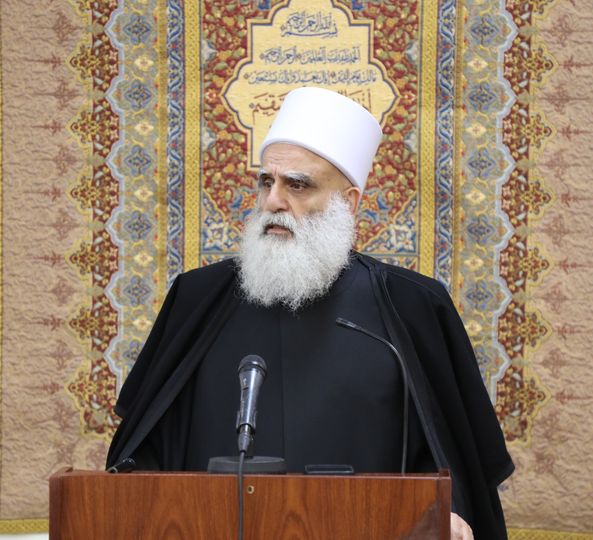
My brothers, O beloved ones, in order for our Eid to be joy and happiness, we must reflect on the meaning of worship, and be certain that worship is an act of repentance and a constant striving and struggle that does not stop at performing an obligation or commemorating an occasion. God the Almighty said to His chosen Prophet (PBUH): “And worship your Lord until there comes to you the certainty [death].” Certainty, whether it be death or the realization and attainment of the goal, in both meanings indicates the request for continuation, increase, and not stopping at a limit or barrier. Death is inevitably coming, and reaching the goal is a higher objective that should not be neglected, as there must be a constant journey in the degrees of worship, knowledge, and teachings to compensate for the passing of fate by realizing what has not been realized and achieving what is hoped for, each according to their capacity, according to the Almighty’s saying: “Allah does not charge a soul except [with that within] its capacity. It will have [the consequence of] what [good] it has gained, and it will bear [the consequence of] what [evil] it has earned. Our Lord, do not impose blame upon us if we have forgotten or erred...” and each according to the status God decrees for them, and always according to the faith-based rule: “O My servant, you must strive and I will provide the aid... you must ask and I will provide the answer.”
It is stated in the Hadith Qudsi, from the tongue of God Almighty, that He said: “And My servant continues to draw near to Me with supererogatory works until I love him. And when I love him, I am his hearing with which he hears, his sight with which he sees, his hand with which he strikes, and his foot with which he walks. And if he asks Me, I will surely give him.” This is our hope, and this is our prayer on the morning of this blessed day, saying: My Lord, make this Eid a breaking of fast on what we love, just as You made it easy for us in Ramadan to fast from what we love, and bless our food as You blessed our fasting, and forgive us if we rejoiced in the completion of the blessed month of fasting and our performance of its duties, just as You forgive us and always pardon us if we fall short in performing the duty completely and we acknowledge our shortcomings. Make our breaking of fast auspicious just as You made our fasting acceptable, and guide our steps, O God, and lead us to the straight path, for You are the Forbearing, the Generous, the Most Gracious, the Most Merciful.
O Unitarian brothers, O Muslims, O Lebanese, this year the time of Christian fasting and glorious Easter meets with the time of Islamic fasting and happy Eid al-Fitr, and in this meeting is harmony, resonance, rapprochement, and fusion. Pain and patience, just like joy and happiness, are all unified human feelings that unite believers, Muslims and Christians, and bring them together in a faith-based journey whose paths differ, but which lead to one goal and a lofty spiritual purpose that is beyond the rulings of fasting and the manifestations of Eid. Perhaps this meeting this year is a message urging us, the Lebanese, in all our various guises and paths, to return to our roots, adhere to the spirit of the national formula, and respect the scene of diversity in unity that characterizes this homeland, and to bear the responsibility for saving the country from collapse, rebuilding institutions, and reviving the state. The wait has been long and the patience of the Lebanese has almost run out, but we always call for wisdom, realism, and a sense of responsibility. We see the Lebanese reality being pulled by tensions here and there, with ideologies and theories flaring up, between a peaceful and resisting country, between an East-West relationship, Arabism and globalism, a Levantine Islamic and Christian identity, between sect and sect, guardianship and guardianship, and loyalty and loyalty, as if this small homeland, small in area but large in its position, is defiant to stability and destined to be the focus of the near and far, the subject of attraction for brother and stranger, and the concern of the friendly beloved and the suspicious enemy.
The reality of the diversity we live in can be a feature and a blessing, or a problem and a curse. This matter or that dilemma depends on the ability of the Lebanese themselves to deal with it with wisdom and positivity, and with their cooperation to invest the relationships of all Lebanese components for the sake of building the state and protecting the homeland, rather than exploiting those relationships and foundations for one side to overpower another, or to produce sectarian, partitionist, or confrontational dreams. For by doing so, we would have condemned Lebanon to failure and the diversity formula to collapse and disintegration, and our children to displacement and loss. To the extent that we call for standing as one united front in the face of Israeli aggression, sowers of discord, and promoters of all kinds of corruption, we also call for self-restraint and addressing emerging problems and issues with deliberation and a national spirit. The country is standing on the edge of danger and collapse, including its economic and living crises, hostile threats, and the accumulation of displacement, refugee, and migration crises. As much as we know that the country cannot bear the adventures of destructive wars, we also realize that it cannot bear any internal conflict or security imbalance, which requires awareness and vigilance to extinguish any spark of challenge and silence any tone of threat, and not to allow foreign hands of evil to tamper with the country's security, and to be mindful of the necessity of addressing pending issues with understanding, unity of position, and decision-making. Let us celebrate our holidays together, let us unite for the salvation of our country, let there be a nation among us that calls for good, enjoins what is right, and forbids what is wrong. Let us respect our constitution and answer the call of duty without hesitation, let us prioritize the logic of dialogue over the logic of obstruction and waiting, and let us pray the prayer of hope, expel despair from our souls, hatred from our hearts, and thoughts of hatred from our minds, and let us rise with the Eid, whether it is Fitr or Easter, to where unity is achieved, oneness is manifested, and happiness is attained.
As for us, at the level of our Unitarian sect, we are the most concerned about its role, mission, future (religious, social, and national), and fortifying the community through cohesion, unity of word, adherence to boundaries, and refraining from arrogance. This is through our vision for reform, our breadth and openness, and because we are the most worthy of hearing constructive ideas, bearing responsibility, and dealing with everyone positively in thought and action, in light of what our faith, conscience, and position dictate to us, always looking forward and calling for what is more exalted and noble. God is witness to what we intend and say, and He is the best Witness and the best Guide, the Praiseworthy. Happy new year, and peace, mercy, and blessings of God be upon you.
Al-Biniyeh
Afterward, His Eminence Sheikh Al-Aql, along with a number of sheikhs and participants, visited His Eminence Judge Sheikh Naim Hassan at his residence in Al-Biniyeh to offer Eid al-Fitr greetings.