
The Lebanese person is by nature talented, creative, and innovative, never resting or settling in the search for a hobby or a productive project. Possessing a strong will, determination, and ambition, their genius drives them to innovate in various fields and arenas to prove their worth and competence, whether on a cultural or artistic level, or in various professions and crafts such as sculpture, where they excel and master their work.
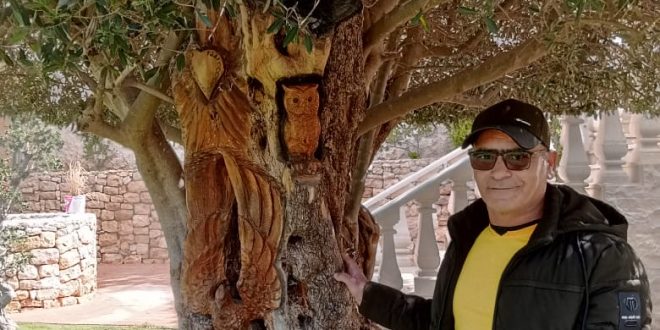
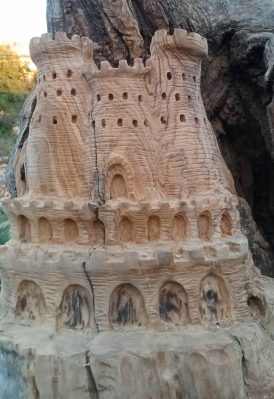
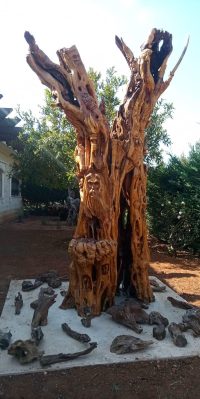
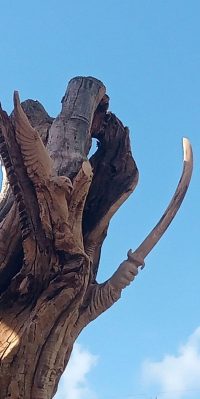
This is exactly what applies to the visual artist and sculptor Bassam Sabeh, son of the city of Hasbaya and a resident of the town of Aramoun, who has mastered the craft of carving and sculpting on rock and olive tree trunks, creating the most beautiful forms, figures, and relief carvings in the heart of the trunk—ranging from various animals and birds to characters and castles—with the utmost taste and artistry. No one has preceded him in using traditional tools to achieve what modern machines cannot.
In an interview with the "Kawaless" magazine website, he discussed all aspects of this hobby and the craft of sculpture. Here is the full interview1.:
We would like an introduction to your personality, what encouraged you to pursue the craft of sculpture, what it means to you, and what was the starting point for your attachment to it?
_ First, I welcome you most warmly and extend my deep thanks for this initiative and kind gesture towards me, and towards the rare craftsmanship I represent in wood and rock carving. My journey began with it from a young age while at school. I practiced some types of drawing on paper, known as visual art, using a pencil to create innovative drawings from my own ideas without borrowing or imitating anyone.
In principle, I did not choose these hobbies; rather, they chose me from a very young age, as I felt something inside me pushing me towards that art. This led me to use pencils to draw everything beautiful my eyes saw. After several years, this talent developed from drawing to sculpture, working with solid materials like synthetic wood, tree trunks, and rock instead of paper. It is distinguished by the creation of tangible models that express forms inspired by nature. Its difficulty lies in the fact that I moved to sculpting on olive tree trunks, which presents challenges in defining a goal in advance for any artistic work. The wood contains many curves and cavities that sometimes put me in a whirlwind of ideas to choose a suitable form for it. I exert physical and intellectual effort to select the appropriate work, whether it be birds, animals, heritage sites, or historical figures. I do this without using any glue or nails in any form; the carving is done in relief and takes a great effort, drawing from the spirit of the tree itself. I use large trunks, and sometimes I use the branches as they play a role in the structure of the model and the chosen image.
Why focus on the olive tree specifically, rather than other trees, such as pine, oak, mulberry, or walnut?
What are the stages a sculpture goes through to become ready for display?
First: Cleaning the trunk intended for the carvings of general dirt.
Second: Soaking it in water for several days so it gets wet and absorbs moisture to the core. After that, I expose it to electric shocks, the goal of which is to kill insects like worms or moths present inside. The work is done according to desire, mood, mind, focus, and calm nerves.
Have you participated in exhibitions or appeared in the media?
Only once on Télé Liban, but I have participated in many exhibitions in several Lebanese regions, starting from my town, Aramoun, under the sponsorship of the municipality. Some people approach me to request drawings and models executed on olive trees planted or brought into their gardens or home courtyards.
Is there an ambition or wish you have that has not been fulfilled?
To continue in this craft as long as there is blood in my veins and a bright mind. I call for attention and support from the relevant ministries because this art is one of the most difficult types of arts. I believe no one else in Lebanon does what I do. Unfortunately, during my participation in exhibitions, ministers and members of parliament attend only for the sake of sponsorship and media posturing, without any initiative of support, even by buying a piece of work, whether from me or other visual artists participating in the exhibition.
Interview by journalist Fouad Ramadan – Kawaless Magazine