
The Cultural Committee of the Druze Religious Council, under the direction of the Sheikh al-Aql of the Unitarian Druze Community, Sheikh Dr. Sami Abi Al-Muna, honored researcher and historian Dr. Riad Hussein Ghannam during a seminar held at the “Dmit” public hall, with the participation of the representative of the Sheikh al-Aql and head of the Cultural Committee in the Religious Council, Sheikh Imad Faraj; the representative of the former president of the Progressive Socialist Party, Walid Jumblatt, and the head of the Progressive Socialist Party, MP Taymour Jumblatt, Dr. Nasser Zeidan; the representative of MP Marwan Hamadeh, Talat Hamadeh; the Director-General of the Parliament, Dr. Adnan Daher; the Government Commissioner to the Council for Development and Reconstruction, Ziad Nasr; the former Chief of Staff, Major General Hatem Malak, alongside a group of sheikhs and spiritual, military, administrative, and educational figures, and a large crowd of mayors, mukhtars, dignitaries, and residents of the town and the region.
Zahr Al-Din
Following an introduction by a member of the Cultural Committee of the Council, Dr. Ferial Zahr Al-Din, and two speeches by the Mayor of Dmit, Bassam Tarbieh, and the head of the Ghannam Family Association, Faisal Ghannam, which lauded the honoree and his intellectual output, Dr. Saleh Zahr Al-Din delivered a speech in which he said: “How wonderful and noble this occasion is; a Druze Religious Council honoring a son of the Lebanese Parliament. He combined in his hand and person two councils and two authorities in Beirut, and here in the Chouf town of Dmit, he combined three councils and three authorities, and rarely have these councils gathered in one personality as they have gathered in the person of the historian Dr. Riad Ghannam.”
He added: “He is a river, calm and roaring at the same time. He is a complete work team in one person; institutions are unable to accomplish what he has accomplished... He is a singular in the plural form. It was his destiny to be born Druze, educated as a Christian, and tolerant as a Muslim, thus becoming humanized as a historian and creative thinker. He believed that history is a message, smaller than that of prophets and messengers, yet greater than the message of ordinary people. Therefore, he rode the horse of history and science to look down from above, but with the ‘eye of a falcon,’ and thus he became one of its knights.”
Al-Zein
In turn, the writer and linguistic researcher Tarek Al-Zein said: “In the presence of Dr. Riad Ghannam, you listen with all your senses to his words, balanced on the edge of elegance and splendor. They reflect his asceticism regarding the materialities of life, and you extract from every phrase he utters a path you were searching for but could not find. You see in them that refined humility that perceives a person by their essence and spirit, by their stored truth rather than their appearance. He shows you values embodied before you in every action, movement, and letter.”
He added: “Dr. Ghannam transcended in his works his own self, the region, the sect, and society. He was objective and neutral in everything he wrote, and faithful to scientific integrity, research, and study. He does not present any news, information, or event without it being documented and supported by its source or reference, after subjecting it to his intellect to ensure it aligns with sound reason and a discerning view of matters. It thus appears in its place serving the subject being treated without addition or subtraction, and without emotion or exaggeration. He sees no harm in mentioning the opinions of other historians with an open mind on the same subject, addressing and critiquing them constructively, with the goal being truth and benefit. He relies on everything that is documented and referential so that the book emerges from his hands as a historical, intellectual, social, economic, and political value, forming a respected source for researchers and students, and food for the mind and soul for every seeker of knowledge, and for everyone who loves reading.”
Daher
The writer, journalist, and linguistic researcher Bassam Daher said: “It is impossible to summarize Dr. Riad’s production in a few minutes. Therefore, out of scientific integrity, I will address his methodology rather than presenting his books. He chose to research the period of the last three centuries in recent history, perhaps in his scientific consciousness and subconscious, he wanted to tell us to take a lesson. For what is happening in our country currently has its roots in the foreseeable past. We must not inherit to our children what we have inherited, so we read the memory with a future-oriented reading, so that history does not repeat itself, becoming a tragedy the first time and a farce the second. He says: The most prominent thing I noticed in Dr. Riad Ghannam’s methodology is extreme precision and verification of historical information. He never ignored the dialectical link between events and their socio-political contexts. He does not present an event or news item without rational and documentary proof; his emotion does not overwhelm his analysis, for objectivity is his habit, and his documentary tendency reached a high level of scientific refinement.”
Faraj
Then, the head of the Cultural Committee in the Religious Council, Sheikh Imad Faraj, delivered a speech in which he said: “When I took over my duties in the Cultural Committee, I spoke with His Eminence Sheikh Dr. Sami Abi Al-Muna about the affairs and concerns of the mission, and His Eminence touched upon the activities he used to perform.”
He added: “Honoring Dr. Riad Ghannam is a priority, but the health crisis that befell the country prevented his honoring. So I told him, God willing, we will fulfill your wish. And here we are today at this honoring. How could we not, when the honoree today is a beacon of knowledge, with his thought, values, precision, and professionalism in history, management, research, and documentation? I used to hear about Dr. Riad in terms of his social fame, but when I got to know him, I found him to be much more than what I had heard. He is the humble great man, the precise historian, and the researcher into the depths and details of history, shedding light on dark aspects from the eighteenth century to our current era. He addressed events and figures that followed one another since 1830, and he was, in all that he wrote, creative, skillful, critical, and insightful. If you were to talk about what Dr. Riad has accomplished, it would be easier for you to list what he has not accomplished, for he is a river flowing with knowledge and culture; he has all our love and appreciation.”
He added: “You entered the Parliament and advanced quickly, and the Speaker trusted you, so he supported and honored you. You were the faithful ambassador of this mountain, and he did not abandon you, nor did he let you rest after the retirement age in the Parliament. You gave a bright image of the loyal and honest employee who keeps his hands clean in an era dominated by corruption. You entered several fields in culture and society, so you were the example in your refinement and giving, and you accumulated knowledge, culture, and dignity. We, as a cultural committee, are proud of you, your history, your contributions, and your achievements. You, our dear doctor, are an example to be emulated and a beacon for every student, researcher, historian, and ambitious person. So rejoice, O Chouf, in your righteous son. From Niha to Dmit, an honorable path, a bright history, and our wishes to you for a long life and lasting glory.”
He continued: “In the Cultural Committee, and under the guidance of His Eminence the Sheikh al-Aql and with the help of God Almighty, we look forward to honoring those deserving among our cultural, social, and national figures and encouraging researchers, and we assist researchers in publishing what is beneficial in topics of thought, history, and society. We support artists in highlighting their talents and refined art, we help promote Tawhidic cultural centers in our regions, and we cooperate with various spiritual leaders, the Ministries of Education and Culture to spread the culture of preserving the family and authentic Druze values. It is culture, ladies and gentlemen; it began with the beginning of the universe and will remain until the Day of Judgment.”
He concluded: “Finally, I thank the head and members of the Dmit municipality, the Ghannam family, the people of Dmit in general, and everyone who responded to our invitation. May this house remain full of joy, cooperation, and giving.”
Ghannam
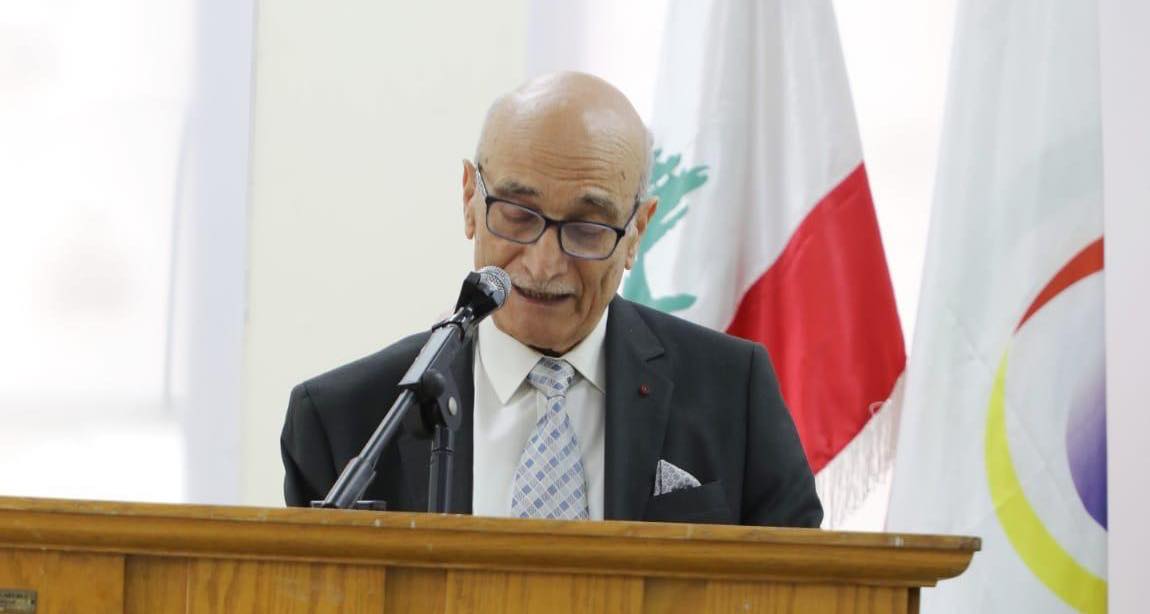
In the conclusion, the honoree, Dr. Ghannam, delivered a speech in which he said: “If I fail to say that I am at an honoring ceremony held by a group of sincere and loyal people, I must not fail to note that we are in a recovery of human glimpses and behavior full of love, in appreciation of giving that has no virtue other than fragrance and spread, just like the scent of daisies or the guelder rose, its appreciation is the pride of heads and the embracing of dreams. It is the good word that brings together the lip and the ear, the expression and the hearing, the two smallest of a person, just like the thought poured between the mind and the tongue. Stones from the quarries of a lifetime, which I paved for years and years, penetrated the folds of a lifetime, or rather, I cultivated them with hard work and diligence, to reach about thirty books, and hundreds of articles, studies, lectures, and interventions, most of them published and some of them in slumber, waiting for the change of circumstances.”
He added: “In my university journey, and after obtaining my law and history degrees from the Lebanese University, and before the crossroads of postgraduate studies, I balanced the deepening between the sciences of law and history, so I chose the latter over the former, for the honesty, nostalgia, and balance it contains, all of which are characteristics of a scholarly historian. For the true historian does not lie, and as Imam Ja’far al-Sadiq says: ‘Whoever God grants a truthful tongue, He grants a clear intuition and a sound vision.’ Thus, the science of history became a field of chivalry, spacious, high-waving, but full of stumbling blocks, thorny issues, and multiple readings and whims. Therefore, some researchers approached it as one approaches the face of light, so they were dazzled and fell! And some of them turned into darkness and faltered, and some took up fanaticism with all its goals and stumbled. But few are those who stood before the light, absorbed it, and united with it; these are the people of success, the successful and immortal ones. And the speech here is a citation of what the friend, Secretary-General of the Parliament, Adnan Daher, mentioned in an honoring seminar for me at the Cultural Movement in Antelias in the month of March 2017. It suffices me to be a researcher, writer, and investigator detached from any whim, not swayed by bias, nor pulled by partisanship or religious or sectarian fervor, intending to dip the pen in the ink of truthfulness and the medium of objectivity, and the honor of belonging to a towering mountain overflowing with faith, full of love and loyalty, presenting facts and concluding with findings with sobriety, precision, and clarity.”
He continued: “During my journey, I wrote several thousand pages of books, studies, and articles, which formed clear landmarks and references that are relied upon. I never strayed from the generous stream, the good shade, or the dewy dew that waters the passion of the ink and the goal. They were a storehouse and reference for many students and researchers in the sciences of law, history, indexes, biographies, and heritage. And a testimony remains for a right that is due, to those who departed and left in my memory a space that cannot be forgotten; they drew for me scenes of reading, searching, and investigation as if it were a Persian carpet that captivates the mind in examining it and raises the standard of creativity in emulating it. Indeed, they are men who left intellectual and cultural achievements; they left their fingerprints as an echo of their books and heritage, specifically: the scholar Mohammed Khalil Al-Basha, Abbas Abu Saleh, Hassan Hallaq, Najib Al-Beaini, and Suleiman Taqi Al-Din, in addition to the giants of the crowns of culture, most notably Kamal Jumblatt, Shakib and Adel Arslan, and Aref Al-Nakadi, and the list goes on. All of them are great figures and among the pillars of the language of the 'Dhad' (Arabic) and its immortal lucky ones, in addition to being among the most powerful minds in thought, science, history, and generous literature.”
He continued: “They were men in this life, like a pencil, honed by the nights to write the pearls of expressions, so the pen and its bearer perish, and nothing remains immortal but the beauty of what was written.” He went on to say: “I was filled with awe as I contemplated the list of speakers, and my imagination flew as if I were before two courts. The first is the court of history, and history does not show mercy, and its public prosecutor is Dr. Saleh. The second is the court of linguists, and its deputies are Dr. Tarek Al-Zein and Dr. Bassam Daher, and the language does not show mercy either. So I held my breath in alarm and feared the situation and the meeting, but the intercession of friendship and good affection was the hope and comfort of the expectation. As for the dear brothers, who took turns ascending this pulpit, they are all guardians of the word and custodians of the truth, who gathered for this meeting. Among them is Al-Zein, who adorned his expressions with the most beautiful words and the deepest images and metaphors, and among them is Al-Bassam, who illuminated the pulpit with his oratory and the light of his words, so they were drawn in black on white and shone with transparency and clarity, and among some who combined the righteous with the flower of religion and the fragrance of faith. And since the pulpit expands like a large heart, the final word is the decision of Ghannam and love, and the municipality is the lung of Dmit, the gateway to the Chouf, taken care of by a president and a group of knights. As for the Religious Council, its pillar is a monument of science and culture who lived it and experienced it and brought it to us with all love and clarity, and chose Ferial as a butterfly, whose luster is words of flower and religion, and they are all dear brothers in whom the eloquence of the expression has grown, and the words have softened.”
He concluded: “A word I pour out in a moment of joy that danced like spring birds between the trees and the autumn of old age that was adorned with lemon blossoms. I scatter it as a fragrance of gratitude and a glow of greetings. I extend my sincere thanks to the Religious Council, which honored me with this tribute, to His Eminence the Sheikh al-Aql, Dr. Sami Abi Al-Muna, the sponsor of the renaissance of the sect religiously and culturally, to the Cultural Committee in the person of its head, Sheikh Imad Faraj, and its esteemed members, to the Municipal Council in Dmit in the person of its head, the friend Bassam Tarbieh, to the Ghannam Family Association and its beloved head, Faisal Ghannam, and the members of the association for their generous efforts, accompanied by thanks. To the dear ones Dr. Tarek Al-Zein, Dr. Saleh Zahr Al-Din, the friend Bassam Daher, and the sister Ferial Zahr Al-Din, who took turns speaking, writing their interventions with the pen of love and the tolerant view, and clothed me in a loose garment—I wish I were some of what is in it. I also thank all the esteemed attendees who went to the trouble of attending from various villages and towns; may God enable me to reward everyone, and peace be upon you.”
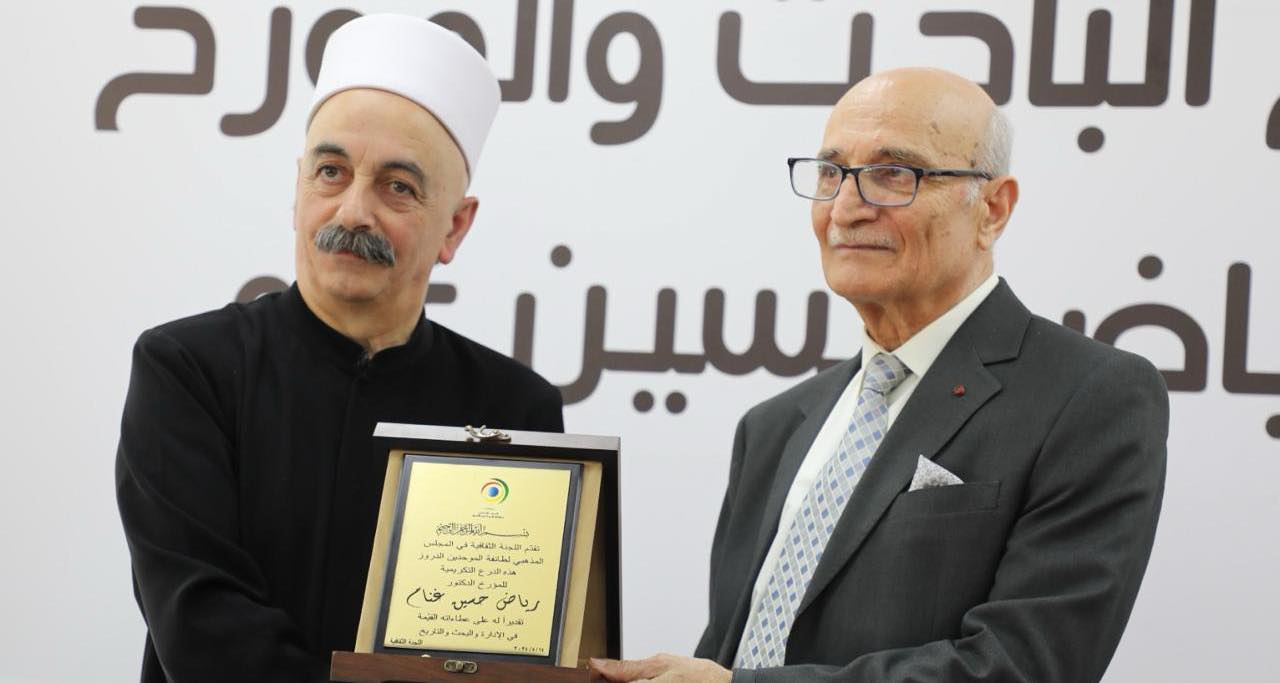
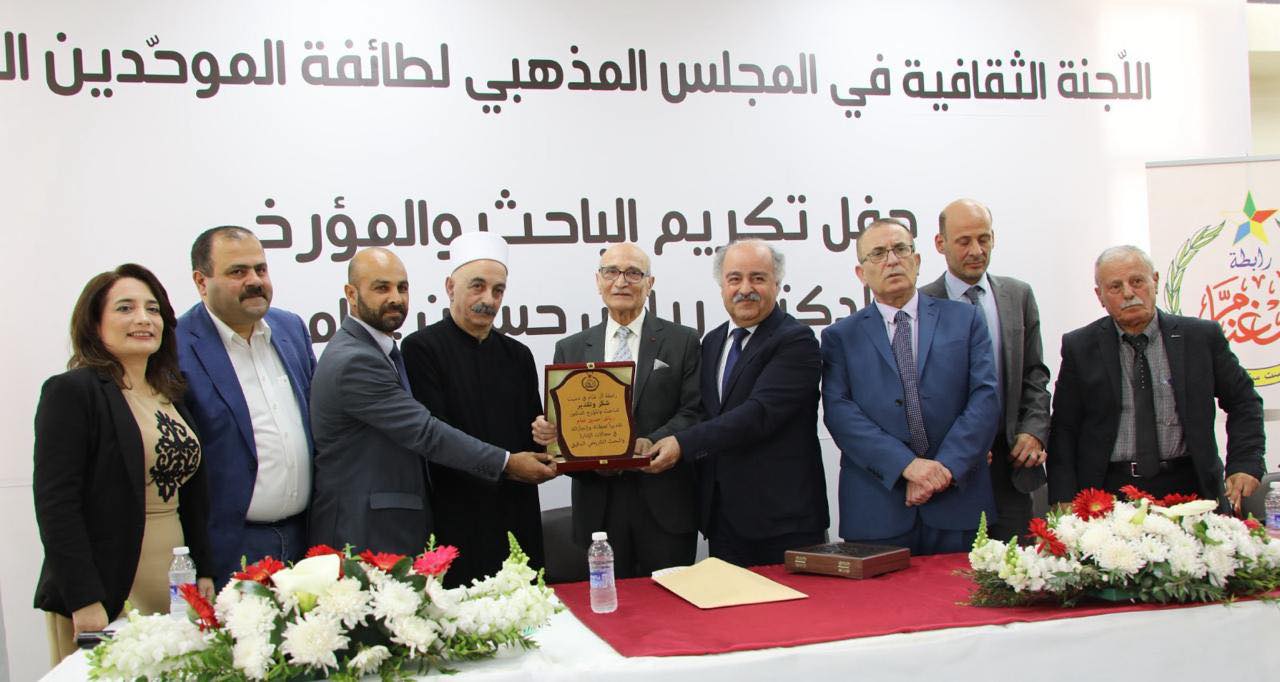
In the conclusion, Dr. Ghannam received an honorary shield from the committee head, Sheikh Imad Faraj, and another shield from the Ghannam Family Association.