

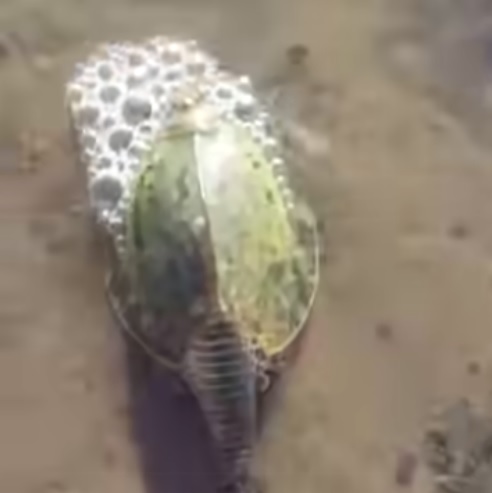
Activists have documented the first appearance of the “living fossil” tadpole shrimp in As-Suwayda, as this creature is considered one of the oldest living organisms on the planet. Its appearance was documented in the “Sahwat al-Balatah” dam through the lens of activist “Tharaa Al-Shomari”.
Activist “Samah Masoud” told the Al-Rasd network that he is very proud of this achievement, considering it opens up broader horizons and sheds light on the need for more attention to wildlife in the governorate.
“Masoud” wrote on his personal Facebook page that the living fossil is considered an “ecosystem engineer, a contemporary of the dinosaur era, dating back to prehistoric times and has existed for more than 400 million years, and now in one of the dams of As-Suwayda.”
“Masoud” added that what he did “is considered the first documentation in Syria.”
“Masoud” wrote a detailed description of the creature in his post, noting that this animal has been found in many regions of California, including the Central Coast, the Sacramento Valley, the San Joaquin Valley, and the foothills of the southern Nevada mountains. It was also found a few years ago in Palestine, Jordan, and Saudi Arabia as well.
“Masoud” quoted environmental activist Yaman Omran regarding the reason for the creature's presence in the Sahwat dam, where “Omran” said that the most likely possibility is that it came to our regions through migratory birds that carried its eggs with mud on their feet. The tadpole shrimp egg is characterized by its high resistance to high and low temperatures and drought as well, as it is only affected by water. Furthermore, it is small in size and can hatch after many years when the appropriate conditions are met exclusively in water.