
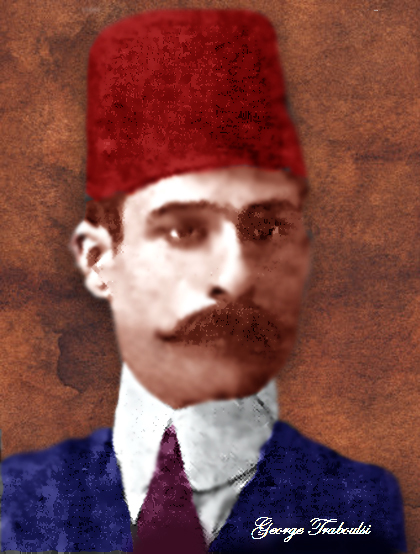
A monthly magazine that later became a weekly scientific, industrial, and historical journal. It was founded in Beirut by Ali Nasir al-Din, a Lebanese politician who fought for Arabism and subsequently faced imprisonment and displacement multiple times during the French mandate. Its editorial management was later taken over by his son, Amin Nasir al-Din.
Ali Nasir al-Din established the newspapers Al-Minbar and Al-Liwa, and co-founded the "League of National Action" in 1933 and the "League for Honoring Martyrs." He published a number of books, mostly essays and lectures, and passed away from an arterial sclerosis stroke in Beirut in 1974.
The first issue of "Al-Safa" magazine was published in 24 pages (23x15 cm) in January 1886. Due to the deteriorating censorship situation regarding publications, it moved to Baabda, where it was issued for a full year, then from Abey for four years, during which it became a literary and political weekly, then to the village of Kfar Matta, and finally to Aley. It ceased publication twice. The status of this magazine among the Druze was akin to that of "Al-Bashir" magazine for Catholics and "Al-Nashra" for Protestants, and it became the first Druze periodical.
The editorial was written by the publisher Ali Nasir al-Din, who expressed in his words his complete commitment to serving the public intellectually and culturally by adopting all that is truly useful, using an easy style and selecting terms that could be simplified to spread scientific and historical awareness on a wide scale.
"Al-Safa" began its first issue with the Science and Industry section, in which it was said that science—at that time—differed from the days of Plato and Pericles with the appearance of the telescope and the microscope. Therefore, the editorial focused on the criteria it followed in presenting scientific culture, including: gathering useful facts, ensuring meticulous arrangement, and selecting topics based on their importance, characteristics, and fruitful results.
It also defined the types of sections the magazine would include: the first for sciences, arts, literature, and industry; the second for debates, correspondence, puzzles, and riddles; the third for historical benefits; the fourth for humor ("literary tales and the like"); and the fifth titled "Miscellaneous Benefits."
In its first pages, the magazine expressed its scientific leanings, featuring articles on the solar corona, the movement of stars, meteors, and celestial spheres in general. The language used for these scientific topics appeared easy and simplified, far from jargon. However, there were subjects characterized by their amusing information and the beauty of their presentation, such as an article about human skin color, its origin, and its relationship to the environment and climate, citing examples that might seem new to the contemporary reader, such as goat wool turning into hair when moved to hot places.
There was also an article about the balloon and the inception of its idea, which started as a myth among the Europeans when a woman washed her bodice and hung it over a fire; when it dried, the bodice rose upward after dry air entered it. Because the woman's husband was a paper merchant, he made paper spheres into which he introduced dry air, and they rose upward. From here, the idea of the balloon originated and spread to this day after the discovery of dry gases.
Following that was the correspondence section, which consisted of reader contributions. It included a history section that provided a brief overview of the languages of Asia, discussed by the Italian scholar Cantù, regarding the Semitic languages, their origins, and the regions where they spread, such as Syriac, Hebrew, and Phoenician, as well as clarifying the true roots of the peoples who spoke them.
As for the humor section, it began with a chapter from a foreign novel titled "Poison in the Fat," translated by the Lebanese poet and writer Mu'allim Shakir Shuqair. The "Miscellaneous Benefits" section came to confirm the magazine's principle of enriching the reader with information of a scientific nature that was extremely beautiful, useful, and selective, such as what was written about the common mistakes when burying their dead alive, in reference to the fact that most people did not have sufficient information about the real death of their loved ones and neighbors.
The article mentioned that the French Scientific Committee offered a prize worth 40,000 francs to anyone who discovered a method to help the public identify strong evidence of death. Several cases of this grave error were mentioned, and the existence of a prize for this purpose is perhaps evidence of its widespread occurrence at the time.
Interestingly, the magazine revealed one of these methods to detect whether a person was dead or not by placing their hand in front of a lamp light or artificial light so that the fingers of the hand were touching, then looking at the spaces between them against the light; if a crimson red appeared in the touching parts of the transparent fingers, it was evidence of blood circulation. If life had ended, nothing of this would appear. Thus ended a tour of a periodical that expressed the nobility and credibility of Ali Nasir al-Din's intentions, who printed "Al-Safa" magazine at his own expense in Beirut at the International Press.