

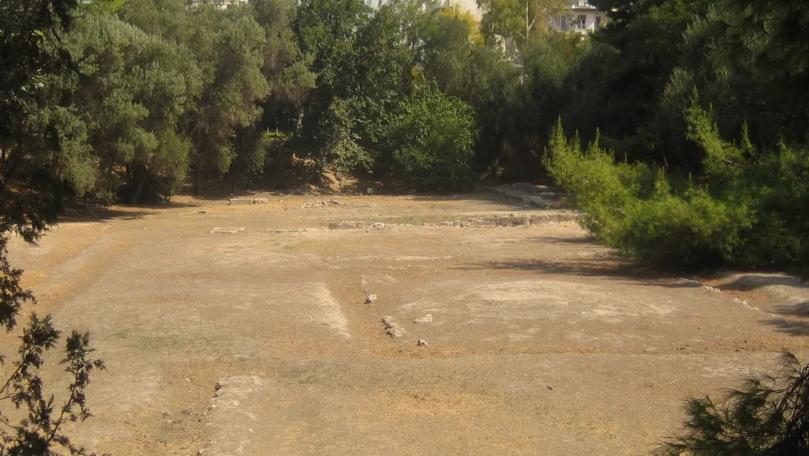
An Italian research team has managed to locate the burial site of the philosopher Plato in Athens, relying on artificial intelligence technology1. .
Papyrologist Graziano Ranocchia, from the University of Pisa, stated that he identified the exact burial place of Plato based on the findings of papyri in the Herculaneum area near Naples, Italy.
Ranocchia revealed that Plato was buried in the "Academy" that bears his name in Athens, in a garden near the “Shrine of the Muses”.
The Herculaneum papyri, discovered in the eighteenth century, include more than 1,800 manuscripts dating back to prehistoric times, which were discovered in the Villa of the Papyri, a Roman estate in Herculaneum, Italy.
The Herculaneum papyri or scrolls, buried and protected by volcanic ash for thousands of years, represent the only large-scale library from the philosopher Plato that has survived in its entirety.
Using artificial intelligence technology, scientists have now attempted to decode the papyri.
The place where Plato was buried is known as the “Academy,” or Plato's Academy, a famous school in ancient Athens founded outside the city walls in 387 BC.
The Herculaneum papyri, which researchers re-examined, indicate that Plato may have been sold into slavery either in 399 BC after the death of Socrates or in 404 BC during the Spartan invasion of the Greek island of Aegina.
This conclusion refutes previous theories that dated the event to 387 BC, during Plato's stay in Syracuse.
There are two accounts regarding Plato's death between Cicero and Hermippus; Cicero says he died while writing, while Hermippus says he died at a wedding at the age of 81 and was buried in the Academy.