
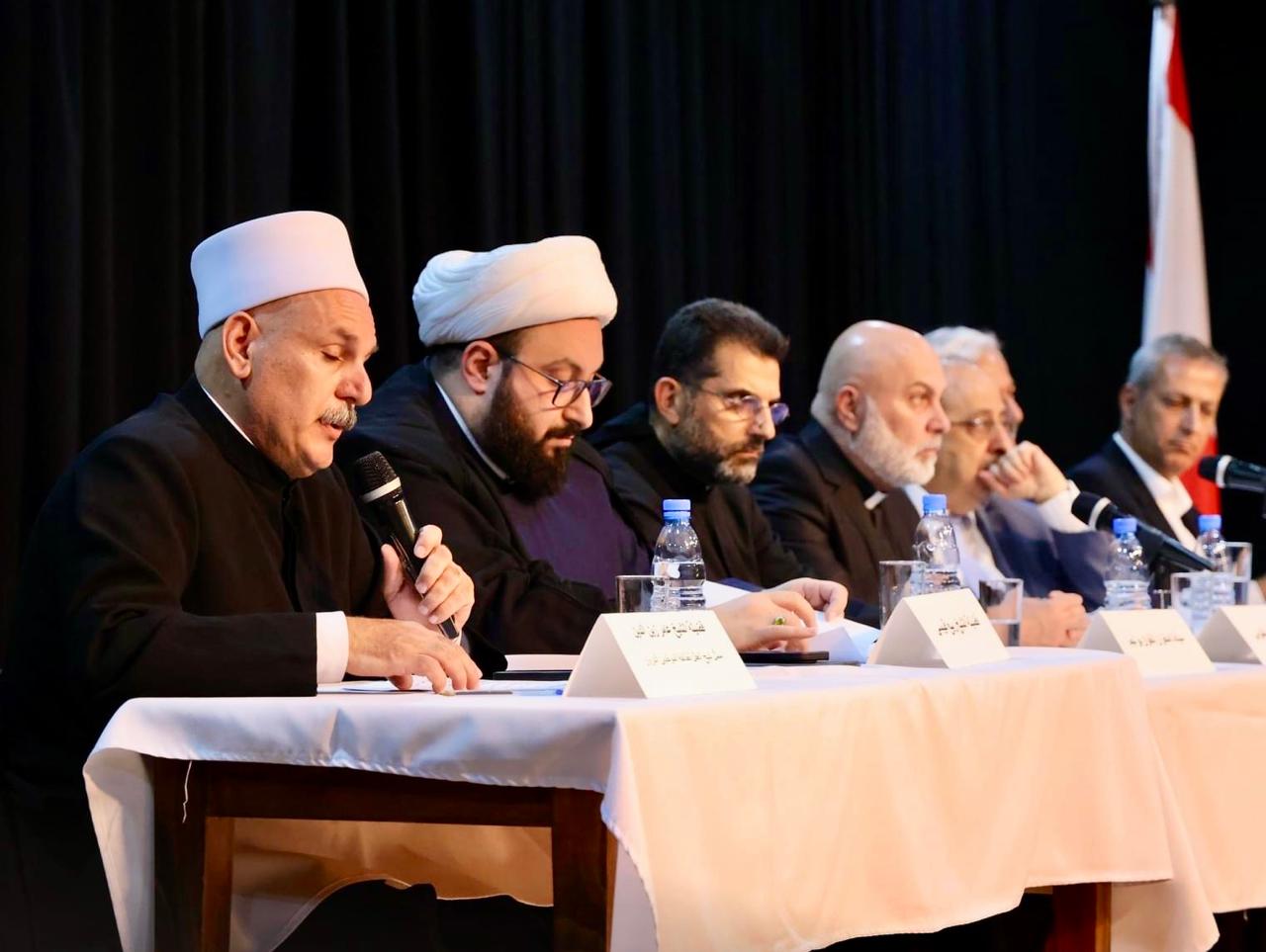
Sheikh Amer Zeineddine, advisor to and representative of the Sheikh Aql of the Druze Unitarian community, participated in the "Bridges of Dialogue" meeting launched by the REACT club at the Jesus and Mary School - Rabweh in Qornet Shehwan. The event was organized based on the "Document on Human Fraternity for World Peace and Living Together," signed by the Grand Imam of Al-Azhar, Ahmed el-Tayeb, and Pope Francis, and was facilitated by the Committee for Ecumenical and Interreligious Dialogue, under the patronage and presence of the Maronite Archbishop of Antelias, Bishop Antoine Bou Najem.
Zeineddine delivered a speech on behalf of the Sheikh Aql, Sheikh Sami Abi Al-Muna, in which he said: "Dialogue and peace stem from the fraternal spirit that should unite the Lebanese people regardless of their sects, far from fanaticism, isolationism, and hostility. 'It is not religion, but our own social relationships, our morals, and our culture that bind us together,' as Kamal Jumblatt says. It is a collective and moral bond, closer to nationalism or patriotism than to religious fanaticism; a bond that urges unity and solidarity among the people of the homeland and the nation, and stresses, on the other hand, the respect for all sects and religions, because 'justice is in choice,' not in coercion and force, as every path and sect has its own teachings, rituals, and rulings, and no one holds a monopoly on the truth."
He added: "The Unitarianism to which we belong, as Unitarians, urges us to constantly strive to be possessed by that truth and to live it, first through sincerity, in sensing the presence of the Creator Almighty, holding good belief in Him, His prophets, His books, His reward, the Day of Judgment, and His destiny; and second, by refining the self and morals, and by safeguarding people and being polite in their company and treatment 'in the best way' in all circumstances, as stated in the book by His Eminence the Sheikh Aql published in 2017 titled: 'Christian-Muslim Dialogue in Lebanon: The Vision of the Druze Unitarians'."
He continued: "The loving human spirit, and the sincere desire to live in fraternity and peace, is what the Unitarians affirm with all that this spirit implies of good coexistence, love, mercy, fraternity, integration, and openness to cultures. Therefore, we can say that building bridges of dialogue cannot mean demolishing the structure of each spiritual family; rather, holding onto one's specific sectarian identity should not conflict with openness, dialogue, living together, and the higher interests of the nation. For we are all linked, despite the challenges and changes, to our heritage and cultural identity, and we are committed to our specificity and proud of our religious and cultural belonging, while possessing the desire and freedom to strive towards integration and complementarity with others. Here lies the dual challenge: the first is the necessity and importance of openness and avoiding isolationism, enclosure, and fanaticism; and the second is the responsibility of educating youth and raising them with sound religious, social, and national upbringing, so that they do not lose their identity, heritage, and the rich values of their society through ignorance, disregard, or weakness in the face of many temptations and currents, and so that they remain guardians of their moderate role and national position. The characteristic of tolerance among those who engage in dialogue outweighs any other, considering that 'the struggle for survival leads to annihilation.' Therefore, they always call for the rejection of conflict, strife, and deadly sectarianism, and for reconciliations, self-reflection, and engagement in the formulas of a unifying, developed, just state that embraces everyone. Dialogue, in all its forms and levels, starting with dialogue with the self and its purification, is the magic key that builds bridges of dialogue and introduces society and people into the realms of truth and peace. May religion, in its essence, be a bridge of connection, bonding, and peace, not a factor of division, estrangement, and conflict."
He concluded: "Let us all realize that Lebanon is the ideal model for achieving such a dream goal, based on its diverse uniqueness and the formula of its unifying constitution. And let us be confident that the Lebanese, if they return to the authenticity upon which they were raised, primarily in Mount Lebanon, are capable of contributing to this national, spiritual, and moral edifice, in harmony with their broad human culture and based on their long social and national experience."