
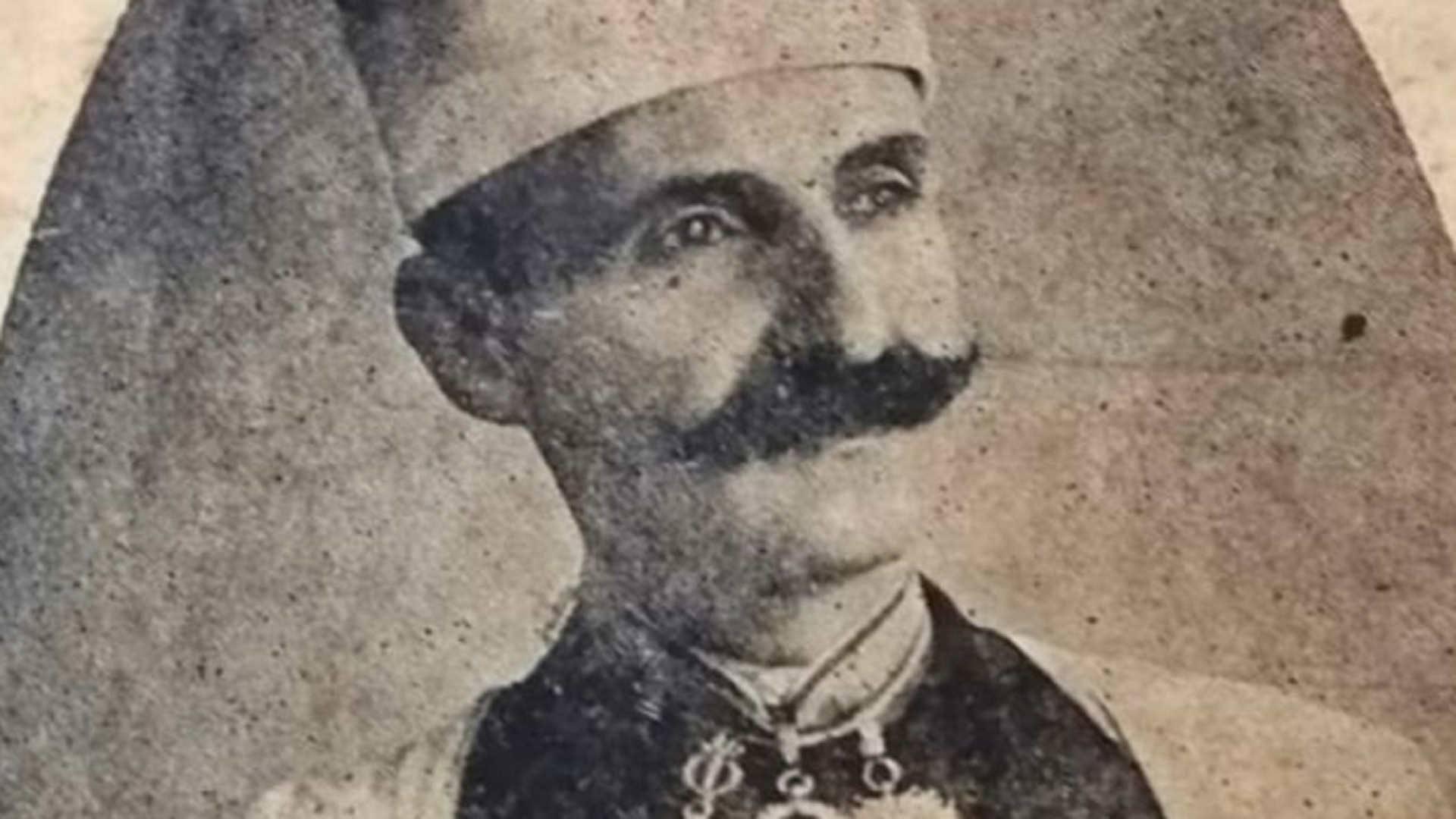
Sheikh Nassib Saeed Makarem is one of the most prominent creative figures in the field of Arabic calligraphy throughout the centuries. Dubbed the “Calligrapher of Kings,” he received numerous awards and certificates of appreciation in Jerusalem, Damascus, and Beirut for his distinguished output. He was a pious and devout sheikh.
Sheikh Nassib Makarem was born on September 14, 1889, in the village of Aitat and entered the American school of Souk El Gharb in 1903, but his father passed away four years later, forcing him to leave school and work to support his mother and eight siblings.
He learned the craft of carpentry from his father, and the hobby of beautiful calligraphy from his mother, Athba, a graduate of the Choueifat English School, from which she earned her high school diploma in 1886—a feat that was not readily available to Druze girls in the nineteenth century.
Athba, who possessed a beautiful handwriting style, encouraged her son Nassib to master this art. The young man managed to balance carpentry with calligraphy, securing a livelihood for the family while spending his nights between the pen and the brush, coordinating his fingers with an artist's spirit in both fields, and achieving art and creativity in both.
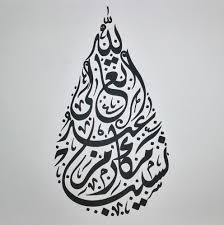
One day in 1909, Nassib read that Prince Ezz El-Din Jawad Al-Tanoukhi had taken the Ayat al-Kursi (Verse of the Throne), which contains about 50 words, and wrote it on a grain of rice. This piqued his curiosity to compete with the Prince, so he wrote a passage of sixty-one words on a grain of rice and displayed it at the Zahle exhibition that year, winning the top prize. From that day on, Nassib's name spread as an exceptional innovator in the art of Arabic calligraphy.
In 1919, he married Wasila, the daughter of Suleiman Faraj, who was similar to him in piety, devotion, and modesty, and possessed a refined artistic taste. The couple was blessed with two sons: Saeed and Sami (one of the most important cultural, academic, and Tawhid figures).
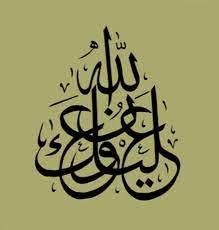
In 1921, Sheikh Nassib established an office for himself in Martyrs' Square, moved from there to a second office in Souk Ayas, then to a third office on Rue du Parlement (Exhibition Street), where he stayed for 44 years, writing calligraphy and being consulted as a technical expert on scripts for the courts.
In addition to calligraphy work, Sheikh Nassib practiced teaching the art of Arabic calligraphy and Arabic engraving at the French Lycée and the American University, as well as the Islamic Sharia College, the Three Moons School, the Lebanese College in Souk El Gharb, and the National University in Aley.
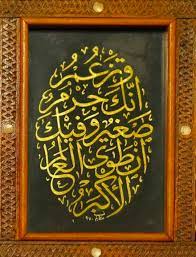
This tireless flow of giving exhausted the venerable Sheikh. He grew weak under the weight of the arduous work and suffered from a heart condition that forced him to leave his office in Beirut, as well as the schools where he taught, and retreat to his home in Aitat, dedicating himself to his Lord and the glorification of beauty. His house became a pilgrimage site for art lovers and admirers of virtue and high moral character.
In Aitat, the lines began to pour forth, glorifying God in every letter and color. Most of his writings during that period were in gold on glass, so he named his house the “Golden Museum.”
In 1968, two Antonine monks, Father George Rahma and Father Antoine Daw, visited Sheikh Nassib in Aitat. The monks were impressed by the beauty his fingers had created and suggested he hold an exhibition at the Antonine Institute in Baabda. However, he apologized, as he avoided all ostentation and spotlights. But the two monks insisted, so the eighty-year-old Sheikh began preparing for this first event of its kind in his life, working while enduring the weakness of his right hand's nerves and the shaking of his grip on the pen. Whenever his pain increased, he treated it with prayer and contemplation; if his right hand failed, he would assist it with his left, and when the left grew tired, he would rest it briefly on the table.
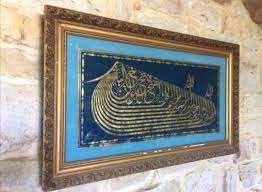
The grand opening of Sheikh Nassib's exhibition took place on Saturday, May 29, 1971, under the patronage of President Suleiman Frangieh, represented by the Minister of Education at the time, Dr. Najib Abu Haidar. It was unfortunate that day that fifteen hundred visitors at the opening were deprived of shaking hands with the genius Sheikh who owned the exhibition because he was bedridden at home, forcing the President's representative to visit him in an official procession at his home to award him the Order of the Cedar, Officer rank.
The following Saturday, exactly one week after the opening of the exhibition and the awarding of the medal, while visitors were still flocking to the Antonine Institute in Baabda, amazed and impressed, dozens of others in Aitat were walking sadly and tearfully behind the coffin of Sheikh Nassib Makarem.
In addition to the beauty and splendor of his calligraphy and his invention of a new typographic font named after him, Sheikh Nassib Makarem was famous for his miniature writings, including: On a marble egg the size of a chicken egg, he drew a map of the Ottoman Empire and its major cities with a text of ten thousand words, all in a single spiral line for which he used 990 pens, and worked on it for two full years. On a grain of wheat, he wrote a 101-word message to the head of the American Red Cross. On a grain of wheat, he wrote a 110-word message to Prince Faisal bin Al-Hussein, after which Faisal made him his honorary calligrapher and bestowed a complete royal robe upon him. On the bezel of a ring, he drew a map of Iraq and three verses of poetry praising Faisal, which he gifted to him on the occasion of his coronation as King of Iraq.
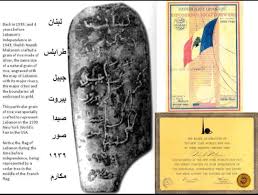
Sheikh Nassib also created a masterpiece on a ring he gifted to King Abdulaziz Al Saud on the occasion of the founding of the Kingdom of Saudi Arabia, engraving the date of the accession to the Hejaz throne in five verses of poetry. On a gold ring bezel, he engraved the Egyptian anthem, written by Ahmed Shawqi, consisting of sixteen verses and 157 words. This ring was displayed at the First Arab Exhibition in Jerusalem. On a grain of rice, he wrote Surah Al-Fatiha, Surah Al-Ikhlas, Surah Al-Falaq, and Surah An-Nas, totaling 110 words. On a grain of rice, he engraved the speech of Abu Bakr Al-Siddiq on the day he took over the Caliphate, and many, many other miniature creations.
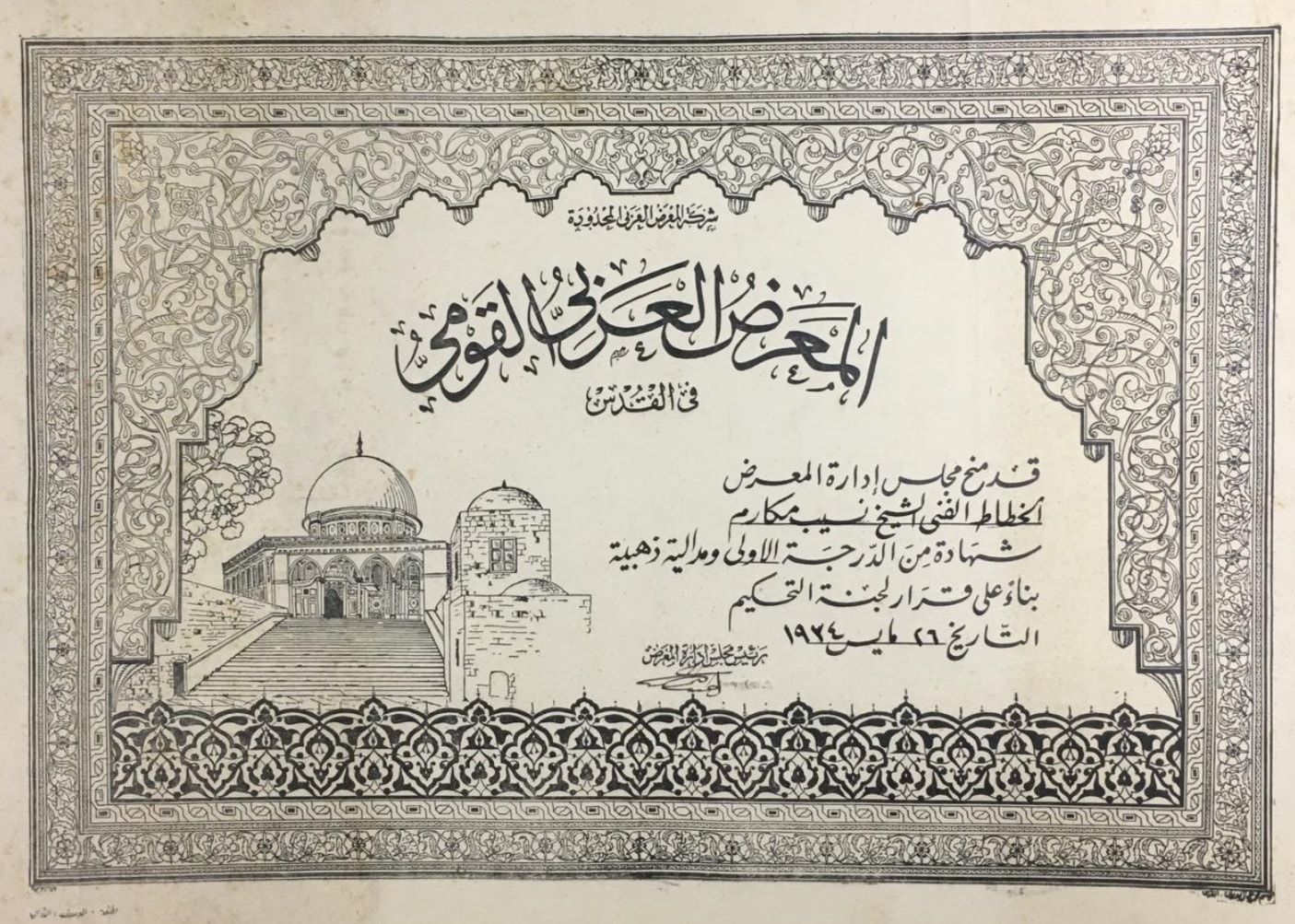
During his lifetime, Sheikh Nassib Makarem received numerous awards and certificates of appreciation in a number of Arab capitals, including the gold medal from the “National Arab Exhibition” in the city of Jerusalem in 1924.