
Abbas Mahmoud Abu Shaqra was a Lebanese Druze journalist and poet known for his nationalistic and patriotic stances. He immigrated to Egypt and then to the United States, where he contributed many nationalistic articles to newspapers and supported revolutionaries against French colonialism.
Abbas Abu Shaqra was born in Amatour, Lebanon, in 1880, studied at the National School in Choueifat, and first immigrated to Egypt in 1900. He worked as an editor at Al-Muqattam newspaper in 1904, and forged strong ties with its writers and politicians such as Saad Zaghloul, Makram Ebeid, Ahmed Shawqi, and Hafez Ibrahim, before returning to Lebanon.
He did not stay long in Lebanon; instead, he traveled to the United States in 1907 and worked in journalism. He wrote for most of the immigrant press, including Al-Hoda, Al-Bayan, Nahdat al-Arab, and others. For a period of time, he was a partner of Suleiman Badour at Al-Bayan newspaper in 1910 and contributed to its editing. In October 1920, he published Al-Burhan newspaper in partnership with Rashid Taqieddin, and in 1926, he was elected Secretary-General of the New Syria Party, where he collected aid and sent it to the Syrian revolutionaries.
He returned to Lebanon in 1934, but the French authorities forced him to stay no longer than three days. He went to Latakia and then to Damascus, where he was welcomed by leaders of the Syrian national movement, including Shukri al-Quwatli, Khalid al-Azm, Jamil Mardam Bey, and Faris al-Khoury.
Filled with nationalistic fervor, he visited Baghdad accompanied by his son, Dr. Raouf. He later returned from Baghdad to Amatour, continuing to follow the affairs of his Arab countrymen from there. He passed away in 1943 at the age of sixty-three following a heart attack.
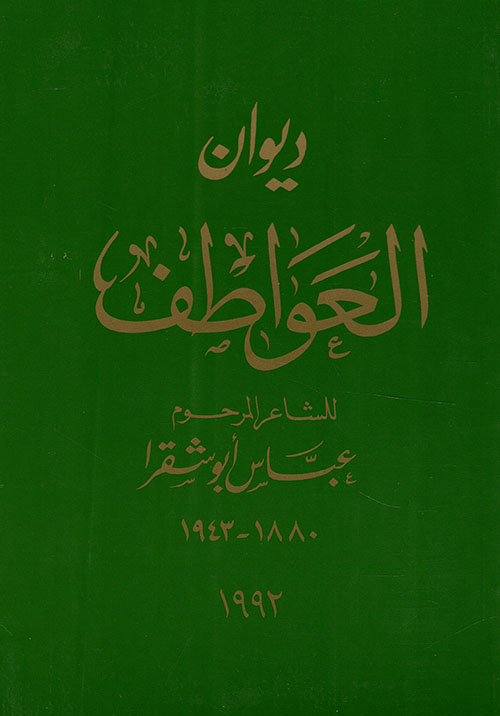
Abu Shaqra was a nationalistic and sentimental poet. He compiled a collection of poems titled "Al-Awatif" (Emotions). His most famous poems were those he delivered at the first Syrian National Congress held in Detroit, Michigan, where the New Syria Party was founded in January 1926.
Among his most famous poems are those he wrote about Saad Zaghloul and the late Lebanese political activist and Syrian supporter Najib Bey Shaqir, in addition to the one he delivered at the grand ceremony held by the Committee for the Relief of the Wounded of the Syrian Revolution, titled: "Oh My Nation, Do Not Despair, Do Not Be Anxious," and the one he composed in honor of Sultan Pasha al-Atrash, the commander-in-chief of the Syrian Revolution, on the occasion of his return to the homeland in 1937, titled: "Embrace, Like a Mother, Sultan to Your Chest."
His deep love for his motherland, Lebanon, was manifested in the poem "The Cedar," in which he reflects on the beauty and greatness of Lebanon.