
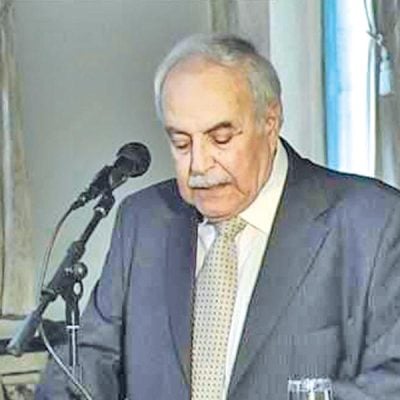
Dr. Sami Makarem is one of the most important thinkers, intellectuals, and academics in the Druze Unitarian community. He contributed dozens of books and articles that discussed the doctrine of Monotheism (Tawhid) and Gnosis (Irfan).
Sami Makarem was born in Aitat, Aley District, Lebanon, on April 14, 1931, and is the son of Sheikh Nassib Makarem, the famous artist and calligrapher.
Makarem is considered one of the main cultural symbols of the Druze community, and was a historian with a philosophical approach and an unparalleled depth of originality and creativity. In addition, he was an academic, historian, writer, and poet, and in the final stage of his life, he was a skilled artist and calligrapher.
His father sent him to receive his primary and middle school education at Beirut High School and his secondary education at the Lebanese College in Souk El Gharb, then he moved to the American University of Beirut for higher education.
Sami Makarem received his Bachelor's degree in Literature and Philosophy in 1954 and a Master's degree in Arabic Literature in 1957 from the American University of Beirut. At the same time, he taught Arabic literature at the Lebanese College in Souk El Gharb and then at the Al-Sirat School in Aley.
Makarem left Lebanon for the United States of America to study at the University of Michigan in Ann Arbor, where he received his PhD in Middle Eastern studies in 1963, specializing in Islamic studies. In addition to that, he taught the Arabic language at the same university for three years.
Sami Makarem returned to his homeland in 1963, where he was appointed Professor of Arabic Culture at the Lebanese University until 1964. He was then appointed Assistant Professor of Arabic Literature and Islamic Thought at the American University of Beirut until 1971, after which he was a professor of Arabic Literature and Islamic Thought from 1971 to 1985.
At the same time, he held the position of Chairman of the Department of Arabic and Near Eastern Languages at the American University for two terms from 1975-1978 and from 1993-1996, in addition to a number of scientific positions until his death on August 21, 2012, at the age of 81.
After his father's death in 1971, Makarem discovered his talent for calligraphy and art, producing works that rivaled the quality of his father's work by following the rules of Arabic calligraphy.
For 50 years, Makarem worked on esoteric, Sufi, Ismaili, and Unitarian heritage in a tireless attempt to highlight common human values. He became an encyclopedia in his own right and wrote works on Gnostic thought, poetry, poetic prose, philosophy, biographical literature, and others.
Makarem's output exceeded 25 books, including "Lights on the Unitarian Path", "The Political History of the Druze Unitarians in the Arab East", "Islam in the Concept of the Unitarians", "The Ismaili Creed", "The Path of Monotheism", "Al-Hallaj: Beyond Meaning, Line, and Color", "Diwan of Amin Taqi al-Din", "A Mirror on Mount Qaf" (Unitarian Sufi poems and reflections), "A Light in the City of Fog", "Lebanon during the Era of the Tanukhid Princes", "Taqiyya in Islam", and "Gnosis in the Druze Path of Monotheism", among others, in addition to dozens of articles.