
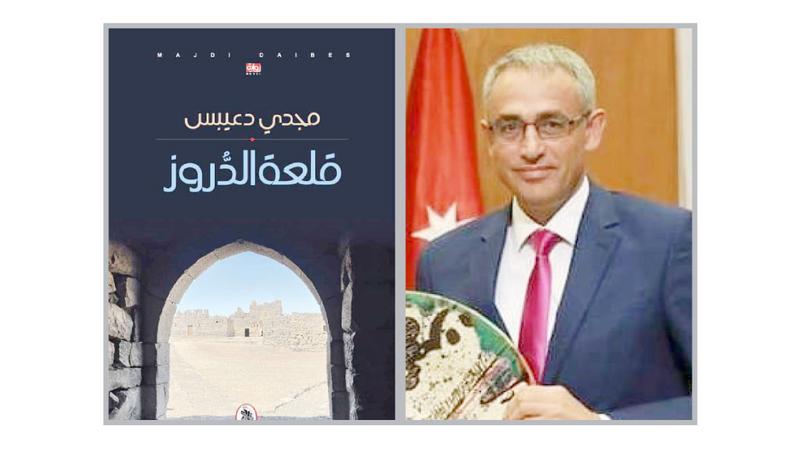
“The Druze Castle” is a novel by Jordanian author Majdi Daibes that uses the Azraq Oasis in northern Jordan and its castle as the spatial setting for most of its events.
The novel explores the conditions of the Arab region in Syria and Jordan during the early second quarter of the 20th century, offering a seamless educational experience that encourages the reader to further investigate the region and its circumstances at that time.
The central event in the novel revolves around the Great Syrian Revolt against the French occupier, which sparked in Jabal al-Arab under the leadership of Sultan Pasha al-Atrash in the mid-1920s. Most of the novel's events are repercussions and consequences of this revolution, such as acts of resistance, flight from the oppressor's brutality, the phenomenon of spies, and more.
The novel follows the story of the Ajaj Abu Ata family, who lived in the village of Umtan in the southern Syrian mountains. When Naif, the son, accidentally kills a French soldier, the simple rural family overnight becomes hunted by a brutal superpower. This forces them to flee to the Azraq Oasis, a distant, safe haven where some families from the mountain had already settled. It becomes their new homeland, and they trade the farming profession they had always known for the work of extracting and selling salt to neighboring villages.
The novel examines the origins of the Azraq Castle, constructed by the Roman engineer Arnesus who built it using slave labor on the ruins of a castle built by the Nabataeans. He acknowledged the wisdom of their location choice, deeming it the best in the oasis, and, impressed by their layout, adopted its foundations and expanded upon them to realize his vision, passion, and ideas. The castle served as a fortress for the Roman Empire deep in the desert, and it was later revived—having been nearly abandoned—by the arrival of Druze families seeking refuge from French oppression, subsequently becoming known as the “Druze Castle.”
The revival of the castle was the catalyst for the emergence of the Azraq Oasis as a place for settlement and life. Many more families sought refuge there, and it expanded until it became a large town today, occupying an important position on the travel route to Saudi Arabia, Kuwait, and Iraq.
The novel also highlights an interesting anecdote regarding the introduction of “Mate” to the villages of Jabal al-Arab, particularly the village of “Umtan.” Tayel, the Mukhtar's cousin, returned from Argentina to settle his affairs and move back, introducing the villagers to drinking “Mate,” which is harvested from a perennial, evergreen tree similar to an olive tree. Tayel told them that Mate was the number one popular drink in Argentina, not coffee or tea.
Women played a prominent and pivotal role in the novel, often no less significant or influential than the role of men, especially Subhiya (Ajaj's wife), Na'ayem (Dhiyab's wife), Adiba and her mother, Dalal, Umm Tayseer, and Bisan, among others. This confirms that women were not marginalized at the time and fulfilled their roles according to their abilities and potential.